India's installed power capacity hits 552 GW; clean energy crosses 54% share
Synopsis
India's power capacity has more than doubled since 2014 to 552 GW, and for the first time, clean energy sources account for over half the installed base. Solar alone has grown 59-fold, wind just posted its biggest-ever annual addition, and nearly 19 lakh households now get zero electricity bills — yet coal still runs over 70% of the grid. That contradiction is the real story of India's energy transition.
Key Takeaways
India's total installed power capacity reached 552 GW in July 2026 , up from 249 GW in 2014.
Non-fossil energy capacity stands at 300.50 GW , crossing 54 per cent of total installed capacity.
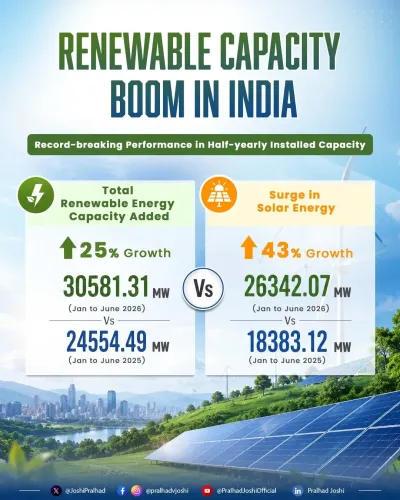
Solar capacity has surged to 164.59 GW from just 2.8 GW in 2014; India was the world's second-largest solar growth market in 2025 .
The PM-Surya Ghar Muft Bijli Yojana has reached 51.58 lakh households , with ₹28,024 crore in subsidies disbursed and 19 lakh households on zero electricity bills.
India added a record 6.05 GW of wind capacity in FY 2025–26 , 46 per cent more than the previous year; 28 GW more is under implementation.
Coal still meets 55 per cent of primary energy needs and supports over 70 per cent of electricity generation.
India's total installed power capacity reached 552 GW in July 2026, more than doubling from 249 GW in 2014, according to a government factsheet released on Thursday, 13 August 2026. Non-fossil energy capacity now stands at 300.50 GW, accounting for over 54 per cent of the country's total installed base — a milestone that marks a structural shift in how India generates electricity.
Solar Leads the Renewable Surge
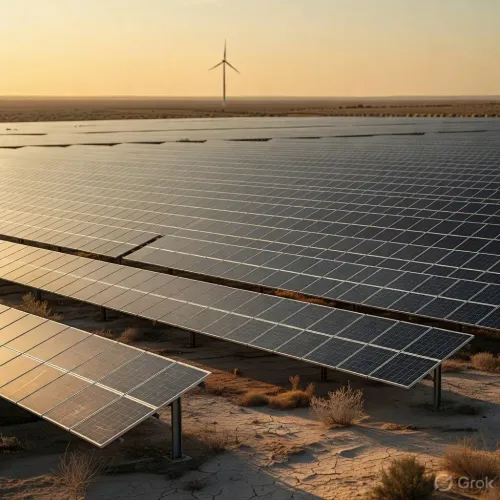
India's installed solar capacity has climbed to 164.59 GW as of 31 July 2026, up from a mere 2.8 GW in 2014 — a nearly 59-fold increase in just over a decade. Solar is now the single largest component of India's renewable energy mix.
According to the factsheet, India became the world's second-largest solar growth market in 2025, adding more than 37 GW of solar capacity during the year — outpacing the 34 GW added by the United States. The country currently ranks third globally in total renewable energy installed capacity.
PM-Surya Ghar Scheme: Rooftop Solar at Scale
The PM-Surya Ghar Muft Bijli Yojana, launched in February 2024 with a total outlay of ₹75,021 crore targeting 1 crore households, has reached 51.58 lakh households as of 12 August 2026. Approximately ₹28,024 crore in subsidy has been disbursed to beneficiaries.
Nearly 19 lakh households are now receiving zero electricity bills under the scheme. Cumulatively, 14.8 GW of rooftop solar capacity has been commissioned, according to the factsheet.
Wind Energy Posts Record Annual Addition
Wind energy, with an installed capacity of 58.14 GW as of 31 July 2026, remains a critical pillar of India's clean energy expansion. India ranks fourth globally in installed wind power capacity.
India added 6.05 GW of wind capacity in FY 2025–26 — its highest-ever annual addition, and 46 per cent higher than the previous financial year. Around 28 GW of additional wind capacity is currently under implementation. Wind turbine manufacturing capacity has grown to approximately 24 GW as of March 2026, up from 10 GW in 2014, with the sector achieving 70–80 per cent indigenisation across key components.
Coal Remains Central to Energy Security
Despite the clean energy push, coal continues to underpin India's energy security. It meets nearly 55 per cent of the country's primary energy needs and supports over 70 per cent of electricity generation.
India holds approximately 4,00,715 million tonnes (MT) of coal reserves and is the world's second-largest coal producer and consumer. Coal production stood at 1,047.52 MT in FY 2024–25 and 1,040.08 MT in FY 2025–26, compared with 609.18 MT in FY 2014–15. This twin-track reality — accelerating renewables alongside sustained coal dependence — defines the central tension in India's energy transition.
With over 28 GW of wind capacity in the pipeline and rooftop solar adoption scaling rapidly, India's energy mix is set to tilt further toward clean sources in the near term.
Point of View
But the headline masks a structural contradiction: coal still runs more than 70 per cent of India's actual electricity generation, even as renewables dominate installed capacity. Installed capacity and generation share are very different metrics, and conflating them overstates the transition's depth. The real test will come when India's peak-hour demand — currently met almost entirely by thermal plants — begins to shift. Until storage and grid-balancing infrastructure scales, the 552 GW milestone is a supply story, not yet a consumption story.
NationPress
27 Sept 2026
Frequently Asked Questions
What is India's total installed power capacity as of 2026?
India's total installed power capacity reached 552 GW in July 2026, more than double the 249 GW recorded in 2014, according to a government factsheet. Non-fossil sources account for 300.50 GW, or over 54 per cent of the total.
How much has India's solar capacity grown since 2014?
India's installed solar capacity has grown from 2.8 GW in 2014 to 164.59 GW as of 31 July 2026 — a nearly 59-fold increase. India became the world's second-largest solar growth market in 2025, adding over 37 GW that year.
What is the PM-Surya Ghar Muft Bijli Yojana and how is it performing?
The PM-Surya Ghar Muft Bijli Yojana is a rooftop solar scheme launched in February 2024 with a ₹75,021 crore outlay targeting 1 crore households. As of 12 August 2026, it has reached 51.58 lakh households, disbursed ₹28,024 crore in subsidies, and enabled nearly 19 lakh households to receive zero electricity bills.
What is India's wind energy capacity and how fast is it growing?
India's installed wind capacity stands at 58.14 GW as of 31 July 2026, making it the fourth-largest in the world. India added a record 6.05 GW of wind capacity in FY 2025–26, which is 46 per cent higher than the previous financial year, with another 28 GW under implementation.
Does India still depend heavily on coal despite its renewable push?
Yes. Coal meets nearly 55 per cent of India's primary energy needs and supports over 70 per cent of its electricity generation. India is the world's second-largest coal producer and consumer, with production at 1,040.08 MT in FY 2025–26.