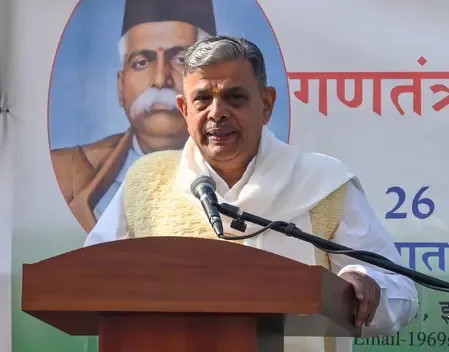
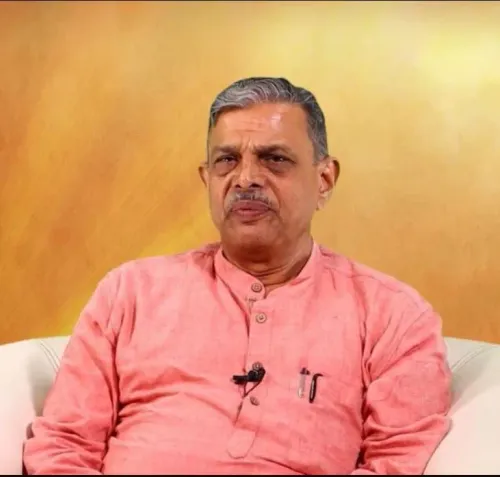
RSS Urges Stronger Efforts to Achieve 'Decolonisation of Mind': Insights from Dattatreya Hosabale
Synopsis
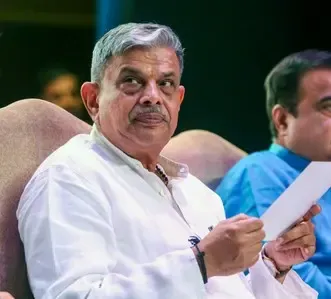
As the RSS marks a century of influence, General Secretary Dattatreya Hosabale emphasizes the urgent need to decolonise the mind and correct distorted narratives that shape India's identity. This call for cultural reawakening aims to foster confidence and unity among Indians.
Key Takeaways
Decolonisation of the mind is a crucial initiative to reshape India's narratives.
Political freedom must lead to cultural freedom .
Misleading theories, such as the Aryan invasion theory , need to be addressed.
Awareness of India's scientific heritage can boost national confidence.
Language plays a pivotal role in shaping cultural identity.
Washington, April 18 (NationPress) The Rashtriya Swayamsevak Sangh (RSS) is advocating for a stronger initiative to “decolonise the mind”, with General Secretary Dattatreya Hosabale asserting that misleading narratives surrounding India’s history, culture, and identity continue to dominate public discussions even decades after the nation gained independence.
In a special interview commemorating the RSS's centenary, Hosabale expressed to IANS that while India has attained political freedom, the journey toward intellectual and cultural decolonisation is far from finished.
“Decolonisation must occur,” he stated, noting that “it remains incomplete in many areas.”
The enduring reality of a “colonised mind” has contributed to the proliferation of narratives that are disconnected from the actual historical facts or the lived experiences of Indian civilization.
“Political freedom should pave the way for additional freedoms—cultural and otherwise,” Hosabale emphasized, underlining the importance of rectifying the narrative surrounding India and its civilisational foundations.
He pointed out the persistent inaccuracies in education and public perception, including the teaching of the Aryan invasion theory.
“Even today, many believe in the concept of an Aryan invasion, despite the fact that it has been disproved,” he remarked.
Hosabale further emphasized the need for greater awareness of India’s scientific heritage and contributions, asserting that these gaps have led to a weakened sense of national pride.
“Often, there is insufficient awareness regarding our scientific legacy,” he noted.
Language is another area where colonial-era attitudes persist, he added.
“For years, people have perceived speaking Indian languages as a sign of inferior education,” he explained, detailing how such beliefs induce a sense of inferiority even among the educated.
Hosabale contested narratives that depict India as a recent political entity, asserting that the nation has enjoyed deep civilisational unity for many centuries.
“We are not a nation in formation. We have been a cohesive nation for millennia,” he stated.
He argued that claims suggesting India became unified solely after independence or under colonial governance disregard the long-standing cultural continuity present across various regions.
According to Hosabale, rectifying these narratives is crucial for attaining “true and complete freedom,” as it would alter how Indians view themselves and their global standing.
The RSS leader connected this intellectual endeavor to broader national progress, asserting that a confident society rooted in its civilisational values is more prepared to make global contributions.
“If the narrative of India is accurately portrayed, then the decolonisation of the mind will follow,” he remarked.
He mentioned that the organization's initiatives over the past century have been directed at building this confidence through cultural appreciation and societal involvement.
“The influence of the RSS promotes Hindu nationalism… fostering pride in our nation, culture, and civilisational values,” Hosabale said, calling it a guiding principle for national existence.
He added that these values remain relevant today and should guide both domestic priorities and India’s role on the global stage.
Hosabale framed decolonisation as part of a broader strategy to tackle modern global challenges, including identity conflicts, social fragmentation, and ideological divisions.
He contended that restoring a balanced understanding of history and culture could enhance social harmony and national unity.
At the same time, he recognized that this process is ongoing and demands continuous engagement from various institutions, including education, media, and civil society.
These comments arrive amid ongoing discussions concerning educational reforms, historical interpretations, and cultural identity that continue to influence public discourse in India and among the diaspora.
In recent years, successive governments have aimed to revise school curricula, promote Indian languages, and elevate indigenous knowledge systems as part of a larger cultural realignment.
Founded in 1925, the RSS has played a pivotal role in shaping these discussions, with its network of affiliates impacting education, social policies, and public discourse.
As the organization approaches its second century, its focus on decolonisation indicates a sustained commitment to redefining India’s intellectual and cultural framework both at home and abroad.
Point of View
Dattatreya Hosabale's remarks reflect a significant discourse on India's historical narratives. The call for decolonisation not only addresses the need for cultural confidence but also emphasizes the importance of historical accuracy in shaping public perception.
NationPress
19 Sept 2026
Frequently Asked Questions
What does 'decolonising the mind' mean?
'Decolonising the mind' refers to the process of challenging and changing the colonial-era narratives and perceptions that continue to influence how history and culture are viewed, promoting a more accurate understanding of one's own heritage.
Why is the Aryan invasion theory significant?
The Aryan invasion theory has been a long-standing narrative in Indian history that suggests an invasion led to the displacement of indigenous people. Its significance lies in its impact on how Indian identity and history are taught and perceived.
How does language play a role in India's cultural identity?
Language is a vital component of cultural identity. Colonial influences have led to a perception that speaking Indian languages is inferior, impacting confidence and pride in India's rich linguistic heritage.
What are the broader implications of cultural decolonisation?
Cultural decolonisation can lead to a stronger sense of national identity, improved social cohesion, and greater global contributions by fostering confidence in one's own civilisational values.
How has the RSS influenced educational narratives?
The RSS has significantly influenced educational policies and narratives in India, aiming to promote a more accurate representation of history and culture that reflects indigenous perspectives.