Is Hindu Identity the Sole Factor for Selecting RSS Sarsanghchalak?
Synopsis
Mohan Bhagwat, the RSS chief, asserts that caste does not influence the selection of the Sarsanghchalak, insisting that Hindu identity is the only qualification. His remarks challenge allegations from political adversaries regarding caste representation in leadership roles, revealing the RSS's commitment to meritocracy over caste.
Key Takeaways
Caste is not a criterion for Sarsanghchalak selection.
Only Hindu identity matters for leadership roles.
Leadership selection is based on competence and availability .
RSS aims for geographical expansion over caste considerations.
Bhagwat's remarks challenge political narratives on caste representation.
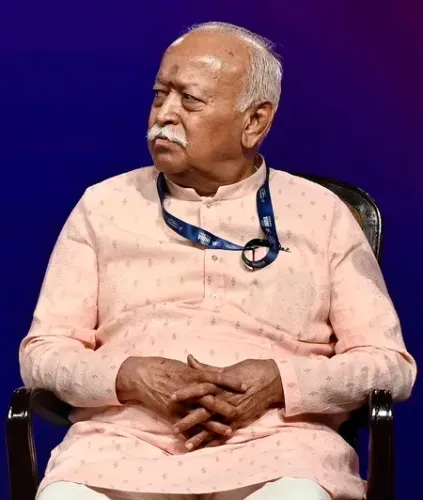
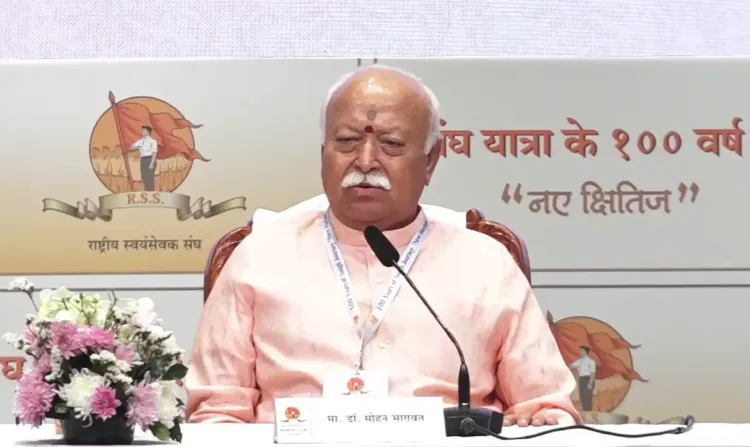
Mumbai, Feb 8 (NationPress) The chief of Rashtriya Swayamsevak Sangh (RSS), Mohan Bhagwat, emphasized on Sunday that caste is not a criterion for choosing the organization's Sarsanghchalak (chief), stating that being a Brahmin is not essential, while asserting that being a Hindu is the only requirement.
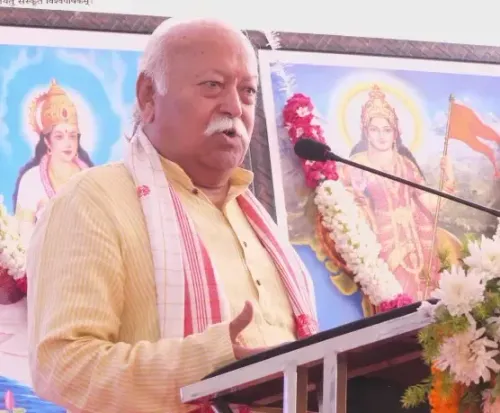
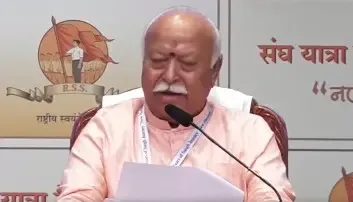
These comments were made during an event titled '100 Years of Sangh Journey - New Horizons' in Mumbai.
His statements come as a response to accusations from the Congress-led INDIA bloc, which has claimed that the RSS permits only Brahmins to occupy top leadership roles and has raised concerns regarding caste representation within the organization.
In addressing these claims, Bhagwat dismissed the allegations and explained the organization's stance on leadership selection, stating, "Who will become the Sarsanghchalak of the organization? No Brahmin can become the Sarsanghchalak of the organization. No Kshatriya, Vaishya, or Shudra can become the Sarsanghchalak. Only a Hindu will become the Sarsanghchalak. The head of the organization can be appointed to that post, and if there's something else, he can be appointed to that too."
Outlining the organizational structure and operations of the RSS, Bhagwat remarked that the Sangh does not appoint its workers or leaders based on caste identity or proportional representation.
"Our workers are not appointed based on this (the caste system). Because we don't have such a proportional system. Whoever works will be the one. Initially, the Sangh was small. The work of the Sangh started in a single locality. It was a Brahmin locality. So, initially, all the office-bearers of the Sangh, from top to bottom, were Brahmins. Then people said that this is a Sangh of these people," he explained.
Bhagwat further noted that the growth of the organization has been influenced by geographical expansion rather than caste considerations. He stated that the nature of development has gradually diversified the composition of the Sangh over time.
"We don't expand based on caste; we expand geographically. We have our own people, but the work of the Sangh has expanded. We don't expand based on caste but geographically. So, this is a natural thing that happens in the Sangh. Therefore, I cannot answer whether there will be an SC/ST tomorrow or not, because the person who has to do it will think about it," he added.
In highlighting the criteria for leadership, Bhagwat stressed that competence and availability are crucial in selecting individuals for key organizational roles.
He stated that the decision is based on who is best suited and capable of taking on responsibilities at a given time.
"One should be the best and also available. I am the Sarsanghchalak. There are other better people, but they are not available. The one who could be made available was the only one. That's why I was made the Sarsanghchalak. So, therefore, being an SC/ST is not a disqualification. Being a Brahmin is not a qualification," he concluded.
Point of View
It is essential to acknowledge the RSS's stance on caste in leadership selection. Bhagwat’s assertions mark a significant shift in dialogue, steering the focus towards Hindu identity and merit, which may reshape discussions around caste representation in various organizations. As the RSS navigates these complex narratives, it highlights a commitment to inclusivity based on capability rather than caste.
NationPress
19 Sept 2026
Frequently Asked Questions
What did Mohan Bhagwat say about caste in RSS leadership?
Mohan Bhagwat stated that caste is not a determining factor in selecting the Sarsanghchalak, emphasizing that only Hindu identity is required for the position.
How does RSS select its leaders?
According to Bhagwat, leaders in the RSS are chosen based on their competence and availability, not on caste identity or proportional representation.
What accusations did the Congress-led INDIA bloc make against RSS?
The Congress-led INDIA bloc accused the RSS of allowing only Brahmins to hold top leadership positions and questioned caste representation within the organization.
What is the RSS's stance on caste representation?
The RSS does not expand or appoint workers based on caste; instead, it focuses on geographical expansion and the merit of its members.
Did Bhagwat mention anything about SC/ST representation?
Bhagwat indicated that being from SC/ST backgrounds is not a disqualification for leadership positions within the RSS.