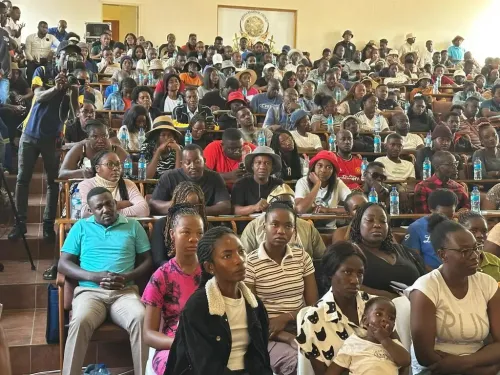
South Africa youth unemployment hits 45.8% as economy sheds 345,000 jobs

Synopsis
South Africa's unemployment rate hit 32.7% in Q1 2026 — but the real alarm is the 45.8% expanded youth unemployment rate, with 345,000 jobs lost in a single quarter. The YES CEO's warning about automation accelerating job losses adds a new dimension to what is already one of the world's most severe youth employment crises.
Key Takeaways
South Africa's official unemployment rate rose to 32.7 per cent in Q1 2026 , up from 31.4 per cent in Q4 2025.
The economy shed 345,000 jobs in the quarter, pushing total unemployed past 8.1 million .
The expanded youth unemployment rate reached 45.8 per cent , the sharpest indicator of the crisis.
GDP grew by just 1.1 per cent in 2025, well below the rate needed to absorb new labour market entrants.
YES CEO Ravi Naidoo warned that automation will further constrain job creation over time.
Naidoo called for urgent public-private collaboration and infrastructure investment in energy, ports, railways, and digital networks.
South Africa's official unemployment rate climbed to 32.7 per cent in the first quarter of 2026, up from 31.4 per cent in the final quarter of 2025, with the economy shedding 345,000 jobs and pushing the total number of unemployed individuals past 8.1 million, according to Statistics South Africa. Young people are bearing the sharpest edge of the crisis, with the expanded youth unemployment rate reaching 45.8 per cent — a figure that underscores the structural depth of the challenge facing Africa's most industrialised economy.
The Scale of the Crisis
The numbers paint a stark picture. Nearly one in three working-age South Africans is unemployed, and among youth the situation is considerably worse. Ravi Naidoo, chief executive officer of the Youth Employment Service (YES), attributes the deterioration to a combination of sluggish economic expansion and systemic failures in education and skills development. South Africa's gross domestic product grew by just 1.1 per cent in 2025, according to Statistics South Africa — far below the rate needed to meaningfully absorb new entrants into the labour market.
Why Young South Africans Are Hardest Hit
'Young people face severe competition from more experienced workers for what are in essence entry-level jobs,' Naidoo said. 'They also lack work readiness, as neither education nor families have been able to prepare them for formal sector employment.'
Naidoo noted that despite significant public spending on education and training, outcomes have fallen short. 'Education and skills development have not generated sufficiently work-ready youth,' he said. While university graduates generally fare better in the labour market, the majority of young South Africans do not hold tertiary qualifications, further narrowing their options.
This is not a new pattern — economists and labour analysts have repeatedly flagged persistently high youth unemployment as a driver of rising inequality, poverty, and social instability. What has changed is the pace of deterioration and the looming threat of automation. 'Over time, we expect new technology to accelerate labour shedding and further constrain the creation of new jobs,' Naidoo warned.
The YES Programme and Its Limits
The Youth Employment Service (YES) was launched in 2018 by South African President Cyril Ramaphosa as a business-led initiative to tackle youth unemployment by placing young people in paid work experiences within the private sector. The programme has placed hundreds of thousands of youth in opportunities since its inception, but its scale remains modest relative to the size of the crisis. With over 8.1 million unemployed individuals and a youth unemployment rate approaching half the youth population, the programme faces structural headwinds it cannot overcome alone.
What Needs to Change
Naidoo called on the government to deepen collaboration with the private sector to stimulate investment and restore economic confidence. He specifically urged authorities to prioritise reforms and infrastructure investment in sectors including ports, railways, roads, energy, water, and digital networks — areas where bottlenecks have long suppressed growth and job creation. This comes amid broader concerns that South Africa's infrastructure deficits, including persistent power outages and logistics failures, are directly deterring the private investment needed to generate employment at scale.
Whether the government moves swiftly on these structural reforms — or whether the youth unemployment rate continues its upward trajectory — will define South Africa's economic trajectory in the years ahead.
Point of View
Yet the YES CEO's own assessment is that neither schools nor families are producing work-ready youth. That gap between public expenditure and labour market outcomes deserves far more scrutiny than it typically receives. The automation warning compounds the urgency: if the economy cannot absorb youth at current technology levels, the arrival of labour-displacing technology will not be a future problem — it will accelerate a crisis already underway. Infrastructure reform is the right prescription, but South Africa has been prescribing it for a decade without the execution to match.
NationPress
25 Sept 2026
Frequently Asked Questions
What is South Africa's current youth unemployment rate?
The expanded youth unemployment rate in South Africa reached 45.8 per cent in the first quarter of 2026, according to Statistics South Africa. This is among the highest youth unemployment rates of any major economy globally.
How many jobs did South Africa lose in Q1 2026?
South Africa shed 345,000 jobs in the first quarter of 2026, pushing the total number of unemployed individuals past 8.1 million. The official unemployment rate rose to 32.7 per cent during this period.
What is the Youth Employment Service (YES) programme?
The Youth Employment Service (YES) is a business-led initiative launched in 2018 by President Cyril Ramaphosa to address youth unemployment by placing young people in paid work experiences within the private sector. Its CEO, Ravi Naidoo, has been a prominent voice on the structural causes of South Africa's youth jobs crisis.
Why are young South Africans struggling to find work?
According to YES CEO Ravi Naidoo, young South Africans face a dual disadvantage: they compete against more experienced workers for entry-level roles while also lacking the work readiness that formal employment demands. Most do not hold tertiary qualifications, and education and training systems have not adequately bridged this gap.
What solutions has the YES CEO proposed?
Ravi Naidoo has called for closer government-private sector collaboration to stimulate investment and restore economic confidence. He specifically urged infrastructure investment in ports, railways, roads, energy, water, and digital networks as critical to unlocking growth and job creation.