Sabarimala Case Review: Devaswom Board Advocates Community-Focused Interpretation of Religion
Synopsis
As the Supreme Court prepares for hearings on the Sabarimala case, the Travancore Devaswom Board emphasizes a community-oriented interpretation of religious practices, urging caution against judicial reinterpretation. This submission could significantly impact the ongoing discourse on religious freedom in India.
Key Takeaways
Community-focused interpretation: Advocating evaluation of religious beliefs from the community's perspective.
Judicial restraint: Urging minimal judicial involvement in religious matters.
Essential practices doctrine: Challenging its relevance and foundation in constitutional text.
Collective vs individual rights: Balancing individual assertions with communal beliefs.
Scheduled hearings: Important arguments set for April 7-22.
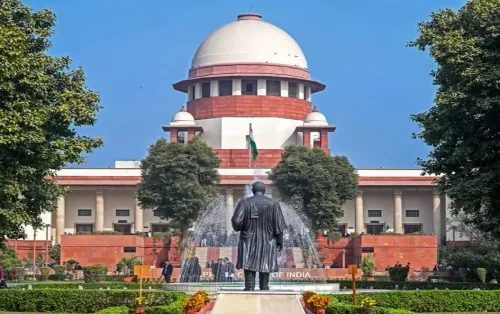
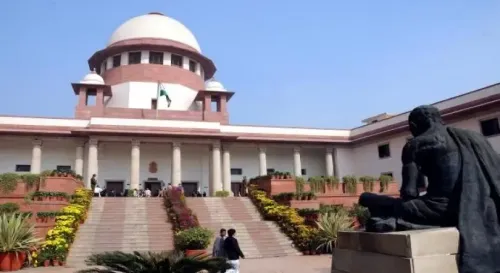
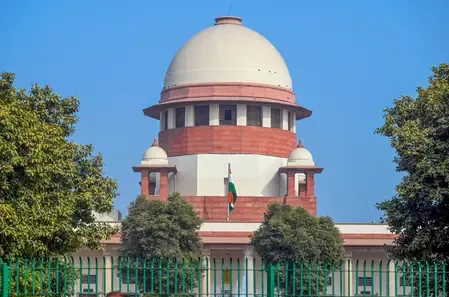
New Delhi, March 24 (NationPress) As the hearings for the Sabarimala review case are set to begin before a nine-judge Constitution Bench, the Travancore Devaswom Board has submitted written arguments to the Supreme Court. They are advocating for a “community-focused and subjective” interpretation of religion as outlined in Article 25 of the Constitution, warning against any judicial reexamination of religious doctrines and customs.
The submissions, crafted by senior advocate Dr. Abhishek Singhvi, assert that religion is a “collective system of beliefs and practices” that should be evaluated from the perspective of the community adhering to it, rather than through external judicial standards.
“The community's beliefs and practices must be evaluated based on their subjective understanding... it is not the role of the Court to evaluate that belief,” the document emphasized, urging courts to avoid imposing their interpretations of rationality or ethics in matters of faith.
Challenging the ongoing relevance of the “essential religious practices” doctrine, the submissions argue that this test lacks foundation in Article 25 and constitutes an impermissible judicial modification of constitutional limitations.
“It is unacceptable to add, alter, or remove elements from the specific constitutional text,” the submissions remarked, highlighting that the essentiality test introduces a “fifth derogation” beyond the clearly defined grounds of public order, morality, health, and other fundamental rights.
The Board maintains that any belief or practice that is genuinely and sincerely held as part of a religion deserves constitutional protection, limited only by explicitly stated restrictions.
Simultaneously, the document points out that religious freedom is not unlimited and is subject to statutory regulation when practices contradict public order, morality, health, or other fundamental rights.
In emphasizing constitutional intent, the submissions trace the formation of Article 25 to discussions in the Constituent Assembly, asserting that permissible limitations on religious freedom were determined after comprehensive deliberations and cannot be broadened through judicial innovation.
The plea further contends that while religion cannot be precisely defined, it encompasses a diverse range of practices including rituals, ceremonies, modes of worship, and elements such as entry, attire, and behavior within religious settings, all of which are part of protected religious expression.
Additionally, the submissions argue that individual rights under Article 25 must be balanced with the collective rights of a religious denomination, asserting that individual claims cannot override the collective beliefs and practices of the community.
The submissions call for minimal and restrained judicial review in religious matters, warning against courts attempting to “rationalize religion” or impose their personal moral views on faith-based practices.
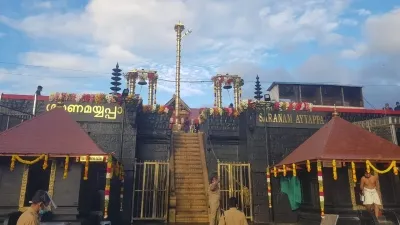
This submission is part of a larger set of review petitions stemming from the Supreme Court's 2018 ruling that allowed women of all ages to enter the Sabarimala temple. The apex court has previously established a detailed timeline for hearing the case, with arguments scheduled to start on April 7 and conclude by April 22.
A Bench led by Chief Justice of India (CJI) Surya Kant has clarified that the issue of maintainability is already settled and has outlined seven significant legal questions for the Constitution Bench's consideration.
Point of View
The outcome may redefine the boundaries of religious practices and judicial involvement in faith-related matters.
NationPress
22 Sept 2026
Frequently Asked Questions
What is the primary argument of the Travancore Devaswom Board?
The Board advocates for a community-centric interpretation of religion under Article 25, arguing that beliefs should be evaluated from the community's perspective, not through judicial standards.
What does the 'essential religious practices' doctrine entail?
This doctrine assesses which practices are fundamental to a religion. The Board contends that it lacks grounding in Article 25 and represents an unwarranted judicial modification.
What limitations exist on religious freedom?
Religious freedom is not absolute and can be regulated by statutes when practices conflict with public order, morality, health, or fundamental rights.
When will the hearings for the Sabarimala case begin?
The arguments are scheduled to commence on April 7 and conclude by April 22.
Who is leading the Supreme Court Bench for this case?
The case is being presided over by a Bench led by Chief Justice of India, Surya Kant.