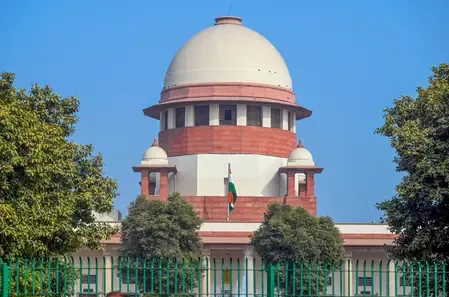
Will the Supreme Court Hear the Sabarimala Review Case Starting April 7?
Synopsis
The Supreme Court is gearing up for a significant hearing on the Sabarimala review case, starting April 7, with potential implications for women's rights and religious practices. This nine-judge Constitution Bench will address pivotal legal questions, making it a landmark event in India's judicial history.
Key Takeaways
Supreme Court to begin hearing on Sabarimala review from April 7.
Nine-judge Constitution Bench will address significant legal questions.
Arguments scheduled to conclude by April 22.
All parties must submit written submissions by March 14.
Union government supports the review petitions.
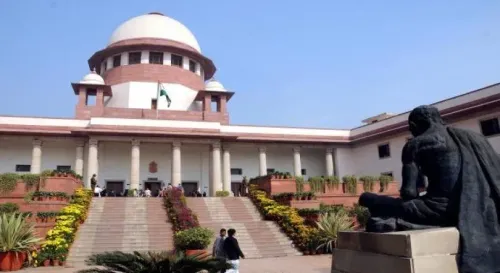
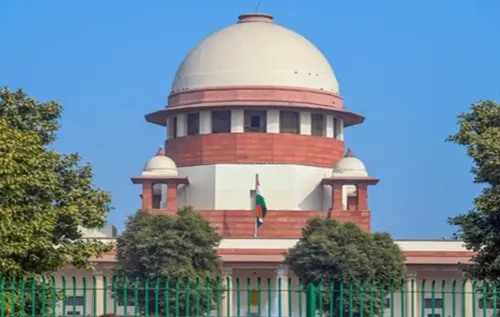
New Delhi, Feb 16 (NationPress) A Constitution Bench consisting of nine judges from the Supreme Court is set to begin hearings regarding the Sabarimala review case on April 7.
This Bench, led by Chief Justice of India (CJI) Surya Kant, is addressing a series of review petitions challenging the court's September 2018 decision that allowed women of all ages to enter the Lord Ayyappa temple at Sabarimala. A timeline for concluding arguments has been established, with the aim of wrapping up by April 22.
All involved parties have been instructed to submit their written arguments by March 14.
“Concerns were previously raised about the validity of the reference, which this court definitively resolved in February 2020, confirming that this Court can refer inquiries to a larger Bench during a review process.
Thus, the question of the validity of the reference has been conclusively settled and does not need to be revisited at this stage,” stated the Bench, which also includes Justices Joymalya Bagchi and Vipul M. Pancholi.
Citing the order from February 10, 2020, the apex court indicated that seven legal questions had already been framed for evaluation by the nine-judge Bench.
“In light of this and to definitively resolve the legal questions still outstanding in these proceedings, we instruct the parties to present their written submissions by 14.03.2026,” the order specified.
According to the timetable set by the Supreme Court, supporters of the review petitions will be heard from April 7 to April 9, while those opposing the review will present their arguments from April 14 to April 16.
If there are any rejoinder submissions, they will be addressed on April 21, followed by the concluding submissions by the amicus curiae, expected to be finalized by April 22.
“The parties must adhere to this schedule. The lead counsels, in coordination with the arguing counsels of the parties, shall organize the internal arrangements to ensure that oral submissions from both parties are heard within the designated timeframe,” the CJI Kant-led Bench ordered.
During the proceedings, the Supreme Court emphasized that the Constitution Bench hearings are “more significant than anything else” and urged both sides to keep their schedules free for the mentioned dates.
Solicitor General Tushar Mehta, the second-highest law officer representing the Centre, informed the court that the Union government is backing the review petitions.
“We are in support of the review,” SG Mehta confirmed.
The Supreme Court has appointed advocate-on-Record Shivam Singh to assist amicus curiae K. Parmeswar and to compile written submissions that reflect the stance of all parties involved.
The specific composition of the nine-judge Constitution Bench will be announced separately by the Chief Justice of India, who oversees the roster, through an administrative order.
In addition to the Sabarimala matter, related issues tagged with the reference include questions concerning the entry of Muslim women into mosques and dargahs, the rights of Parsi women to enter Fire Temples after marrying outside their community, the validity of excommunication practices, and the legality of female genital mutilation within the Dawoodi Bohra community.
Point of View
I stand firmly with the principles of equality and justice that define our nation. The upcoming Supreme Court hearings on the Sabarimala case represent not just a legal battle but a reflection of our societal values. Ensuring that all women have the right to worship freely is a cornerstone of our democratic ethos. We must uphold these rights as we move forward.
NationPress
19 Sept 2026
Frequently Asked Questions
What is the Sabarimala review case about?
The Sabarimala review case concerns the Supreme Court's earlier ruling that permitted women of all ages to enter the Lord Ayyappa temple, which has been the subject of various review petitions.
When will the Supreme Court start hearing the case?
The hearings on the Sabarimala review case will commence on April 7.
What is the significance of this case?
The case holds significant implications for women's rights and access to religious spaces in India, marking a critical moment in the ongoing discourse around gender equality.
What is the timeline for the hearings?
The Supreme Court has set a schedule for arguments from April 7 to April 22, with specific dates allocated for supporters and opponents of the review petitions.
Who is involved in the hearings?
The hearings will involve a nine-judge Constitution Bench, various petitioners, and representatives from the Union government.