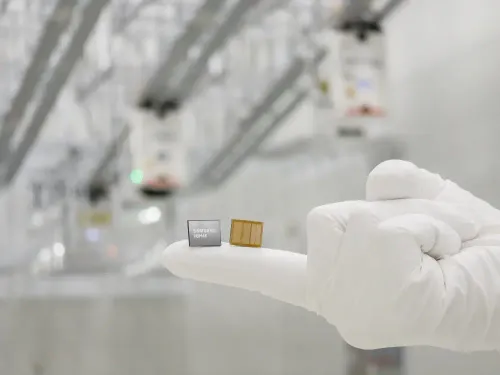
Samsung Launches HBM4E Chip Amid Strengthening Ties with Nvidia
Synopsis
Samsung Electronics has unveiled its HBM4E chip during Nvidia's technology conference, marking a significant step in their partnership that now includes foundry services. This new memory technology promises unprecedented speeds for AI applications.
Key Takeaways
Samsung Electronics has launched the HBM4E chip at Nvidia's conference.
The new chip promises speeds of 16 gigabits per second and bandwidth of 4.0 terabytes per second .
The partnership between Samsung and Nvidia is expanding into foundry services .
Samsung's hybrid copper bonding technology enhances memory chip efficiency.
Both companies aim to transform the global AI infrastructure .
Seoul, March 17 (NationPress) Samsung Electronics has officially launched its latest seventh-generation high bandwidth memory (HBM), called HBM4E, at an annual technology conference organized by Nvidia. During the event, the U.S. tech leader emphasized its growing alliance with the South Korean semiconductor company that extends beyond just memory solutions.
Samsung Electronics shared insights into the progress of its HBM4E products while demonstrating its expertise as a comprehensive memory solution provider for Nvidia's Vera Rubin AI platform. This unveiling occurred during Nvidia GTC 2026, which commenced in California on Monday, as reported by Yonhap news agency.
This event marked the inaugural display of the actual HBM4E chip, which is anticipated to deliver speeds of 16 gigabits per second per pin and a bandwidth of 4.0 terabytes per second.
This performance signifies an enhancement over the previous HBM4, which achieved speeds of 13 gigabits per second per pin and a bandwidth of 3.3 terabytes per second.
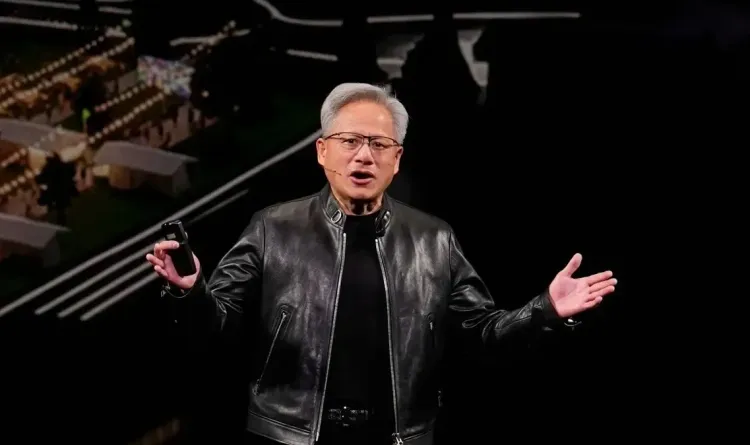
During his keynote address, Nvidia CEO Jensen Huang expressed his appreciation to Samsung Electronics for producing the Groq 3 language processing unit (LPU), which is set to boost Nvidia's AI platform capabilities.
"I want to thank Samsung, who manufactures the Groq 3 LPU chip for us, and they are working tirelessly. I truly appreciate your efforts," the CEO remarked, confirming that Samsung Electronics' foundry division is responsible for the chip's production.
Huang's comments indicate that the collaboration between Samsung Electronics and Nvidia has expanded to encompass the foundry sector, or chip contract manufacturing.
Earlier, Samsung Electronics initiated its first commercial shipments of sixth-generation HBM, known as HBM4, tailored for Nvidia's Vera Rubin platform, which the chipmaker claims provides the "ultimate performance" for AI operations.
Additionally, Samsung Electronics presented its hybrid copper bonding (HCB) technology, which allows for stacking over 16 layers while reducing thermal resistance by 20% compared to thermal compression bonding (TCB), showcasing its packaging advancements for next-generation HBM.
The South Korean tech giant stated, "In order for innovation in the AI industry, strong AI systems like the Vera Rubin platform are critical."
"Samsung Electronics intends to persist in supplying high-performance memory solutions that support the Vera Rubin platform," the company added.
Moreover, both companies are looking to lead a shift in the global AI infrastructure paradigm through their partnership.
At the event, Samsung Electronics set up an exhibition booth featuring three distinct zones: AI Factories, Local AI, and Physical AI, showcasing the firm's next-generation chips designed to meet the evolving demands of the AI sector.
Point of View
The collaboration between Samsung Electronics and Nvidia reflects a significant advancement in the tech industry, particularly in memory solutions for AI. This partnership not only highlights the capabilities of Samsung but also points to the increasing importance of integrated technology solutions in driving innovation.
NationPress
29 Sept 2026
Frequently Asked Questions
What is the HBM4E chip?
The HBM4E chip is the latest seventh-generation high bandwidth memory developed by Samsung Electronics, designed to deliver exceptional performance for AI applications.
How does HBM4E compare to its predecessor?
HBM4E offers improved speeds of 16 gigabits per second per pin and a bandwidth of 4.0 terabytes per second, surpassing the HBM4, which had speeds of 13 gigabits per second per pin.
What role does Nvidia play in this partnership?
Nvidia partners with Samsung to utilize its memory solutions in the Vera Rubin AI platform, enhancing the overall performance of AI applications.
What is hybrid copper bonding technology?
Hybrid copper bonding technology allows for stacking more than 16 layers of chips while reducing thermal resistance, enhancing the efficiency of next-generation memory solutions.
Where was the HBM4E chip launched?
The HBM4E chip was unveiled at Nvidia's GTC 2026 technology conference held in California.