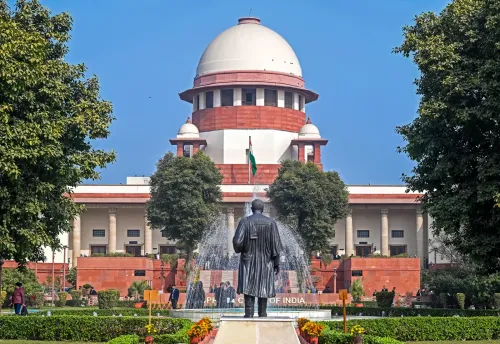
SC orders MP Speaker to decide Nirmala Sapre disqualification within 2 months
Synopsis
The Supreme Court has put a two-month clock on the Madhya Pradesh Assembly Speaker to decide whether Bina MLA Nirmala Sapre — elected on a Congress ticket in 2023 but publicly backing BJP since May 2024 — should be disqualified under the anti-defection law. The case has sat unresolved for over two years, and the apex court's intervention follows a pattern of judicial pressure on Speakers who delay Schedule-X rulings for political reasons.
Key Takeaways
The Supreme Court on 4 November 2026 directed the MP Assembly Speaker to decide the anti-defection petition against Bina MLA Nirmala Sapre within two months .
Sapre was elected from Bina constituency, Sagar district on a Congress ticket in November 2023 but appeared at a BJP event in May 2024 alongside CM Mohan Yadav .
The petition was filed by Umang Singhar , Leader of Opposition in the MP Assembly, under the Tenth Schedule of the Constitution.
The petition had been pending before the Speaker for over two years ; the MP High Court had earlier declined to grant time-bound relief.
The Supreme Court's order sets a deadline but does not amount to a disqualification — the Speaker retains authority to decide the merits.
The Supreme Court on Wednesday, 4 November 2026, directed the Madhya Pradesh Assembly Speaker to decide within two months the disqualification petition against Bina MLA Nirmala Sapre, who won the November 2023 Assembly election on a Congress ticket but subsequently extended support to the ruling Bharatiya Janata Party (BJP). The direction came on a petition moved by Umang Singhar, Leader of Opposition in the Madhya Pradesh Assembly, invoking the anti-defection law.
Background: What Triggered the Disqualification Move
Sapre was elected from the Bina Assembly constituency in Sagar district during the November 2023 state polls as a Congress candidate. In May 2024, during the Lok Sabha election campaign, she appeared at a BJP programme in Sagar in the presence of Chief Minister Mohan Yadav and publicly expressed support for the ruling party. The Congress accused her of defection and filed a disqualification petition before the Assembly Speaker. Singhar argued that Sapre had voluntarily relinquished her party membership, attracting provisions of the Tenth Schedule of the Constitution — the anti-defection law.
Sapre's Defence
Sapre has denied formally joining the BJP or tendering her resignation from the Congress. The question of her continuation as an MLA, therefore, remains unresolved pending the Speaker's decision. The court's direction does not amount to a disqualification order — it only sets a deadline for the Speaker to adjudicate the existing petition in accordance with constitutional provisions.
How the Case Reached the Supreme Court
The disqualification petition has been pending before the Assembly Speaker for over two years, according to Singhar's media department. The Congress first approached the Madhya Pradesh High Court seeking a time-bound order, but the High Court declined to grant the requested relief. Singhar subsequently escalated the matter to the Supreme Court. Senior Advocate Vivek Tankha represented Singhar before the apex court during the hearing.
What the Supreme Court Said
The court underscored that petitions filed under the Tenth Schedule must be decided expeditiously and cannot be allowed to remain pending indefinitely. It directed the Assembly Speaker to complete the decision-making process within a two-month window. This comes amid a broader judicial push to end the practice of Speakers sitting on anti-defection petitions as a political tactic — a pattern the Supreme Court has flagged in multiple cases over the past decade, including landmark rulings on floor crossings in Maharashtra, Goa, and Manipur.
What Happens Next
The Assembly Speaker must now pass an order on the disqualification petition within the stipulated period. If Sapre is disqualified, the Bina seat would fall vacant, triggering a by-election. If the Speaker rules in her favour, the Congress may challenge that decision in the higher judiciary. Either way, the ruling puts long-delayed accountability mechanisms in motion and signals that the apex court will not tolerate indefinite inaction on Schedule-X petitions.
Point of View
The apex court will keep issuing two-month orders, and Speakers will keep testing them.
NationPress
4 Nov 2026
Frequently Asked Questions
What is the Nirmala Sapre disqualification case about?
Bina MLA Nirmala Sapre was elected from Sagar district, Madhya Pradesh on a Congress ticket in November 2023 but appeared at a BJP campaign event in May 2024, prompting the Congress to file a disqualification petition against her under the anti-defection law. The Supreme Court has now ordered the MP Assembly Speaker to rule on that petition within two months.
What did the Supreme Court order on 4 November 2026?
The Supreme Court directed the Madhya Pradesh Assembly Speaker to decide the disqualification petition against Sapre within two months. The court emphasised that Tenth Schedule petitions must be resolved expeditiously and cannot remain pending indefinitely.
Has Nirmala Sapre been disqualified?
No. The Supreme Court's order only sets a deadline for the MP Assembly Speaker to decide the petition. Sapre's status as an MLA remains unchanged until the Speaker delivers a ruling; she has also denied formally joining the BJP or resigning from the Congress.
Why was the case taken to the Supreme Court?
The disqualification petition had been pending before the MP Assembly Speaker for over two years. When the Madhya Pradesh High Court declined to grant time-bound relief, Congress leader and Leader of Opposition Umang Singhar escalated the matter to the Supreme Court, where Senior Advocate Vivek Tankha argued the case.
What happens if the Speaker disqualifies Sapre?
If the Assembly Speaker rules in favour of disqualification, the Bina Assembly seat would fall vacant and a by-election would be required. If the Speaker rules against disqualification, the Congress can challenge that decision before a higher court.