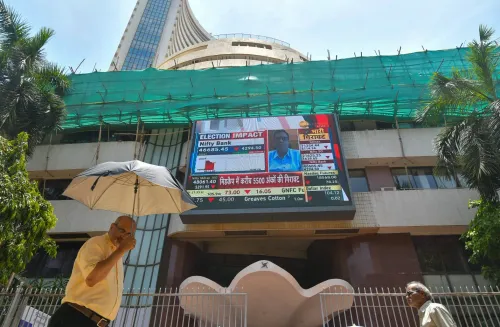
Sensex, Nifty fall for 2nd straight session; Smallcap 100 drops 2.37%

Synopsis
Indian markets posted a second straight day of losses on 21 October, with the Sensex shedding 143 points and the Nifty closing at 22,811 — but the real story is in the broader market, where the SmallCap 100 crashed 2.37%, signalling that the recent small-cap rally is facing a serious stress test. Analysts warn that a break below 22,600 on the Nifty could trigger a deeper slide.
Key Takeaways
BSE Sensex fell 143.21 points ( 0.19% ) to close at 73,709.69 on 21 October .
Nifty50 dropped 77.60 points ( 0.34% ) to settle at 22,811.35 — its second consecutive decline.
Nifty SmallCap 100 slumped 2.37% ; Nifty MidCap 100 fell 1.58% , reflecting sharper broader-market selling.
Top Nifty losers: Bajaj Finance , BSE Limited , and Eternal .
Nifty IT was the lone sectoral outperformer; Nifty Metal , Chemical , and Consumer Durables led sectoral losses.
Analysts flag 22,600 as a critical support; a break below it could open a slide to 22,300–22,200 .
Indian equity benchmarks closed lower for the second consecutive session on Wednesday, 21 October, weighed down by selling in auto, metal, and select heavyweight stocks, while the broader market bore a sharper brunt of the selloff.
The BSE Sensex shed 143.21 points, or 0.19%, to settle at 73,709.69, while the Nifty50 declined 77.60 points, or 0.34%, to close at 22,811.35. The session extended a run of cautious trade that has kept headline indices pinned below key technical resistance.
Broader Market Takes the Harder Hit
The weakness was considerably more pronounced beyond the headline indices. The Nifty MidCap 100 index declined 1.58%, while the Nifty SmallCap 100 slumped 2.37% — underscoring a risk-off tilt among investors who had piled into smaller counters during the earlier bull run. Market participants remained cautious amid continued volatility in mid- and small-cap stocks, with profit-booking in several sectors offsetting gains in information technology shares, according to market analysts.
Top Losers and Sectoral Snapshot
Among Nifty50 constituents, Bajaj Finance, BSE Limited, and Eternal emerged as the session's biggest drags, exerting meaningful pressure on the headline indices. Sectoral performance was mixed: the Nifty Chemical, Nifty Consumer Durables, and Nifty Metal indices ranked among the biggest laggards. In contrast, the Nifty IT index outperformed the broader market and closed as the top sectoral gainer of the day — a reversal of recent trend where IT had been a source of drag.
What Analysts Are Watching
Technical analysts flagged 23,000 as the critical threshold for the Nifty. A sustained move above that level would be required to improve the short-term outlook; failure to reclaim it, they cautioned, could leave the index vulnerable to further downside, with selling pressure likely to resurface at higher levels despite intermittent recovery attempts.
On the downside, analysts identified 22,650–22,600 as the immediate support zone, followed by 22,300. 'A decisive break below 22,600 could intensify selling pressure and expose the index to the 22,300–22,200 range,' analysts stated.
Key Macro Triggers to Watch
Looking ahead, analysts said near-term market direction will hinge on the breadth of corporate earnings delivery, progress on trade negotiations, and the trajectory of foreign institutional flows. 'Durable moderation in crude, global yields and currency volatility' remains crucial for market stability, they added. This comes amid a broader backdrop of global macro uncertainty that has kept foreign flows tentative across emerging markets, including India.
Point of View
But the 2.37% SmallCap 100 collapse tells a more uncomfortable story — the retail-investor-driven froth in small caps is unwinding, and fast. Two consecutive losing sessions with accelerating breadth deterioration typically precede either a decisive bounce above resistance or a capitulation leg lower. The Nifty's failure to hold 23,000 means the next two to three sessions of earnings and FII flow data are not just noise — they will set the technical tone for the rest of the quarter. The IT sector's outperformance today is a narrow silver lining, but one sector cannot carry an index when metals, chemicals, and consumer durables are all selling off simultaneously.
NationPress
21 Oct 2026
Frequently Asked Questions
Why did the Sensex and Nifty fall for a second straight session on 21 October?
The Sensex and Nifty fell for the second consecutive session on 21 October due to selling pressure in auto, metal, and select heavyweight stocks, combined with broad profit-booking across mid- and small-cap counters. Macro uncertainty around crude prices, global yields, and foreign institutional flows added to investor caution.
How much did the Nifty SmallCap 100 and MidCap 100 fall?
The Nifty SmallCap 100 index slumped 2.37% and the Nifty MidCap 100 dropped 1.58% on Wednesday, significantly outpacing the decline in headline indices and reflecting a sharper risk-off move in the broader market.
What is the key support level for Nifty according to analysts?
Analysts have identified 22,650–22,600 as the immediate support zone for the Nifty, followed by 22,300. A decisive break below 22,600 could intensify selling and expose the index to the 22,300–22,200 range.
Which sectors gained and which fell during the session?
The Nifty IT index was the top sectoral gainer of the session. On the losing side, Nifty Chemical, Nifty Consumer Durables, and Nifty Metal were the biggest laggards, dragging the overall market lower.
What will determine the near-term direction of Indian markets?
According to analysts, near-term direction will depend on the breadth of corporate earnings delivery, progress on trade negotiations, and foreign institutional investor flows. A sustained moderation in crude oil prices, global bond yields, and currency volatility is seen as crucial for market stability.