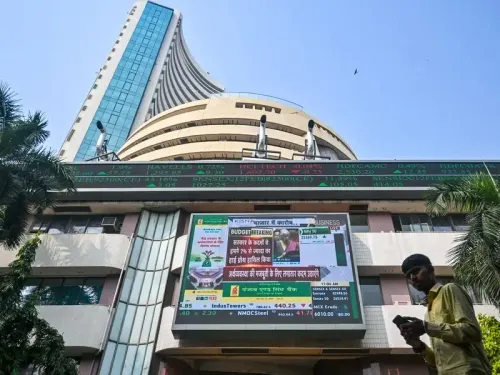
Sensex falls 242 points, Nifty at 22,716 as crude oil weighs on markets

Synopsis
Indian markets logged a second successive losing session on 29 September, with crude oil prices and global bond yield swings keeping bulls at bay. The Nifty is now testing a critical support band near 22,550, and with Q2 earnings expectations already muted, the next trigger — or landmine — could be geopolitical rather than domestic.
Key Takeaways
Sensex closed 242.65 points lower at 72,529.07 on 29 September — its second straight losing session.
Nifty50 ended down 64.05 points at 22,716.20 ; immediate support seen at 22,550–22,600 .
Titan Company , Wipro , and HCLTech were among the top Nifty laggards.
Nifty MidCap fell 0.99% and Nifty SmallCap dropped 0.81% , extending the broad-based selloff.
Nifty Pharma bucked the trend, closing as one of the better-performing sectoral indices.
The rupee held near 95.97 , with analysts projecting a near-term range of 95.65–96.15 .
Indian equity benchmarks closed lower for the second straight session on Tuesday, 29 September, as elevated crude oil prices and persistent volatility in global bond yields kept investors firmly in risk-off mode. The BSE Sensex shed 242.65 points, or 0.33%, to settle at 72,529.07, while the Nifty50 slipped 64.05 points, or 0.28%, to close at 22,716.20.
Key Drags on the Session
Titan Company emerged as the top loser on the Nifty index, while IT heavyweights Wipro and HCLTech featured among the biggest drags on the benchmark. Selling pressure was broad-based, touching large-cap counters across sectors. Consumer durables, chemicals, real estate, and information technology stocks registered the steepest declines, with concerns over global growth and higher input costs — linked to firm crude oil prices — cited as the primary triggers.
Broader Market and Sectoral Picture
The weakness extended well beyond the headline indices. The Nifty MidCap index dropped 0.99%, while the Nifty SmallCap index fell 0.81%, reflecting investor caution on risk exposure across market capitalisation bands. The Nifty Consumer Durables, Nifty Chemical, Nifty Realty, and Nifty IT indices closed among the worst performers of the session.
The one bright spot was the pharmaceutical space. The Nifty Pharma index outperformed its peers, offering some relief to market participants as defensive positioning gathered pace.
Technical Levels to Watch
Analysts noted that the 23,500–23,600 zone has drawn limited buying interest in recent sessions, keeping any recovery attempt subdued. On the upside, 22,750–22,800 is flagged as the immediate resistance zone. 'On the downside, 22,550–22,600 remains the key immediate support zone, while a decisive break below 22,500 could intensify selling pressure and expose the index to the 22,300–22,000 region,' analysts stated.
What the Market Is Watching Next
Market watchers noted that attention is gradually shifting towards Q2 earnings season, with expectations already tempered compared to Q1 performance. 'A meaningful de-escalation of the U.S.-Iran conflict could trigger a sharp relief rally driven by improved risk sentiment. Until then, investors are likely to remain selective, favouring fundamentals and earnings visibility over broad-based market exposure,' analysts noted.
On the currency front, the rupee traded largely flat near 95.97, edging marginally higher by around 0.10%, as crude prices saw some profit booking from recent highs. Analysts pegged the rupee's near-term range at 95.65–96.15. With geopolitical tensions and energy prices still in focus, a sustained recovery in equities will depend heavily on incoming macro cues and early earnings signals.
Point of View
Chemicals, realty all down in a single session — shows how a firm oil price is a compound tax on corporate margins and household spending simultaneously. What the data does not yet fully price is the Q2 earnings risk: if input cost pressure from crude has been biting through the quarter, the reporting season starting in weeks could accelerate the derating. The pharma outperformance is instructive but thin cover for an index that needs a real catalyst, and right now the most plausible one — a U.S.-Iran de-escalation — is entirely outside domestic policymakers' hands.
NationPress
29 Sept 2026
Frequently Asked Questions
Why did the Sensex and Nifty fall on 29 September 2026?
Both indices declined for the second straight session as elevated crude oil prices and volatility in global bond yields pushed investors toward a defensive, risk-off stance. The Sensex fell 242.65 points to 72,529.07 and the Nifty lost 64.05 points to close at 22,716.20.
Which sectors were worst affected in today's market fall?
Consumer durables, chemicals, real estate, and IT were the hardest-hit sectors, with all four sectoral indices closing among the day's worst performers. Elevated crude oil prices raised input cost concerns across these industries.
What are the key support and resistance levels for Nifty?
Analysts have flagged 22,550–22,600 as the immediate support zone, with a decisive break below 22,500 potentially opening a drop toward 22,300–22,000. On the upside, 22,750–22,800 is the near-term resistance band.
Which stock was the top loser on the Nifty today?
Titan Company was the top loser on the Nifty50 during the session. IT stocks Wipro and HCLTech also featured among the biggest drags on the index.
What could reverse the current market weakness?
Analysts said a meaningful de-escalation of the U.S.-Iran conflict could trigger a sharp relief rally. In the near term, market focus is shifting to Q2 corporate earnings, though expectations are already more cautious than in Q1.