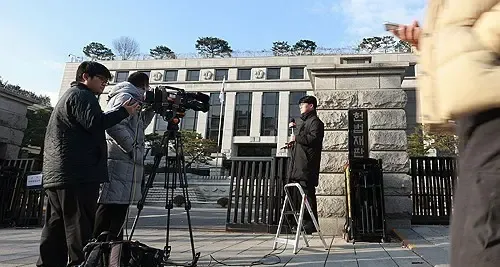
Judicial Reform in South Korea: New Laws Enable Constitutional Appeals and Penalties for Legal Distortion

Synopsis
South Korea's judicial landscape is transforming with new laws enabling constitutional appeals against Supreme Court rulings and imposing penalties on judges for legal distortions. This significant reform aims to enhance accountability but raises questions about judicial independence.
Key Takeaways
Constitutional Appeals: Citizens can challenge Supreme Court rulings.
Legal Distortion Penalties: Judges face severe penalties for intentional legal distortion.
Judiciary Expansion: Supreme Court justices will increase from 14 to 26 by 2028.
Accountability Focus: Reforms aim to enhance judicial accountability.
Concerns Raised: Potential impact on judicial independence is a key issue.
Seoul, March 12 (NationPress) A new series of judicial reform laws were officially enacted on Thursday, enabling constitutional appeals against rulings made by South Korea's Supreme Court, instituting penalties for judges who deliberately distort legal principles, and facilitating an expansion of the Supreme Court's bench. This reform represents the first significant revision of the judiciary system since the constitutional amendment of 1987.
The National Assembly, dominated by the ruling Democratic Party, approved these legislative measures last month, pushing for judicial reform in the face of substantial opposition from the main opposition, the People Power Party, and the judiciary itself, which argued that these changes could jeopardize judicial independence.
The new laws regarding constitutional appeals and penalties for “legal distortion” are effective immediately, while the increase in the number of Supreme Court justices will be executed gradually, starting in 2028.
According to the amended Constitutional Court Act, individuals may now file constitutional complaints regarding finalized rulings if they are believed to contradict Constitutional Court decisions, fail to adhere to due process, or violate fundamental rights through clear constitutional infractions. These complaints must be submitted within 30 days following a final ruling.
If the Constitutional Court finds a court ruling to be unconstitutional, the case must be re-evaluated. There have been criticisms that such legislation undermines the country's three-instance trial system; however, the Constitutional Court asserts that it facilitates constitutional review.
The court has already received its first petition from a Syrian national challenging a court's dismissal of a request to annul a deportation order issued by immigration authorities. Further details have not been disclosed. By 9 a.m. on the same day, three other complaints had been lodged, including one seeking state compensation for a delayed court ruling regarding damages to a late South Korean fisherman who was abducted by North Korea. The family of the deceased fisherman had previously brought the case to court, which ruled unfavorably for the plaintiff. A civic group advocating for such fishermen has submitted a complaint asking for constitutional review of the finalized ruling.
Regarding the offense termed “legal distortion,” judges presiding over criminal cases, prosecutors, or those involved in investigations could face up to 10 years in prison if they intentionally distort legal principles to harm others. The ruling party believes this legislation will deter judges or prosecutors from attempting to influence the outcomes of rulings or investigations.
The judiciary has expressed concerns regarding the newly established offense, suggesting that it may compel judges to adhere strictly to precedent out of fear of punishment, potentially hindering rulings that reflect contemporary societal values, as reported by Yonhap news agency.
Under the revised Court Organization Act, the number of Supreme Court justices will increase from the current 14 to 26 over a three-year period starting in March 2028. While the reform aims to alleviate a backlog of cases at the Supreme Court, it raises concerns about whether a larger court could hinder effective internal deliberation.
A two-day closed-door meeting involving heads of courts nationwide is scheduled to commence later today to deliberate on the reform measures. Supreme Court Chief Justice Cho Hee-dae, who has indicated that the reforms could result in “great harm” to the public, is expected to participate in the discussions.
Point of View
It is crucial to observe the balance between reforming the judiciary for accountability and safeguarding its independence. While the new laws aim to address pressing issues, the potential repercussions on judicial impartiality warrant thorough examination.
NationPress
26 Sept 2026
Frequently Asked Questions
What are the new judicial reform laws in South Korea?
The new laws allow constitutional appeals against Supreme Court rulings, punish judges for legal distortions, and expand the number of Supreme Court justices.
When will the new laws take effect?
The laws regarding constitutional appeals and legal distortion penalties are effective immediately, while the expansion of Supreme Court justices will begin in 2028.
What is considered 'legal distortion' under the new laws?
Legal distortion refers to the intentional distortion of legal principles by judges or prosecutors with the intent of causing harm, which can lead to up to 10 years in prison.
How will these reforms impact the judicial system?
The reforms aim to enhance accountability within the judiciary but raise concerns regarding the potential influence on judicial independence and decision-making.
Who can file constitutional complaints under the new laws?
Individuals can file complaints against finalized rulings that contradict Constitutional Court decisions or infringe on fundamental rights within 30 days of the ruling.