Are the Glowing Waters in Australia’s Tasmania Linked to Climate Change Rather Than Fish-Farm Waste?
Synopsis
A stunning bioluminescent bloom along Tasmania's coast has scientists asserting that climate change, not fish farming pollution, is to blame. This natural phenomenon poses ecological challenges, reflecting the impact of warming oceans. Discover the implications and beauty of this captivating event.
Key Takeaways
Bioluminescent blooms are caused by Noctiluca scintillans .
Climate change is linked to ocean warming.
These blooms can pose risks to marine life and human health.
Natural sea nutrients, not fish farms, drive these blooms.
Understanding these phenomena is crucial for ecological balance.
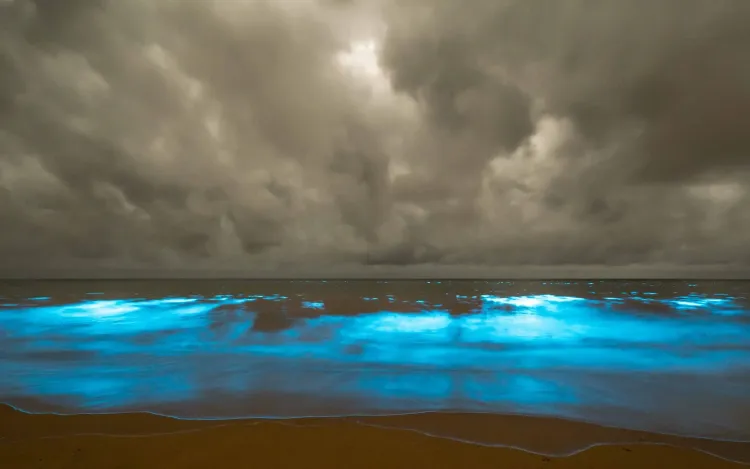
Melbourne, Jan 6 (NationPress) Researchers have identified that a bioluminescent bloom illuminating the southeast coastline of Tasmania, Australia, characterized by red tides during the day and blue glows at night, is a result of climate-induced ocean warming rather than pollution from nearby salmon farms.
The glow, which has returned nearly a year after a similar occurrence, is attributed to Noctiluca scintillans, a bioluminescent marine plankton that consumes microscopic algae. When it dies, it rises to the surface, producing red slicks that glow upon disturbance, as reported by the Australian Broadcasting Corporation.
Authorities have recommended avoiding swimming in the affected areas, although the natural spectacle continues to attract visitors to Tasmania's southern beaches, according to the Xinhua news agency.
Marine biologist Lisa-ann Gershwin noted that, while visually stunning, the bloom can release ammonia, potentially causing skin irritation in humans and depleting oxygen levels in nearby waters, which could lead to the demise of certain marine life.
Gershwin emphasized that this phenomenon signifies an ecological imbalance driven by warmer water conditions from the intensifying East Australian Current, a result of climate change.
Emeritus Professor Gustaaf Hallegraeff from the University of Tasmania stated that the bloom is fueled by natural nutrients from the deep sea rather than land runoff or salmon farms.
This organism has no requirement for nutrients such as ammonia and urea that are released by salmon farms, according to Hallegraeff, who has studied harmful algal blooms for over four decades.
Nonetheless, it may pose challenges for the salmon farming industry. In 2003, a Noctiluca bloom near Tasmania's Tasman Peninsula prevented salmon from surfacing to feed, experts reported.
Gershwin cautioned that conditions favorable to Noctiluca could lead to similar harmful blooms akin to the extensive toxic algal outbreaks caused by the Karenia cristata organism in South Australia.
Despite this, Hallegraeff asserted that Noctiluca scintillans blooms present minimal risks, highlighting no current evidence of its climate-expanded range disrupting other organisms.
Point of View
It’s crucial to highlight the intersection of environmental phenomena and climate change. This bioluminescent bloom in Tasmania serves as a stark reminder of our changing oceans and the urgent need for sustainable practices. We must address these ecological signals with seriousness and commitment.
NationPress
2 Oct 2026
Frequently Asked Questions
What causes the bioluminescent bloom in Tasmania?
The bloom is primarily caused by Noctiluca scintillans, a type of bioluminescent marine plankton that thrives in warmer ocean conditions.
Is the bloom harmful to humans?
While visually stunning, the bloom can emit ammonia, which may cause skin irritation for humans and deplete oxygen in the water, impacting marine life.
Are fish farms responsible for the bloom?
No, scientists indicate that the bloom is driven by natural nutrients from the deep sea, not by pollutants from fish farms.
What ecological implications does the bloom have?
The bloom indicates an ecological imbalance due to climate change, potentially leading to challenges for marine ecosystems.
How can we mitigate the effects of climate change on marine life?
Adopting sustainable practices and reducing carbon emissions are crucial steps to mitigate climate change’s impact on marine ecosystems.