How is TEC Collaborating with IIT Kanpur to Enhance Telecom Standards in India?
Synopsis
In a groundbreaking move, TEC has partnered with IIT Kanpur to create India-specific telecom standards. This collaboration aims to enhance India’s role in global standardisation while fostering indigenous technologies, aligning with the Atmanirbhar Bharat vision. Discover how this initiative could shape the future of telecom in India!
Key Takeaways
Collaboration between TEC and IIT Kanpur aims to enhance India’s telecom standards.
Focus on developing India-specific standards for emerging technologies.
Partnership seeks to strengthen India’s participation in global standardisation.
Supports the Atmanirbhar Bharat vision by promoting indigenous technology.
Key areas include 6G , AI , and IoT research.
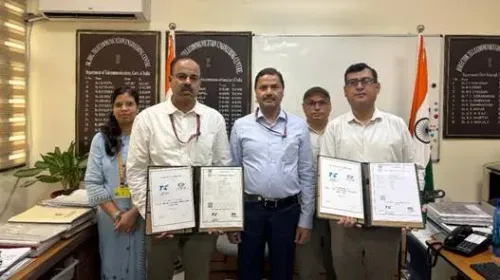
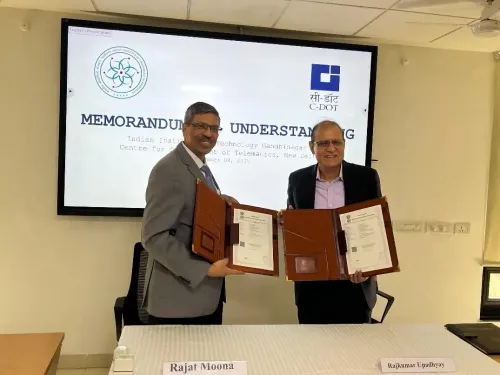
New Delhi, Jan 8 (NationPress) The Telecommunication Engineering Centre (TEC), the technical division of the Department of Telecommunications (DoT), announced on Thursday that it has entered into a Memorandum of Understanding (MoU) with the Indian Institute of Technology, Kanpur (IIT Kanpur). This collaboration aims to engage in joint studies, research, and technical contributions regarding advanced telecom technologies and global standardisation efforts.
The focus of this partnership will be the creation of India-specific standards and testing frameworks for emerging communication technologies, which encompass 6G, Artificial Intelligence in Telecom, Non-Terrestrial Networks (NTNs), Internet of Things (IoT), Digital Twin, Metaverse, and Quantum Communication.
Furthermore, it seeks to strengthen India’s involvement and leadership within global standard-setting and radiocommunication organizations such as ITU-T, ITU-R, 3GPP, and other pertinent international platforms.
The agreement establishes a formal structure for TEC to collaborate closely with IIT Kanpur on next-generation telecom and standardisation initiatives.
Key collaboration areas will include the investigation of 6G architecture and enabling technologies, along with contributions to research, pre-standardisation, and standardisation efforts in global bodies like 3GPP and ITU. Additionally, there will be joint studies and technical contributions focusing on 4G, 5G, LTE-A, NB-IoT, and future networks, covering aspects like architecture, signalling, protocols, and interoperability testing. Research will also be conducted in AI/ML for network automation, optimization, and intelligent management, all aimed at developing AI-native capabilities for future networks.
Other significant areas include collaborative research into advanced antenna systems, massive MIMO, and related radio access technologies, as well as joint studies in satellite communication systems, NTNs, HAPS, and satellite-terrestrial integration, which will include solutions for disaster-resilient and emergency connectivity.
The ministry indicated that this partnership is intended to amplify India’s influence in global standardisation processes by strengthening the nation's contributions to institutions like ITU and 3GPP.
Moreover, the ministry emphasized that this collaboration will further the vision of 'Atmanirbhar Bharat' by bolstering indigenous research, design, and manufacturing in telecommunications—developing standards and testing frameworks tailored to India, along with homegrown solutions that promote national self-reliance, secure critical communication infrastructures, and diminish reliance on imports.
Point of View
I believe this partnership marks a pivotal step towards enhancing India's technological capabilities and self-reliance in telecom standards. By collaborating with IIT Kanpur, TEC is not only fostering innovation but also positioning India as a significant player in the global telecommunications arena. This is a promising development for the nation's technological future.
NationPress
29 Sept 2026
Frequently Asked Questions
What is the purpose of the TEC and IIT Kanpur partnership?
The partnership aims to collaborate on research and development of India-specific telecom standards and testing frameworks for emerging technologies including 6G, AI, IoT, and more.
How will this collaboration impact global standardisation?
This collaboration is designed to enhance India's leadership and participation in international standard-setting organizations, strengthening its influence in global telecom standards.
What technologies are being focused on in this partnership?
Key technologies include 6G, AI in telecom, IoT, Non-Terrestrial Networks, Digital Twins, Metaverse, and Quantum Communication.
What is the Atmanirbhar Bharat vision?
The Atmanirbhar Bharat vision aims to promote self-reliance in India by fostering indigenous research, design, and manufacturing in various sectors, including telecommunications.
What are the expected outcomes of this partnership?
The partnership is expected to result in the development of new standards, enhanced technical capabilities, and increased self-reliance in telecommunications.