Tharoor on Independence Day: Sing the Full Anthem

Synopsis
On Independence Day 2026, Congress MP Dr. Shashi Tharoor admitted he had never heard a complete rendition of India's national symbols and called for fuller versions of both Jana Gana Mana and Vande Mataram at official ceremonies — reigniting a quiet but persistent debate about patriotic protocol.
Key Takeaways
Shashi Tharoor posted on Independence Day, 15 August 2026 , calling for fuller renditions of India's National Anthem and National Song.
Jana Gana Mana , composed by Rabindranath Tagore , was adopted as National Anthem on 24 January 1950 ; only its first stanza is used at official events.
Vande Mataram , written by Bankim Chandra Chattopadhyay , is the National Song; only the first two stanzas are conventionally performed.
Tharoor admitted he had 'never heard' the fuller version referenced in the Instagram reel he was responding to.
India formally distinguishes between the National Anthem and the National Song — a distinction rooted in the Constituent Assembly's 1950 decisions.
The debate over rendition completeness resurfaces regularly around national holidays but has not prompted formal policy change.
On Independence Day, 15 August 2026, Congress MP Dr. Shashi Tharoor stumbled upon something that stopped him — a rendition of India's national symbols he admitted he had never heard before, and it moved him enough to ask a pointed question: why do Indians only ever hear part of the story?
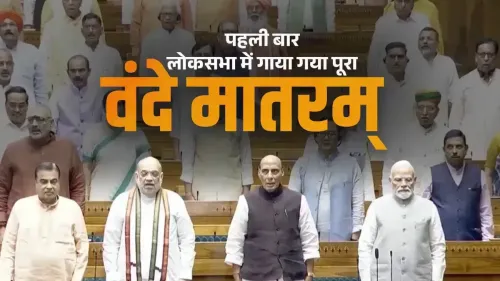
Reacting to an Instagram reel, Tharoor wrote: 'Fabulous! Ashamed to say that I had never heard this. Perhaps we need the fuller version of the #NationalAnthem too, and not just of #VandeMataram!' The post, brief as it is, lands with weight on a day when both Jana Gana Mana and Vande Mataram echo from every official ceremony across the country.
Two symbols, two truncated traditions
India formally distinguishes between its National Anthem and its National Song. Jana Gana Mana, composed by Rabindranath Tagore, was adopted as the National Anthem by the Constituent Assembly on 24 January 1950. Vande Mataram, written by Bankim Chandra Chattopadhyay, was recognised as the National Song in the same year. In practice, official settings render only the first stanza of Jana Gana Mana and only the first two stanzas of Vande Mataram — a convention so entrenched that most Indians have never encountered the complete texts in a public setting. Tharoor's surprise is, in that sense, entirely ordinary. Generations of schoolchildren have sung abbreviated versions at morning assemblies, flag-hoisting ceremonies, and sporting events without ever being told there was more. That a former UN Under-Secretary-General and Union Minister — a man whose career has been built on language and literature — admits the same gap speaks to how thoroughly the truncation has been normalised.A recurring question around national holidays
Commentary on how India renders its patriotic symbols tends to surface around 15 August and 26 January, then fade. Tharoor's post fits that pattern but adds a specific edge: he links the anthem question directly to the Vande Mataram debate, implying both deserve the same scrutiny. Whether the Ministry of Culture or Parliament takes up the question of rendition protocols in any formal way remains to be seen — but on a day when the tricolour flies from every public building, the reminder that the songs beneath it are heard only in part is, at minimum, a conversation worth having.Point of View
The gap between official protocol and public knowledge is wider than policy-makers may acknowledge. The comment arrives as India marks 79 years of independence, a moment when questions of national identity and cultural memory carry particular resonance. It also connects to a longer debate about whether Vande Mataram's partial rendition — a compromise rooted in post-Partition sensitivities — still reflects contemporary India's self-understanding. The Ministry of Culture has historically been reluctant to revisit rendition norms, but prominent voices asking the question publicly can shift the terms of that conversation.
NationPress
30 Sept 2026
Frequently Asked Questions
What did Shashi Tharoor say about the National Anthem on Independence Day 2026?
Tharoor posted on 15 August 2026 that he had never heard a certain rendition of India's national symbols and called for fuller versions of both Jana Gana Mana and Vande Mataram to be used in official settings.
Is Jana Gana Mana sung in full at official events in India?
No. Official protocol in India uses only the first stanza of Jana Gana Mana , which takes approximately 52 seconds. The complete song composed by Rabindranath Tagore has five stanzas and is rarely heard in public settings.
What is the difference between India's National Anthem and National Song?
Jana Gana Mana , composed by Rabindranath Tagore , is India's National Anthem, adopted on 24 January 1950 . Vande Mataram , written by Bankim Chandra Chattopadhyay , is the National Song, recognised in 1950 — a separate designation with equal historical prestige but different ceremonial use.
Why is only part of Vande Mataram sung at official events?
By convention, only the first two stanzas of Vande Mataram are rendered at official ceremonies. The practice dates to the Constituent Assembly era, partly reflecting sensitivities around later stanzas that reference Hindu imagery, though the convention has never been formally codified in law.
Has the government ever considered changing how the National Anthem is performed?
Periodic public commentary — often around Independence Day and Republic Day — has raised the question, but the Ministry of Culture has not formally revised rendition protocols. Tharoor's post adds a prominent voice to the recurring debate.