Should Shashi Tharoor's Concerns Over the SHANTI Bill be Taken Seriously?
Synopsis
Congress MP Shashi Tharoor raises alarming concerns about the SHANTI Bill in a recent Lok Sabha debate. He warns that the proposed legislation could endanger public safety and national security, urging Parliament to thoroughly review its implications before rushing through. His call for a bipartisan examination highlights the importance of safeguarding citizens in sensitive sectors.
Key Takeaways
Shashi Tharoor raises critical concerns about the SHANTI Bill, 2025 .
He advocates for a bipartisan review of the legislation.
The Bill may weaken nuclear safety standards .
Compensation limits under the Bill are deemed inadequate.
Concerns about privatization without accountability are highlighted.
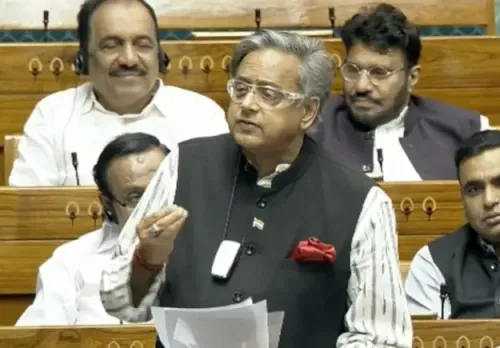
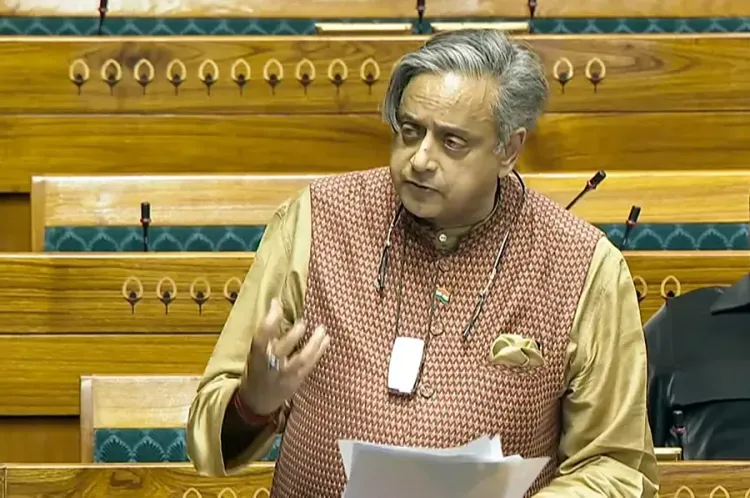
New Delhi/Thiruvananthapuram, Dec 17 (NationPress) Congress MP from Thiruvananthapuram, Shashi Tharoor, on Wednesday expressed strong reservations about the proposed SHANTI Bill, 2025, during the Lok Sabha session, cautioning that the legislation, in its current state, could jeopardize public safety and national security.
Tharoor called for a comprehensive and bipartisan examination, urging that the Bill be sent to a Parliamentary Standing Committee for in-depth analysis.
As he engaged in the discussion, Tharoor recognized the significance of energy security but warned against what he termed as the government's “hasty approach” to privatization in such a delicate sector.
"We are deliberating on a framework that will shape India’s strategic landscape for years to come," he noted, indicating that the Bill introduces ambiguity in areas where clear definitions are crucial.
Highlighting several structural issues, Tharoor raised alarms about clauses that could weaken safety regulations.
He specifically referenced Section 44, which grants the government the authority to exempt nuclear installations from licensing protocols.
This broad discretion, he cautioned, might create a perilous regulatory gap, endangering citizens without adequate legal protections.
Another significant issue he pointed out was the insufficiency of compensation frameworks.
Tharoor observed that despite global inflation and lessons learned from nuclear catastrophes like Fukushima, the compensation limit under the Bill stands at about Rs 3,900 crore.
He also condemned the proposal to restrict the timeframe for filing claims to 10-20 years, contending that radiation-related illnesses can emerge much later, thereby obstructing victims’ access to justice.
Tharoor further cautioned against allowing the entire nuclear fuel cycle to be privatized without stringent eligibility and accountability standards.
While acknowledging the necessity of investment, he asserted that unchecked privatization could lead to “systemic risk”, where profits are privatized while liabilities in case of an accident fall to the state, burdening it completely.
Expressing serious concerns regarding civil rights, Tharoor opposed provisions that grant the power to file criminal complaints against errant operators exclusively to the central government.
This, he argued, would strip affected communities of their right to independently seek justice.
"The strength of legislation is evaluated not just by its intent, but by its ability to safeguard the most vulnerable," Tharoor declared in the House, emphasizing that justice should not be limited by arbitrary deadlines.
He urged Parliament to resist expedited legislation, advocating for a thoughtful, non-partisan review of the Bill, prioritizing the safety of future generations over political interests.
Point of View
It is imperative to approach Shashi Tharoor's critique of the SHANTI Bill with a balanced lens. His concerns reflect the need for careful scrutiny in legislation that impacts crucial sectors like energy. Parliament must prioritize public safety and accountability in any decision-making process, ensuring that the voices of the affected communities are heard and upheld. The focus should remain on safeguarding national interests while fostering bipartisan cooperation.
NationPress
29 Jul 2026
Frequently Asked Questions
What is the SHANTI Bill?
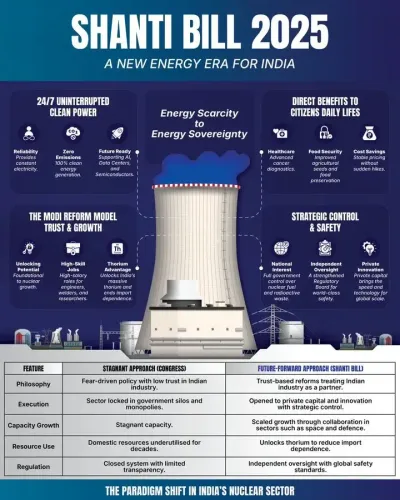
The SHANTI Bill, proposed in 2025, aims to regulate nuclear energy and safety standards in India.
Why is Shashi Tharoor concerned about the SHANTI Bill?
Tharoor believes the Bill could compromise public safety and national security, lacking adequate safety measures and compensation frameworks.
What are the key issues raised by Tharoor?
He highlighted concerns about safety norm dilution, compensation inadequacies, and the potential risks of privatizing the nuclear fuel cycle.
What does Tharoor suggest for the Bill?
He calls for a detailed, bipartisan review and referral of the Bill to a Parliamentary Standing Committee for thorough examination.
How does the SHANTI Bill affect citizens?
The Bill's provisions could impact public safety, access to justice for victims of radiation exposure, and overall accountability in the nuclear sector.