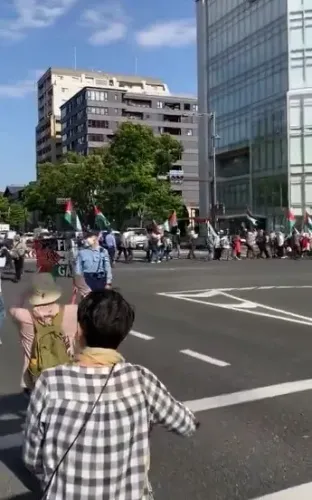
Thousands rally in Tokyo against Takaichi's push to revise Article 9

Synopsis
Around 10,000 people gathered outside Japan's parliament on 20 May to oppose PM Sanae Takaichi's push to rewrite Article 9 — the clause that has kept Japan formally pacifist since 1947. With the LDP reportedly drafting revisions to three national security documents and eyeing long-range missile-capable submarines, the rally signals that public resistance to Japan's military pivot is hardening.
Key Takeaways
An estimated 10,000 protesters rallied outside Japan's National Diet Building in Tokyo on 20 May .
Demonstrators opposed Prime Minister Sanae Takaichi's drive to revise Article 9 of Japan's pacifist constitution.
The Liberal Democratic Party (LDP) has reportedly drafted revisions to Japan's three key national security documents, including plans for long-range missile-capable submarines.
Article 9 , in force since 1947 , renounces war and prohibits Japan from maintaining war potential.
Keio University professor emeritus Hiroshi Onishi said the military buildup contradicts the constitution's pacifist principles.
Constitutional revision requires a two-thirds parliamentary supermajority and a public referendum — a threshold the LDP does not currently hold alone.
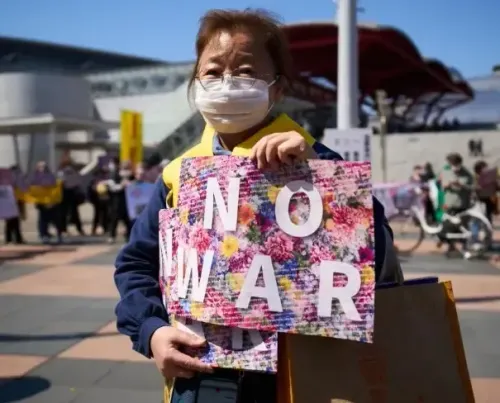
Thousands of demonstrators assembled outside Japan's National Diet Building in Tokyo on 20 May to protest the government's drive to revise the country's pacifist constitution and expand its military capabilities. Organisers estimated the crowd at roughly 10,000 people, making it one of the most visible shows of public opposition to Prime Minister Sanae Takaichi's security agenda this year.
What Protesters Demanded
Demonstrators carried placards bearing messages such as 'Stop constitutional revision and military expansion' and 'Do not destroy Article 9,' while chanting 'Stop missile deployment' and 'Takaichi must resign.' The breadth of the slogans reflected opposition spanning both constitutional and operational defence concerns.
Yuki Hoshino, one of the participants, said the public does not want constitutional amendments and that the Takaichi administration is advancing the agenda without adequate public consent. 'So many people have gathered here (to protest), hoping that (the government) will change its mind,' Hoshino said.
Another protester, Ryosuke Tanji, invoked Japan's wartime history. 'Absolutely no war should be allowed to happen,' he said. 'Japan committed terrible acts in the past, and perhaps many Japanese are gradually forgetting that history. But the more I learn about it, the more strongly I feel that such things must never happen again.'
Academic Voices at the Rally
Hiroshi Onishi, professor emeritus at Keio University, argued at the rally that the government's military buildup directly contradicts the pacifist principles enshrined in Japan's constitution. His presence alongside ordinary citizens underscored the cross-sectoral nature of the opposition.
The LDP's Proposed Security Revisions
Japanese media reported on Monday that the ruling Liberal Democratic Party (LDP) had drafted proposals to revise Japan's three key national security documents. The proposals reportedly call for strengthening Japan's air defence systems and sustained combat capabilities, as well as the early deployment of submarines equipped with advanced propulsion systems and designed to carry long-range missiles — measures framed by the government as bolstering Japan's so-called 'counterstrike capabilities.'
What Article 9 Says and Why It Matters
Japan's current constitution, which took effect in 1947, contains Article 9 — under which the country renounces war as a sovereign right and the threat or use of force as a means of settling international disputes. The article also stipulates that Japan shall not maintain war potential, earning the document its global reputation as the 'pacifist constitution.'
Takaichi and other right-wing factions within the LDP have long advocated revising Article 9. The prime minister has repeatedly expressed her support for constitutional revision this year, reportedly drawing growing concern across Japanese civil society, academia, and opposition parties. This comes amid a broader regional security debate, with Japan having already approved a record defence budget increase in recent years. Whether the LDP can muster the parliamentary supermajority required for a constitutional referendum remains an open question.
Point of View
However, is the operational reality: Japan has already approved record defence budgets and acquired strike capabilities that sit uneasily alongside the constitution's text, creating a de facto revision without a formal one. The protest movement's challenge is to translate crowd numbers into referendum-bloc discipline before the government normalises the gap between law and practice.
NationPress
5 Oct 2026
Frequently Asked Questions
Why are thousands protesting in Tokyo against the Takaichi government?
Protesters oppose Prime Minister Sanae Takaichi's push to revise Japan's pacifist constitution, specifically Article 9, and to expand the country's military capabilities. Around 10,000 people rallied outside the National Diet Building in Tokyo on 20 May, demanding the government abandon plans for constitutional revision and the deployment of long-range missile-capable submarines.
What is Article 9 of Japan's constitution?
Article 9 is a clause in Japan's 1947 constitution under which the country renounces war as a sovereign right and pledges not to maintain war potential. It is the foundation of Japan's internationally recognised 'pacifist constitution' and has been the central point of contention in the country's defence debate for decades.
What changes is the LDP proposing to Japan's security documents?
According to Japanese media reports, the ruling Liberal Democratic Party has drafted proposals to revise Japan's three key national security documents. The proposals reportedly call for stronger air defence systems, enhanced sustained combat capabilities, and the early deployment of advanced submarines capable of carrying long-range missiles to develop what the government terms 'counterstrike capabilities.'
Who attended the Tokyo rally and what did they say?
The rally drew an estimated 10,000 people, including ordinary citizens and academics. Participant Yuki Hoshino said the government is pushing constitutional revision without sufficient public consent, while protester Ryosuke Tanji invoked Japan's wartime history to argue against any return to conflict. Keio University professor emeritus Hiroshi Onishi said the military buildup contradicts the pacifist principles in Japan's constitution.
Can Japan's constitution actually be revised?
Revising Japan's constitution requires a two-thirds supermajority in both houses of parliament, followed by approval in a public referendum — a high bar that the LDP does not currently meet on its own. Despite repeated calls from Takaichi and right-wing factions, the formal revision process has not been initiated as of the time of the rally.