How has flower cultivation surged in Tripura, benefiting over 59,000 farmers?

Synopsis
Discover how Tripura has transformed flower cultivation into a thriving business, benefiting more than 59,000 farmers. From increased land usage to lucrative profits, this article explores the remarkable growth of floriculture in the state.
Key Takeaways
Floriculture has become a profitable venture for farmers in Tripura.
Over 59,000 farmers are benefiting from this industry.
Local production now meets 89% of the state’s flower demand .
The area for flower cultivation has expanded from 2,738 kani to 11,720 kani .
High-value flowers are increasingly grown under protected structures .
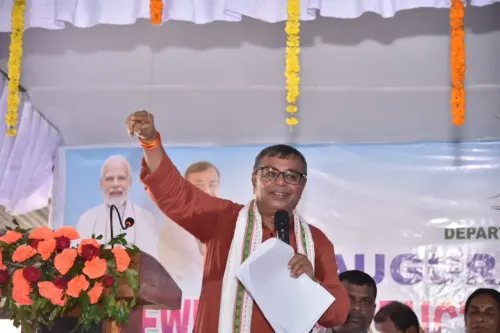
Agartala, Feb 4 (NationPress) The state of Tripura has experienced a remarkable growth in flower cultivation and production over the last seven years, positively impacting over 59,000 farmers throughout the region, as stated by Agriculture and Farmers’ Welfare Minister Ratan Lal Nath on Wednesday.
During the inauguration of the Vivekananda Flower Garden in West Tripura, the Minister emphasized the rising significance of floriculture, noting that flowers play a vital role in social, cultural, and religious activities.
“The demand for flowers is ubiquitous—from greetings and religious ceremonies to various social and cultural gatherings. The fertile soil and abundant rainfall in Tripura create an ideal environment for flower farming,” he remarked.
Nath highlighted that while flowers were previously regarded solely as decorative elements, floriculture has evolved into a lucrative source of income, with many farmers now earning substantial annual profits.
For instance, Sentu Bhowmik from Barjala makes approximately Rs 8 lakh each year from his flower crops, Pradip Sarkar from Kanchanmala earns around Rs 12 lakh, and farmers like Jayanta Dey from Chandibari and Indrajit Debnath from Baikhora report earnings between Rs 8 lakh and Rs 9 lakh.
“The rise in flower farming has considerably enhanced the livelihoods of farmers. Previously, marigold, rose, and rajanigandha were primarily cultivated in open fields,” Nath explained.
He reported that prior to 2018, flower cultivation occupied only 2,738 kani (with one kani equal to 0.34 acres) of land in Tripura, which has now expanded to 11,720 kani over the past seven years.
“The number of farmers involved in floriculture has surged from 2,190 to 59,100, while production has escalated from 1,117 metric tonnes to 2,704 metric tonnes,” stated the Minister.
He added that previously, only 35 percent of the state’s floral needs were met through local production, whereas now about 89 percent is sourced locally, with only around 21 percent coming from outside.
Nath noted that in addition to open-field cultivation, protected structures are increasingly utilized for high-value flowers such as orchids, gerbera, and anthurium.
“The number of protected cultivation units has increased from 225 to 504, and the proportion of such cultivation has risen from 25 percent to 43 percent, reflecting the growing demand for flowers in Tripura,” he commented.
Emphasizing the role of farmers, the Minister declared that agriculture remains one of the most esteemed professions globally.
“Everyone loves flowers and children. Flowers have the ability to uplift spirits and spread positivity,” he concluded.
Point of View
It is heartening to witness Tripura's flourishing floriculture sector. This growth not only enhances the agricultural landscape but also supports thousands of families, demonstrating the power of sustainable farming practices. It is a testament to the resilience and ingenuity of farmers in adapting to changing market demands.
NationPress
29 Sept 2026
Frequently Asked Questions
What is the current status of flower cultivation in Tripura?
Tripura has seen a significant increase in flower cultivation, with over 59,000 farmers now engaged in this sector, and local production meeting 89% of the state's floral needs.
How has the income of farmers changed due to floriculture?
Many farmers in Tripura are earning substantial incomes from flower cultivation, with some reporting annual earnings of up to Rs 12 lakh.
What types of flowers are being cultivated in Tripura?
Farmers in Tripura are cultivating a variety of flowers, including marigolds, roses, rajanigandha, orchids, gerbera, and anthurium.
How has the area for flower cultivation changed in recent years?
The area dedicated to flower cultivation in Tripura has expanded from 2,738 kani to 11,720 kani in the past seven years.
What is the future outlook for floriculture in Tripura?
With rising demand for flowers and increased cultivation practices, the future of floriculture in Tripura looks promising, offering more opportunities for local farmers.