Is Trump Really Proposing a $1.5 Trillion Military Budget?
Synopsis
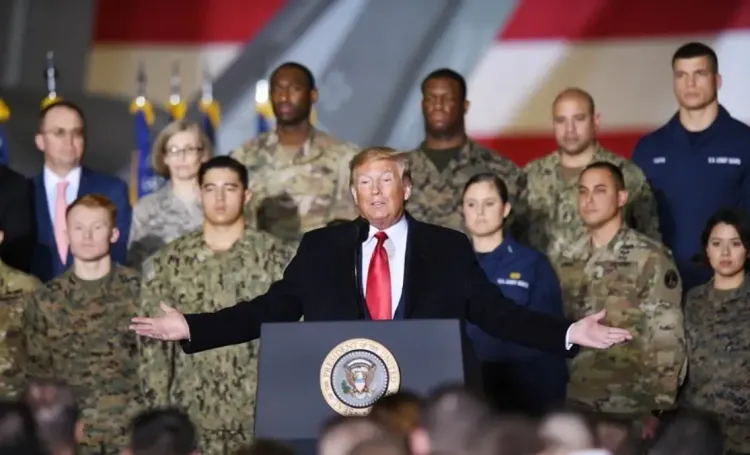
In a significant move, President Donald Trump proposes a staggering $1.5 trillion military budget for 2027, emphasizing the necessity for such an increase to protect the nation in increasingly perilous times. This bold proposal comes on the heels of rising tensions globally and aims to enhance the country's military capabilities.
Key Takeaways
Trump proposes a $1.5 trillion military budget.
The increase is aimed at enhancing national security.
Funding is linked to tariffs from foreign nations.
Previous administration's revenue levels were criticized.
Legislative approval is required for the budget.
Washington, Jan 8 (NationPress) US President Donald J. Trump has expressed his intention to boost the nation's military budget to an astounding $1.5 trillion for the fiscal year 2027, deeming this increase essential to safeguard the United States during what he categorizes as perilous times.
Trump shared this news in a post on Truth Social, noting that the decision followed discussions with senators, congressional members, and senior officials. He asserted that the military budget "should not be $1 trillion, but instead $1.5 trillion."
The President claimed that this enhanced expenditure would enable the United States to develop a "Dream Military." He emphasized that the aim is to guarantee the country's "safety and security, irrespective of any adversary."
Trump linked the proposed budget increase to revenue generated from tariffs on foreign nations. He remarked that these tariffs had significantly increased government revenue and altered the financial capabilities of the nation.
"If it weren't for the substantial amounts accrued from tariffs imposed on other countries," Trump stated, "I would remain at the $1 trillion figure." He also mentioned that several nations had historically "ripped off" the United States.
Trump noted that tariff revenues had reached levels previously deemed "unthinkable." He highlighted this change compared to the circumstances just a year prior.
The President used this opportunity to criticize the previous administration, referring to the "Sleepy Joe Biden Administration" and asserting that revenue levels were considerably lower during that period. He did not provide specific figures to substantiate his claims.
Furthermore, Trump asserted that the increased military budget would not hinder the government from achieving other financial objectives. He proclaimed that the United States could enhance its military strength while simultaneously reducing its debt.
He also stated that the country would have the capacity to "disburse a substantial dividend to moderate-income patriots within our nation."
However, the statement lacked details regarding the allocation of the proposed $1.5 trillion. Trump did not specify which military initiatives would receive the most investment, nor did he outline how Congress would be solicited for approval of such a significant increase.
Trump has long advocated for augmented defense spending. During his presidency, he consistently argued that the US military required rebuilding and modernization. His latest comments imply a desire to elevate spending to unprecedented levels.
The United States already maintains the world's largest defense budget. Transitioning to $1.5 trillion would constitute a major escalation, likely attracting close scrutiny from lawmakers worried about deficits and domestic priorities.
Discussions surrounding US military expenditure have intensified in recent years, influenced by tensions with China and Russia, the ongoing war in Ukraine, and instability throughout the Middle East. Emerging technologies, such as cyber tools and artificial intelligence, have reshaped legislators' perspectives on defense necessities.
According to US law, Congress governs federal spending, necessitating that any military budget proposal undergo a lengthy approval process.
Point of View
It is vital to understand the implications of President Trump's proposal for a $1.5 trillion military budget. While the need for national security is paramount, the potential strain on domestic programs and the growing national debt must also be considered. A balanced approach is necessary to ensure the safety of our nation without compromising other critical financial responsibilities.
NationPress
3 Oct 2026
Frequently Asked Questions
What is the proposed military budget for 2027?
The proposed military budget for fiscal year 2027 is $1.5 trillion.
Why does Trump believe the military budget needs to increase?
Trump argues that the increase is essential to keep the United States safe during dangerous times.
How does Trump plan to fund this military budget?
Trump has linked the budget increase to revenue generated from tariffs imposed on other countries.
What are the potential implications of such a large military budget?
The proposed budget could face scrutiny from lawmakers concerned about national debt and domestic spending priorities.
What has been the historical context of military spending in the US?
Military spending has been a contentious issue, with debates intensifying due to global tensions and emerging technology.