UP doubles disaster death compensation to ₹8 lakh, raises crop loss relief by 30%
Synopsis
The Yogi Adityanath government has doubled disaster death compensation to ₹8 lakh and raised crop loss relief by up to 30%, with over 10 lakh UP farmers set to benefit. The revision — covering livestock, housing, schools, and roads — marks one of the most comprehensive overhauls of UP's disaster relief framework in years, with DBT transfers and mandatory public disclosure of beneficiary lists built in.
Key Takeaways
The Uttar Pradesh government on 6 November 2026 doubled natural disaster death compensation to ₹8 lakh from ₹4 lakh .
Crop loss compensation raised by 25–30 per cent ; more than 10 lakh farmers expected to benefit.
Livestock compensation revised: large cattle from ₹40,000 to ₹50,000 ; horses/mules from ₹20,000 to ₹25,400 ; small livestock from ₹4,000 to ₹5,500 .
Housing assistance fixed at ₹1.85 lakh (plain areas, fully damaged), ₹2.06 lakh (hilly areas), and ₹93,000 (partially damaged, plain areas).
All payouts will be made via Direct Benefit Transfer (DBT) ; beneficiary lists must be made public for transparency.
Relief Commissioner has sought damage reports from all District Magistrates for the period 1 April – 4 November 2026 .
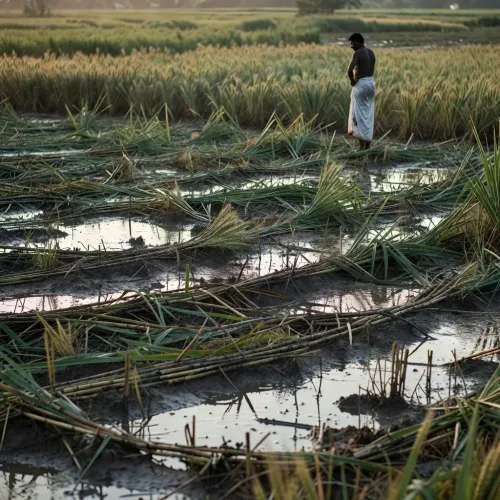
The Yogi Adityanath-led Uttar Pradesh government on Friday, 6 November 2026, announced a sweeping revision of its disaster relief compensation framework, doubling the financial assistance for deaths caused by natural calamities to ₹8 lakh and raising crop loss compensation by 25–30 per cent. The move is expected to benefit more than 10 lakh farmers across the state, according to government estimates.
Key Changes in Compensation Rates
Under the revised package, families who lose a member to a natural disaster will now receive ₹8 lakh in financial assistance, up from the earlier ₹4 lakh — a full doubling of the death relief amount. The crop damage compensation has been raised by approximately 25–30 per cent, bringing meaningful relief to cultivators hit by floods, storms, or other calamities. All payouts will be transferred directly into beneficiaries' bank accounts via Direct Benefit Transfer (DBT), and the list of eligible recipients along with eligibility criteria must be made public to ensure transparency.
Livestock and Property Relief Also Revised
The revised rates extend beyond crops and human losses. Compensation for the death of large livestock — such as cattle — has been raised from ₹40,000 to ₹50,000. For horses and mules, the assistance has gone up from ₹20,000 to ₹25,400. Smaller livestock including goats and sheep now attract a payout of ₹5,500 per head, compared with the earlier ₹4,000. On the housing front, the state has fixed assistance at ₹1.85 lakh for a fully damaged house in plain areas, ₹2.06 lakh for a fully damaged house in hilly areas, and ₹93,000 for a partially damaged house in plain areas. New standards for repair assistance covering schools, roads, and hospitals have also been established.
Assessment Process Under Way
The Relief Commissioner has directed all District Magistrates (DMs) to submit damage reports for the period between 1 April and 4 November 2026. The collation of district-level data is expected to precede the actual disbursal of the enhanced relief amounts. This comes amid a broader push by the state administration to streamline post-disaster support and reduce the gap between assessed damage and actual payouts — a persistent criticism in earlier relief cycles.
Why This Matters for Farmers and Families
Uttar Pradesh is among India's most agriculturally significant states, with millions of smallholder farmers vulnerable to weather-related crop failures every season. Critics and farmer groups have long argued that earlier relief rates failed to cover even a fraction of actual losses. Notably, the previous death compensation of ₹4 lakh had remained unchanged for several years, making the revised ₹8 lakh figure a significant, if overdue, correction. The state government's decision to mandate public disclosure of beneficiary lists is also seen as a step toward reducing diversion of relief funds — a problem that has dogged past disbursement exercises in the state.
What Happens Next
Once district damage reports are compiled, the DBT transfers are expected to be initiated in tranches. The government has not specified a timeline for completing disbursements, but the directive to DMs suggests the process is already in motion. Farmer organisations are likely to monitor whether the revised rates translate into actual payouts, given past instances of delays in UP's disaster relief pipeline.
Point of View
But the harder test will be execution. UP's disaster relief system has historically struggled with delays, under-reporting of damage at district level, and leakage in beneficiary identification — none of which a rate revision alone can fix. The mandate to make beneficiary lists public is the more structurally important reform in this package, yet it comes without an enforcement or audit mechanism. With more than 10 lakh farmers in the queue and district-level damage assessments still pending, the gap between announced rates and actual payouts will be the real measure of this policy's impact. The doubling of death compensation to ₹8 lakh is overdue, but it also underscores how inadequate the ₹4 lakh floor had become given inflation and the scale of losses families typically face.
NationPress
6 Nov 2026
Frequently Asked Questions
How much compensation will UP families receive for deaths due to natural disasters?
Families who lose a member to a natural disaster in Uttar Pradesh will now receive ₹8 lakh in financial assistance, doubled from the earlier ₹4 lakh . The revised rate was announced by the Yogi Adityanath government on 6 November 2026.
By how much has UP increased crop loss compensation for farmers?
The Uttar Pradesh government has raised crop damage compensation by approximately 25–30 per cent under the revised disaster relief package. More than 10 lakh farmers are expected to benefit, with payouts made directly via DBT.
What are the new livestock compensation rates in UP after the revision?
For large livestock like cattle, compensation has risen from ₹40,000 to ₹50,000 . Horses and mules now attract ₹25,400 (up from ₹20,000), while small livestock including goats and sheep will receive ₹5,500 per head, up from ₹4,000.
What housing assistance is available under UP's revised disaster relief package?
The state has fixed housing assistance at ₹1.85 lakh for a fully damaged house in plain areas and ₹2.06 lakh in hilly areas. Partially damaged houses in plain areas attract ₹93,000 . New standards for repair of schools, roads, and hospitals have also been set.
How will the UP government disburse disaster relief to beneficiaries?
All financial assistance under the revised package will be transferred directly into beneficiaries' bank accounts via Direct Benefit Transfer (DBT) . The state has also mandated that beneficiary lists and eligibility criteria be made public to ensure transparency.