UP Launches GPS Sugarcane Survey May 1: Key Details for Farmers
Synopsis
Uttar Pradesh is rolling out a GPS-based sugarcane crop survey from May 1 to June 30, 2025 — a first-of-its-kind real-time data upload exercise covering 45 lakh farmers. Only those registered by September 30 can supply cane, making this survey a make-or-break moment for millions of UP farmers.
Key Takeaways
GPS-based sugarcane survey in Uttar Pradesh runs from May 1 to June 30, 2025 under the Sugarcane Survey Policy 2026-27.
Survey teams include one government sugarcane supervisor and one sugar mill employee , both trained before deployment.
Farmers will receive SMS alerts three days in advance ; their physical presence during the survey is mandatory.
Only farmers registered by September 30, 2025 will be eligible to supply sugarcane to mills this season.
Yield enhancement application fees: Rs 10 (SC/ST), Rs 100 (small farmers), Rs 200 (others) — accepted until September 30.
Survey data is cross-verifiable via the Revenue Department portal upbhulekh.gov.in ; mills must also publish data on their own websites.
Lucknow, April 24: The Uttar Pradesh government is launching a comprehensive GPS-based sugarcane crop survey across the state from May 1 to June 30, 2025, under its Sugarcane Survey Policy 2026-27. The two-month exercise, overseen by the Sugarcane Development and Sugar Industry Department, aims to generate accurate cultivation estimates, ensure transparency, and directly address farmers' long-standing concerns about data integrity in the sugarcane sector.
What the Survey Entails
The GPS survey will deploy two-member teams, each comprising one government sugarcane supervisor and one sugar mill employee, both of whom will be trained before the exercise begins. The physical presence of the farmer at the time of the survey will be mandatory — a step designed to eliminate discrepancies and prevent data manipulation.
Using GPS technology, the team will visit each farmer's field and directly upload production data — including field area, sugarcane variety, and crop details — to the department's central server in real time. Farmers will be notified via SMS at least three days in advance of their scheduled survey visit.
After the survey, all collected data — including field dimensions and crop variety — will be shared with farmers via SMS, ensuring ground-level transparency that has historically been lacking in manual surveys.
Farmer Registration and Eligibility
Registration of new sugarcane farmers will be conducted during the survey window itself. Critically, only farmers registered by September 30 will be eligible to supply sugarcane to mills — making timely participation essential for livelihood security.
Applications for yield enhancement will be accepted from the start of the survey through September 30. Fee structures have been tiered: Rs 10 per farmer for Scheduled Caste and Scheduled Tribe farmers, Rs 100 for small farmers, and Rs 200 for other farmers.
What the Government Said
Sugarcane Development and Sugar Industry Commissioner Veena Kumari Meena confirmed that farmers can verify their surveyed land data through the Revenue Department's official portal at upbhulekh.gov.in. This integration with the revenue records system adds an additional layer of accountability.
Sugar mills will be required to upload the final survey data directly to the departmental website and simultaneously display it on their own websites — a dual-disclosure mechanism intended to prevent mills from underreporting farmer acreage, a practice critics have flagged in previous years.
Why This Survey Matters
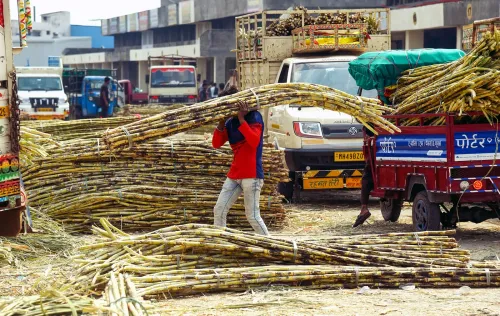
Uttar Pradesh is India's largest sugarcane-producing state, accounting for nearly 45% of the country's total sugar output. Accurate crop estimates are foundational to fair pricing, timely payments, and supply chain planning across the sugar industry. Historically, disputes between farmers and mills over crop area measurements have led to delayed payments and suppressed Fair and Remunerative Price (FRP) settlements.
This comes amid growing pressure on the Yogi Adityanath government to modernise agricultural data systems ahead of the 2027 Uttar Pradesh Assembly elections. The introduction of GPS-based, real-time data uploading marks a structural shift from paper-based surveys, which were susceptible to manipulation by mill operators and field staff alike.
The survey will also record plant cane and ratoon crop data on a yearly basis, and a consolidated summary of total sugarcane area will be prepared upon completion — data that will directly influence procurement quotas and mill-wise supply allocations for the 2026-27 crushing season.
Impact on Farmers and the Sugar Industry
For the state's estimated 45 lakh sugarcane farmers, this survey is more than a bureaucratic exercise — it determines their legal right to supply cane, access yield enhancement schemes, and claim dues from mills. The mandatory SMS notification system and farmer presence requirement are safeguards that directly empower smallholder farmers who have previously been bypassed in ground-level data collection.
Sugar mills, on the other hand, face greater scrutiny under the new framework. With data uploaded directly to government servers and cross-verifiable via revenue records, the scope for under-recording farmer plots — which previously allowed mills to manage supply and depress payments — is significantly curtailed.
With the survey window closing on June 30 and farmer registration deadline set at September 30, 2025, stakeholders across Uttar Pradesh's sugar belt — from Muzaffarnagar to Gorakhpur — should prepare for field team visits and ensure their land records are updated on the revenue portal before the deadline.
Point of View
Costing farmers billions in suppressed FRP payments. By mandating real-time GPS uploads, farmer presence, and cross-verification with revenue records, the Yogi government is raising the accountability bar — but the training quality of survey teams and the responsiveness of the grievance mechanism will determine whether this becomes a genuine reform or another well-designed policy that fails at the last mile.
NationPress
30 Sept 2026
Frequently Asked Questions
When will the UP sugarcane GPS survey start and end?
The UP sugarcane GPS survey will begin on May 1, 2025 and conclude on June 30, 2025 . It is a two-month exercise conducted under the state's Sugarcane Survey Policy 2026-27.
What is the deadline for sugarcane farmer registration in UP?
Sugarcane farmers in UP must register by September 30, 2025 to be eligible to supply cane to mills. New farmer registrations will be carried out during the GPS survey itself.
How will farmers be informed about the UP sugarcane survey visit?
Farmers will be notified via SMS at least three days before the survey team visits their field. After the survey, field details including area and crop variety will also be sent to the farmer by SMS.
What fees are charged for yield enhancement applications in the UP sugarcane survey?
Fees are tiered: Rs 10 for SC/ST farmers, Rs 100 for small farmers, and Rs 200 for other farmers. Applications are accepted from the survey start date through September 30.
How can a UP sugarcane farmer verify their survey data?
Farmers can verify their surveyed land data through the Revenue Department's portal at upbhulekh.gov.in . Sugar mills are also required to display final survey data on their own websites.