CM Yogi highlights UP farm welfare gains since 2017
Synopsis
CM Yogi Adityanath's office has outlined nine years of farm welfare in Uttar Pradesh, citing a 2017 loan waiver, over ₹3.22 lakh crore in sugarcane payments, enrolment of 3 crore farmers in PM-KISAN, and free electricity for 15 lakh tubewell operators.
Key Takeaways
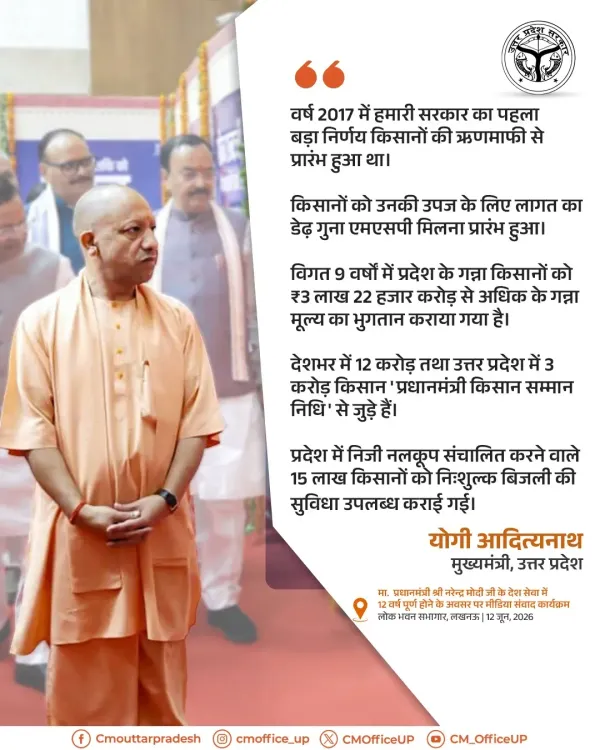
The UP government's first major decision in 2017 was a farm loan waiver, according to the Chief Minister's Office.
Sugarcane farmers in UP have received cane-price payments of more than ₹3 lakh 22 thousand crore over the past nine years .
3 crore farmers in Uttar Pradesh are enrolled in the Pradhan Mantri Kisan Samman Nidhi scheme, out of 12 crore nationally.
Farmers began receiving an MSP of 1.5 times the cost of production after the 2017 government took office.
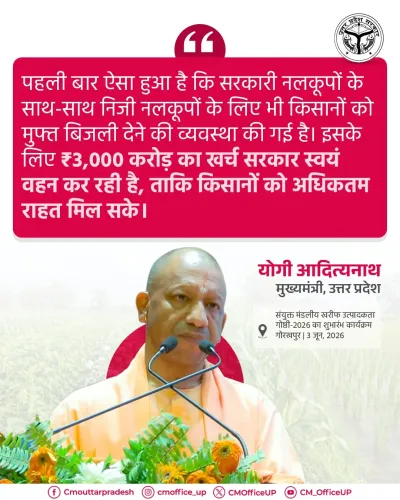
15 lakh farmers operating private tubewells in UP have been given free electricity for irrigation.
The Chief Minister's Office of Uttar Pradesh, citing Chief Minister Yogi Adityanath, on Friday, June 12, 2026, outlined a series of farm-sector measures undertaken since 2017, ranging from a debt waiver and enhanced minimum support prices to cane-payment clearances and free electricity for tubewell operators across the state.
Context
The post states that the government's first major decision in 2017 was a farm loan waiver, after which farmers began receiving an MSP of डेढ़ गुना लागत (one-and-a-half times the cost of production) for their crops. The MSP revision aligns with the central government's adoption of the Swaminathan Commission recommendation, which was implemented from the 2018-19 crop season for major crops. These two early moves — debt relief and better price support — are presented as the foundation of the state's agrarian policy over the past nine years.Policy Backdrop
Uttar Pradesh is India's largest sugarcane-producing state, and timely cane-price payments have long been a politically sensitive issue in its western and eastern belts. The post claims that sugarcane farmers in the state have received cane-price payments of more than ₹3 lakh 22 thousand crore over the past nine years. Separately, the post notes that 12 crore farmers nationally and 3 crore farmers in Uttar Pradesh are enrolled in the Pradhan Mantri Kisan Samman Nidhi (PM-KISAN) scheme, the central direct-benefit-transfer programme that provides ₹6,000 annually to eligible landholding farm families. The convergence of state-level interventions with national schemes such as PM-KISAN reflects a broader pattern in which the state has tried to layer multiple support channels for the same beneficiary base.Stakeholders and Impact
Three distinct groups are highlighted in the post. Sugarcane farmers, who depend on state-directed cane prices and mill payments, are the largest cohort by payment volume. PM-KISAN enrollees — 3 crore in UP alone — represent a wide cross-section of small and marginal landholders. The third group consists of 15 lakh farmers who operate private tubewells and have been provided free electricity for irrigation, directly reducing input costs for those relying on groundwater. Together, these measures address three distinct pressure points in farm economics: credit burden, price realisation, and input costs.What's Next
Attention will now turn to the state's upcoming budget presentations and whether the free-power scheme will be extended to a larger pool of irrigation users. Parliamentary discussions on legally guaranteeing the MSP floor price remain a live national debate, and any movement there would have direct implications for the framework CM Yogi has described. Progress on clearing any residual sugarcane arrears from mills will also be a key indicator of whether the payment momentum cited in the post is sustained.Point of View
Timed likely to reinforce the government's agrarian credentials ahead of a political or budgetary cycle. By anchoring the narrative to 2017 — the year the current government took office — the communication draws a direct line between electoral mandate and policy delivery. The emphasis on sugarcane payments is telling: cane arrears have historically been the sharpest flashpoint in UP's farm politics, and citing a cumulative ₹3.22 lakh crore figure is a direct counter to that vulnerability. Layering state initiatives onto the central PM-KISAN scheme also signals a deliberate strategy of co-branding with national welfare architecture.
NationPress
26 Oct 2026
Frequently Asked Questions
What was the UP government's first major decision in 2017?
According to the Chief Minister's Office, the first major decision of the UP government in 2017 was a farm loan waiver aimed at relieving agricultural debt.
How much have UP sugarcane farmers been paid in the last 9 years?
The Chief Minister's Office states that sugarcane farmers in Uttar Pradesh have received cane-price payments of more than ₹3 lakh 22 thousand crore over the past nine years.
How many UP farmers are enrolled in PM-KISAN?
According to the post, 3 crore farmers in Uttar Pradesh are enrolled in the Pradhan Mantri Kisan Samman Nidhi scheme, which provides ₹6,000 annually to eligible farm families.
What is the MSP benefit mentioned by CM Yogi for UP farmers?
The post states that farmers have been receiving an MSP equal to one-and-a-half times their cost of production, consistent with the Swaminathan Commission recommendation adopted by the central government from 2018-19.
Which UP farmers are getting free electricity?
The Chief Minister's Office says 15 lakh farmers in Uttar Pradesh who operate private tubewells have been provided free electricity to support irrigation.