CM Yogi Extends Free Power to Private Tubewells for UP Farmers
Synopsis
The Chief Minister's Office of Uttar Pradesh announced that CM Yogi Adityanath has, for the first time, extended free electricity to private tubewells alongside government ones, with the state bearing a ₹3,000 crore cost to deliver maximum relief to farmers.
Key Takeaways
Free electricity now extended to private tubewells in addition to government tubewells in Uttar Pradesh.
The state government will bear an estimated ₹3,000 crore cost for the subsidy.
Announcement attributed to Chief Minister Yogi Adityanath on 3 June 2026 .
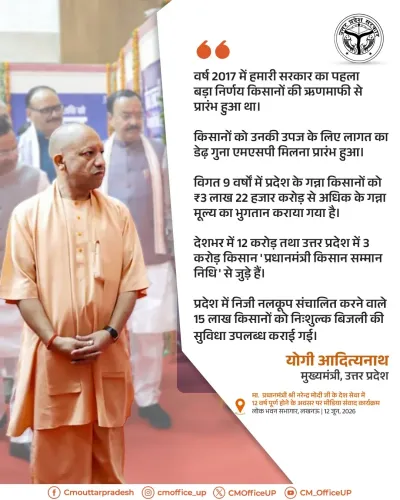
Builds on UP's 2017 decision to provide free power to government tubewells.
Implementation details and tariff orders from the state regulator are awaited.
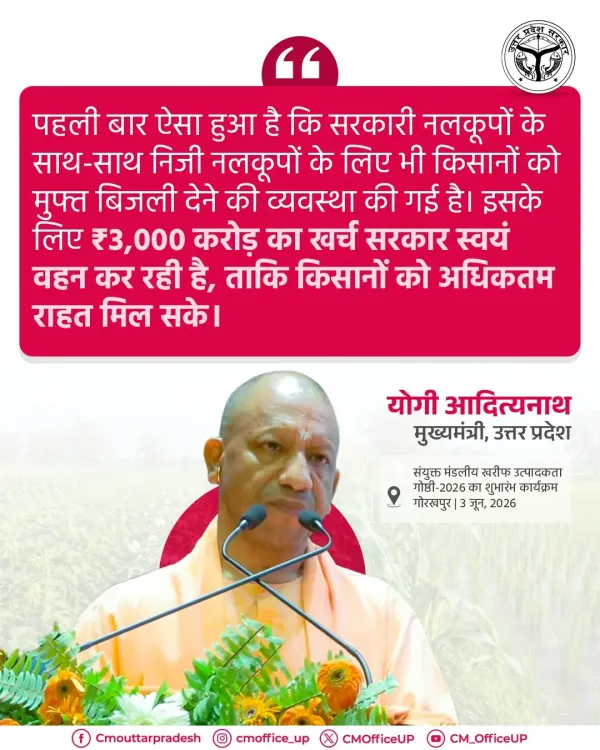
The Chief Minister's Office of Uttar Pradesh on 3 June 2026 announced that the state government has, for the first time, extended free electricity to private tubewells used by farmers, in addition to the existing free-power facility for government tubewells. The announcement, attributed to Chief Minister Yogi Adityanath, said the state exchequer will bear an estimated ₹3,000 crore in costs to deliver the subsidy.
In the post, the Chief Minister said, 'For the first time, arrangements have been made to provide free electricity to farmers for private tubewells along with government tubewells,' adding that the government itself is bearing the ₹3,000 crore expense 'so that farmers receive maximum relief.' The original Hindi phrasing — 'किसानों को अधिकतम राहत मिल सके' (so that farmers get maximum relief) — frames the measure as a direct income-support intervention.
Context
Irrigation power is one of the largest recurring input costs for cultivators in Uttar Pradesh, a state where groundwater extraction through tubewells drives a substantial share of kharif and rabi acreage. Until now, the state's free-power facility was largely confined to government-owned tubewells, while private operators paid metered or flat-rate agricultural tariffs.
By absorbing the tariff burden for privately owned pumpsets as well, the government is effectively universalising irrigation power subsidy across ownership categories. The announcement does not specify a connection-load ceiling or eligibility cut-off; those operational contours are expected to be detailed in subsequent orders.
Policy backdrop
The move builds on a trajectory that began in 2017, when the Yogi Adityanath administration first announced free electricity for government tubewells to lower irrigation costs. Successive state budgets have steadily expanded power-sector support for agriculture, including loan waivers, solar pump distribution and tariff rationalisation.
Extending the benefit to private tubewells marks a structural shift — from subsidising a state-owned asset class to underwriting consumption by individual farmers regardless of pump ownership. It also aligns Uttar Pradesh with a broader pattern across groundwater-dependent states, where governments have progressively socialised agricultural power costs through state-funded transfers to distribution companies.
Stakeholders and impact
The primary beneficiaries are farmers operating private borewells, particularly small and marginal cultivators in western and central Uttar Pradesh where tubewell irrigation dominates. Free power for private pumps can compress per-acre input costs and may shift cropping choices toward water-intensive cycles unless paired with metering or extraction norms.
For the state's power distribution companies (discoms), the measure shifts collection risk from farm consumers to the state treasury, since the ₹3,000 crore outlay is to be borne by the government itself. Cleaner subsidy accounting could, in principle, improve discom cash flows, provided the reimbursements arrive on schedule.
Independent power regulators and groundwater authorities will watch the rollout closely. Universal free agricultural power has historically been linked to higher groundwater drawdown in other states, an externality that may require parallel conservation measures.
What's next
Attention now turns to the implementing notification, tariff order and the appropriations through which the ₹3,000 crore will be routed to discoms. Subsequent guidance from the state's electricity regulator will determine billing mechanics, sanctioned loads and verification protocols for private connections.
If executed at the announced scale, the scheme would represent one of the largest single-year agricultural power subsidies committed by the state, and could set a template for further consolidation of farm-input support under direct state financing.
Point of View
Moving subsidy from asset class to end-user. By placing the ₹3,000 crore bill on the state treasury rather than discoms, the government is attempting cleaner subsidy accounting while delivering a politically resonant relief measure. The arc — from 2017's government-tubewell scheme to today's universalisation — fits a wider pan-India pattern of socialising agricultural power costs. The sustainability question is fiscal and ecological: whether annual outlays can be ring-fenced, and whether universal free power will accelerate groundwater stress without parallel conservation rules.
NationPress
20 Sept 2026
Frequently Asked Questions
What did the UP government announce about free electricity for tubewells?
The Uttar Pradesh government announced that, for the first time, free electricity will be provided for private tubewells in addition to government tubewells. The state will bear an estimated ₹3,000 crore cost itself.
How much will UP spend on the tubewell power subsidy?
The state government has said it will bear ₹3,000 crore in costs for the scheme. The amount is to be borne directly by the government to maximise relief to farmers.
Who is eligible for free electricity under the UP tubewell scheme?
Farmers operating both government and private tubewells in Uttar Pradesh are covered under the expanded arrangement. Detailed eligibility, load limits and connection criteria are expected in subsequent implementation orders.
When was free power for government tubewells first introduced in UP?
Free electricity for government tubewells was first announced by the Yogi Adityanath government in 2017. The current measure extends the same benefit to privately owned tubewells.
How will the subsidy affect UP power distribution companies?
The state has said it will itself bear the ₹3,000 crore cost, effectively transferring collection risk from farm consumers to the treasury. Discom cash flows could improve if state reimbursements are timely.