Hyderabad Liberation Day 2026: VP Radhakrishnan honours Operation Polo, Sardar Patel's legacy
Synopsis
Seventy-eight years after Operation Polo ended Hyderabad's standoff with the Indian Union, Vice President C. P. Radhakrishnan used the Liberation Day stage to draw a direct line from Sardar Patel's unifying statecraft to PM Modi's Viksit Bharat 2047 vision — a pointed political framing that signals how the Centre reads this anniversary.
Key Takeaways
Radhakrishnan addressed the 79th Hyderabad Liberation Day celebrations at Parade Ground, Secunderabad on 17 September 2026 .
He called 17 September 1948 the conclusion of a decisive chapter, marking Hyderabad's integration via Operation Polo .
He paid tribute to Sardar Vallabhbhai Patel , crediting him as the architect of princely-state unification alongside Gandhi and Bose.
He honoured people's movement heroes Ramji Gond , Turrebaz Khan and Komaram Bheem , among others.
He acknowledged the Central Armed Police Forces' role in the 1947–48 integration and in combating Left-Wing Extremism in Telangana , Chhattisgarh and Jharkhand .
Senior Union ministers and Telangana Governor Shiv Pratap Shukla were present at the event.
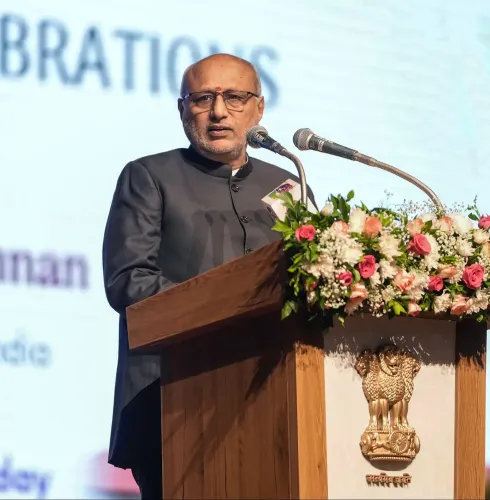
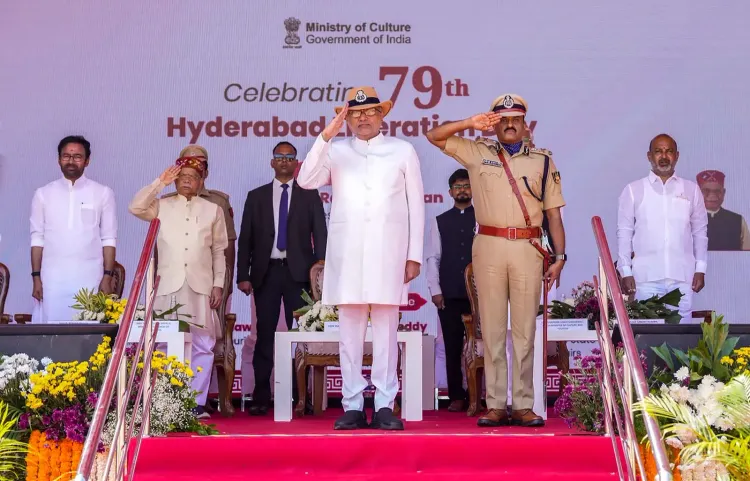
Vice President C. P. Radhakrishnan on Thursday, 17 September declared that 17 September 1948 marked the conclusion of a decisive chapter in India's post-independence history — the integration of the erstwhile Hyderabad State into the Indian Union through Operation Polo. He was addressing the 79th Hyderabad Liberation Day celebrations at Parade Ground, Secunderabad.
A Reminder of Nation-Building, Not Just History
Radhakrishnan stressed that Hyderabad Liberation Day is not merely a commemoration of a historic date but a living reminder of the values that continue to bind Bharat together. He described the story of Hyderabad as one of statesmanship, courage and sacrifice, followed by the larger and continuing task of building a constitutional democracy in which every citizen has an equal place.
The Vice President noted that the integration process reflected the enormous challenges faced by a young nation in unifying people who had emerged from vastly different political circumstances.
Tribute to Sardar Patel and the Freedom Struggle
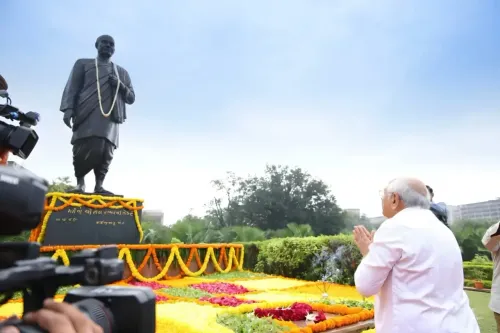
Paying tribute to Sardar Vallabhbhai Patel, Radhakrishnan said that as India's first Home Minister and Minister for States, Patel bore an extraordinary responsibility at a time when the country was simultaneously recovering from Partition and consolidating hundreds of princely states into one Union. He placed Patel alongside Mahatma Gandhi and Netaji Subhash Chandra Bose as pivotal architects of modern India — Gandhi and Bose in winning freedom, and Patel in forging unity from fragmentation.
Radhakrishnan also said that Prime Minister Narendra Modi is playing a pivotal role in the making of a developed India by 2047.
Honouring Ordinary Patriots
The Vice President paid homage to the people's movement behind the Hyderabad struggle, noting that students, intellectuals, writers, social workers, political activists, farmers and ordinary citizens participated and endured imprisonment, violence and immense personal hardship. He specifically honoured patriots including Ramji Gond, Turrebaz Khan and Komaram Bheem, among many others.
'Political integration can bring territories together; constitutional democracy brings citizens together,' he said, adding that national unity must be strengthened through equal rights, equal dignity and equal opportunity — not geography alone.
Diversity Within Unity
Radhakrishnan underlined that Bharat's unity does not require every citizen to be identical. Indians may speak different languages, follow different traditions, worship differently and hold different political opinions, yet remain bound together by the Constitution and the principle that sovereignty ultimately belongs to the people.
Role of Security Forces and Key Attendees
Acknowledging the Central Armed Police Forces, the Vice President noted their contribution to the integration of princely states in 1947–48 and their continued role in combating Left-Wing Extremism in Telangana, Chhattisgarh, Jharkhand and other affected regions. He inspected the parade, witnessed a March Past and cultural performances, laid a wreath at the War Memorial, and visited an exhibition by the Central Bureau of Communication under the Ministry of Information and Broadcasting.
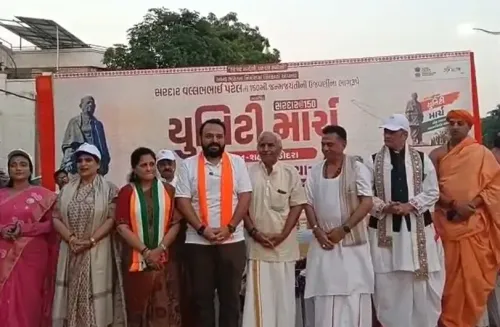
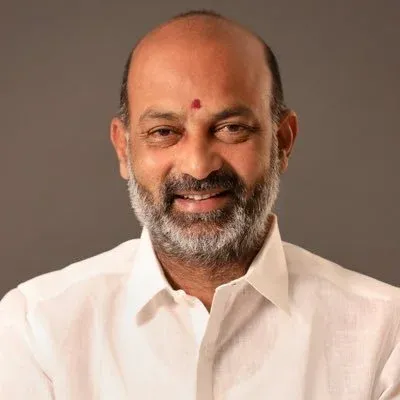
Also present were Telangana Governor Shiv Pratap Shukla, Union Minister for Culture and Tourism Gajendra Singh Shekhawat, Union Minister for Coal and Mines G. Kishan Reddy, Union Minister of State for Home Affairs Bandi Sanjay Kumar, and Malkajgiri MP Etela Rajender. As India marks 78 years since the integration, the occasion continues to carry political resonance across Telangana and beyond.
Point of View
Multiple Union ministers, the state Governor — underscores how politically charged this anniversary remains, particularly in Telangana where rival narratives around 1948 continue to contest the official framing. Radhakrishnan's explicit linkage of Sardar Patel's legacy to PM Modi's Viksit Bharat 2047 goal is less a historical observation than a campaign in continuity — threading the BJP's integrationist nationalism from post-independence consolidation to present-day development politics. Notably, no mention was made of state-level leadership or the ruling government in Telangana, a silence that itself speaks to the contested ownership of this day. Whether the Liberation Day narrative can accommodate all claimants — from the Telugu people's movement to the Hyderabadi Muslim community — remains the unresolved tension beneath the pageantry.
NationPress
17 Sept 2026
Frequently Asked Questions
What is Hyderabad Liberation Day and why is it observed on September 17?
Hyderabad Liberation Day, observed on 17 September, marks the day in 1948 when Indian forces completed Operation Polo and the Nizam of Hyderabad acceded to the Indian Union, ending the princely state's post-independence standoff. The date is particularly significant in Telangana, where it is observed as a state holiday.
What did Vice President C. P. Radhakrishnan say at the 2026 celebrations?
Radhakrishnan called 17 September 1948 the conclusion of a decisive chapter in independent India's history and stressed that Hyderabad Liberation Day is a reminder of nation-building values. He paid tribute to Sardar Patel, honoured grassroots patriots like Ramji Gond, Turrebaz Khan and Komaram Bheem, and linked the integration legacy to PM Modi's Viksit Bharat 2047 vision.
What was Operation Polo?
Operation Polo was the Indian Army's military action in September 1948 that led to the Nizam of Hyderabad's surrender and the integration of the Hyderabad State into the Indian Union. It lasted approximately five days and was directed by Sardar Vallabhbhai Patel as Home Minister.
Who else attended the 79th Hyderabad Liberation Day event at Secunderabad?
Senior dignitaries present included Telangana Governor Shiv Pratap Shukla, Union Minister for Culture and Tourism Gajendra Singh Shekhawat, Union Minister for Coal and Mines G. Kishan Reddy, Union Minister of State for Home Affairs Bandi Sanjay Kumar, and Malkajgiri MP Etela Rajender.
Why did the VP highlight the Central Armed Police Forces at the event?
Radhakrishnan acknowledged the Central Armed Police Forces for their dual historical and contemporary role — their contribution to integrating princely states in 1947–48, and their ongoing operations against Left-Wing Extremism in Telangana, Chhattisgarh, Jharkhand and other affected states.