Waheeda Rahman Reveals Shocking Bathroom Secret from Mughal-e-Azam Set
Synopsis
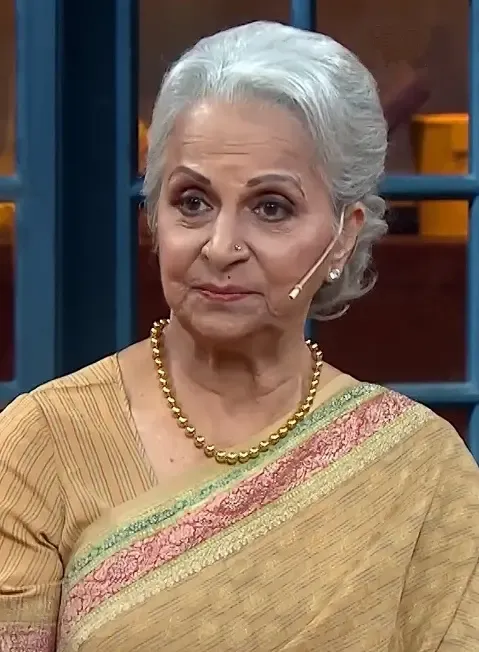
Legendary actress Waheeda Rahman stunned audiences on The Kapil Sharma Show by revealing that Mohan Studios had zero washrooms during the shoot of the iconic Mughal-e-Azam. When she and late actor Mehmood funded a bathroom themselves, the studio delivered a thunder box in a corridor — forcing cast members to stop drinking water entirely.
Key Takeaways
Waheeda Rahman revealed on The Kapil Sharma Show that Mohan Studios had no washrooms during the filming of Mughal-e-Azam .
Waheeda Rahman and the late actor Mehmood personally contributed money to request a bathroom be built at the studio.
After 10 days , the studio management provided only a thunder box placed in an open corridor as the promised bathroom.
To cope with the lack of facilities, cast members including Waheeda Rahman resorted to stopping water consumption entirely during shoots.
Mughal-e-Azam ( 1960 ), directed by K.
Asif , starred Prithviraj Kapoor , Dilip Kumar , and Madhubala and remains one of Indian cinema's greatest films.
Waheeda Rahman debuted in 1955 and was honored with the Dadasaheb Phalke Award in 2021 , India's highest cinematic recognition.
Veteran actress Waheeda Rahman recently disclosed a startling behind-the-scenes story from the making of K. Asif's legendary historical epic Mughal-e-Azam, revealing the primitive working conditions that cast and crew endured during one of Indian cinema's most celebrated productions. Appearing on The Kapil Sharma Show, the iconic actress recounted how the absence of basic sanitation facilities at Mohan Studios forced actors to take drastic measures — including completely stopping their water intake.
No Washrooms at Mohan Studios During Mughal-e-Azam Shoot
Waheeda Rahman revealed that Mohan Studios, where the monumental film was shot, did not have even a single washroom available for the cast. This was particularly shocking given the grand scale of the production, which featured elaborate sets, lavish costumes, and hundreds of crew members working simultaneously.
Determined to resolve the issue, Waheeda Rahman and the late comedian-actor Mehmood pooled their own money and approached the studio management, requesting that a proper bathroom be constructed before the next schedule began.
What the Studio Owners Did Instead
When the two actors returned after 10 days, they eagerly asked the studio manager whether the bathroom had been built. The manager confirmed that arrangements had indeed been made — but what they discovered left them speechless.
In her own words, Waheeda Rahman said: "There was not even a single washroom in Mohan Studios, where a film like 'Mughal-e-Azam' was shot. So, me and late Mehmood decided that we would give the money to the studio owners and ask them to make a bathroom. So, we discussed the issue with them and left. When we came back for the next schedule after 10 days, we asked the manager if the bathroom was ready. He said, yes, we have made arrangements."
The so-called arrangement turned out to be a thunder box — a rudimentary portable commode — placed in an open corridor. Far from the enclosed, functional bathroom they had envisioned, this makeshift solution was both inadequate and undignified.
Actors Stopped Drinking Water to Cope
When host Kapil Sharma expressed disbelief at the difficult working conditions of that era, Waheeda Rahman candidly admitted the extreme step the cast had to take: "We had stopped drinking water."
This revelation underscores just how challenging film production was in 1950s and 1960s India, even on projects of enormous prestige and budget. The lack of basic amenities contrasted starkly with the grandeur being captured on screen — a telling irony of the golden age of Hindi cinema.
About the Film: Mughal-e-Azam's Legendary Legacy
Mughal-e-Azam, released in 1960, remains one of the most iconic films in Indian cinematic history. Directed by K. Asif, the film starred Prithviraj Kapoor as Emperor Akbar, Dilip Kumar as Prince Salim, and the incomparable Madhubala as Anarkali.
The film dramatized the forbidden love story between Mughal Prince Salim and Anarkali, a court dancer, and the fierce disapproval of Emperor Akbar that ultimately led to a dramatic father-son confrontation. The film took nearly 16 years to complete and was one of the most expensive Indian productions of its time, making these revelations about its primitive shooting conditions all the more astonishing.
Notably, the film was re-released in color in 2004, introducing it to a new generation of audiences, and it continues to be studied and celebrated as a milestone of Indian cinema.
Waheeda Rahman: A Timeless Icon of Indian Cinema
Waheeda Rahman made her acting debut with the Telugu film Rojulu Marayi in 1955 and quickly rose to national prominence through a series of critically acclaimed Hindi films. Her collaborations with director Guru Dutt in particular — including Pyaasa (1957) and Kaagaz Ke Phool (1959) — are considered masterpieces of world cinema.
She went on to deliver celebrated performances in Chaudhvin Ka Chand (1960) and Sahib Bibi Aur Ghulam (1962), cementing her status as one of the finest actresses of her generation. She was honoured with the prestigious Padma Bhushan in 1976 and the Dadasaheb Phalke Award in 2021, recognizing her extraordinary contribution to Indian cinema.
As Waheeda Rahman continues to make rare public appearances and share memories from cinema's golden era, her anecdotes serve as invaluable oral history — reminding audiences that the magic of the silver screen was often built on remarkable personal sacrifice and resilience.
Point of View
Stories like these demand a more honest reckoning with the exploitation that often underpinned its glamour. Today, as the industry debates pay parity and working conditions, Waheeda Rahman's words serve as a grounding historical benchmark.
NationPress
19 Sept 2026
Frequently Asked Questions
What anecdote did Waheeda Rahman share about Mughal-e-Azam?
Waheeda Rahman revealed on The Kapil Sharma Show that Mohan Studios, where Mughal-e-Azam was filmed, had no washrooms. She and late actor Mehmood contributed their own money to have one built, only to find a thunder box placed in an open corridor upon their return.
Where was Mughal-e-Azam filmed and what were the conditions like?
Mughal-e-Azam was primarily filmed at Mohan Studios in Mumbai. Despite being one of the most expensive and elaborate productions of its era, the studio lacked basic sanitation facilities, forcing cast members to stop drinking water during shoots.
Who were the main stars of Mughal-e-Azam?
Mughal-e-Azam (1960), directed by K. Asif, starred Prithviraj Kapoor as Emperor Akbar, Dilip Kumar as Prince Salim, and Madhubala as Anarkali. The film depicted the tragic love story between Prince Salim and the court dancer Anarkali.
What awards has Waheeda Rahman received for her contribution to Indian cinema?
Waheeda Rahman was awarded the Padma Bhushan in 1976 and received the Dadasaheb Phalke Award — Indian cinema's highest honour — in 2021. She is celebrated for iconic films including Pyaasa, Kaagaz Ke Phool, and Sahib Bibi Aur Ghulam.
When did Waheeda Rahman make her acting debut?
Waheeda Rahman made her acting debut in 1955 with the Telugu film Rojulu Marayi. She rose to national fame through her collaborations with director Guru Dutt in landmark Hindi films of the late 1950s and early 1960s.