How Are World Leaders Addressing Global Trade Challenges?
Synopsis
World leaders convened at the APEC summit in Gyeongju to tackle global trade uncertainties. South Korean President Lee Jae Myung urged for collaboration among member economies. This summit is crucial for shaping the future of the Asia-Pacific region amidst evolving trade dynamics.
Key Takeaways
Leaders convened at APEC to address global trade challenges.
Cooperation and solidarity emphasized by South Korean President.
Focus on maintaining free trade and regional integration.
China proposed strategies for an inclusive Asia-Pacific economy.
Consensus needed for a joint declaration on trade issues.
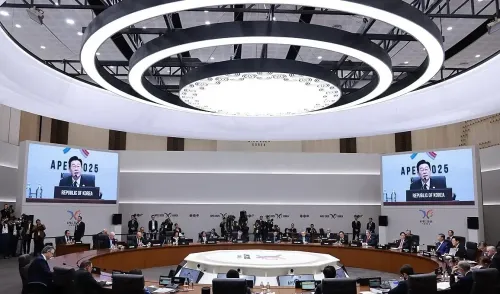
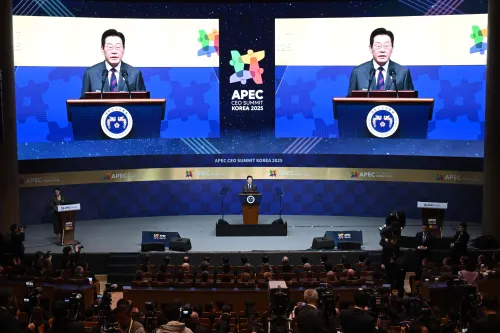
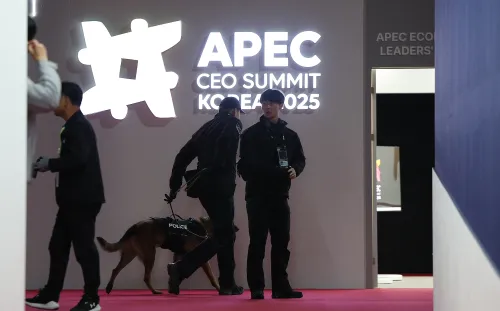
Gyeongju, Oct 31 (NationPress) Leaders from around the globe convened at the Asia-Pacific Economic Cooperation (APEC) summit on Friday, aiming to enhance resilience and stimulate growth amidst uncertain global trade dynamics. South Korean President Lee Jae Myung emphasized the necessity for collaboration and unity among APEC nations.
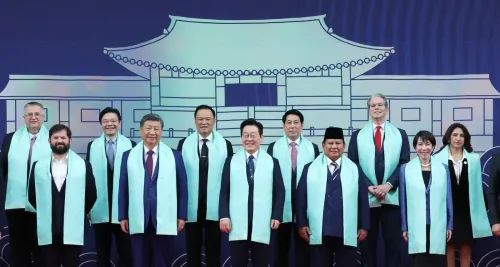
This two-day summit has united the heads of 21 APEC member economies, alongside guest countries and representatives from international organizations. Key discussions revolve around maintaining free trade and enhancing regional economic integration.
During the initial session themed “Towards a More Connected, Resilient Region and Beyond,” President Lee highlighted the significance of this APEC meeting in light of the changing landscape of free trade and escalating global economic volatility.
“Collaboration and unity is the most reliable pathway to a brighter future,” Lee stated in his opening remarks. “We are at a pivotal moment as the global order experiences swift transformation.”
President Xi Jinping of China addressed the assembly, proposing five strategies for creating an inclusive and open Asia-Pacific economy for all, as per the information shared by the Chinese foreign ministry.
He urged collective efforts to uphold the multilateral trading framework centered around the World Trade Organization (WTO), foster an open economic climate in the region, and ensure the stability and seamless operation of industrial and supply chains.
Notably, Friday's discussions proceeded without the presence of U.S. President Donald Trump, who had departed the previous day after engaging in a business forum and holding discussions with Lee and Xi.
The summit saw the participation of leaders from the 21 member economies, including Japanese Prime Minister Sanae Takaichi, along with representatives from various international organizations.
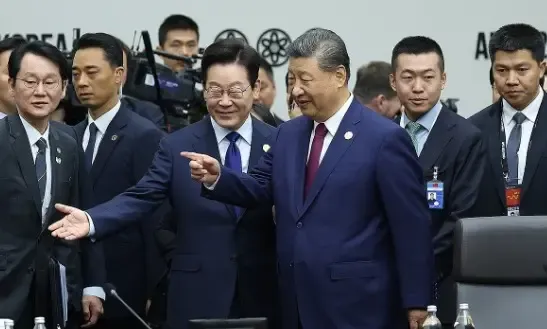
Prior to the session, Lee welcomed his visiting counterparts and participating guests, including President Xi Jinping, with whom he had a brief exchange upon entering the summit hall. This meeting marks the first interaction between the two leaders since Lee assumed office in June.
The presidential office indicated that the leaders intend to discuss strategies to render the Asia-Pacific region “more open, dynamic, and resilient” during the session.
“President Lee is set to act as a bridge among leaders to foster consensus on the need for tighter cooperation. Our goal is to revive the region's commitment to collaboration and explore tangible measures for APEC to maintain its status as the region's primary economic forum and relevant platform for the future,” the statement read.
As the host of this year’s APEC events, South Korea aspires to achieve a consensus outcome endorsed by all APEC participants in the anticipated “Gyeongju Declaration”, while also highlighting its own initiatives concerning AI and demographic shifts, according to Yonhap news agency.
Throughout the two sessions, the leaders will evaluate proposals made by high-ranking foreign and trade officials from APEC members regarding strategies to enhance prosperity in the Asia-Pacific region, focusing on strengthening cooperation in supply chains and digital transitions.
The attention will be on whether and how effectively the leaders can converge on a shared direction for international trade, given their differing perspectives on the global free trade framework supported by multilateralism and the WTO system.
In recent years, the majority of APEC economies have endorsed free trade grounded in the WTO system, reaffirming their dedication to multilateralism.
Between 2021 and 2024, every APEC summit declaration included the phrase: a rules-based multilateral trading system with the WTO “at its core,” which first appeared in the 2021 declaration following the conclusion of Trump’s first term.
A leaders' declaration can only be adopted with unanimous support from all APEC members.
After Thursday's final APEC ministerial meeting, South Korean Foreign Minister Cho Hyun remarked that the forum is “very close” to finalizing a joint declaration, with last-minute negotiations ongoing regarding the ministerial statement to be presented to the leaders' session.
“We anticipate the ministerial document to be approved by Saturday, coinciding with the leaders' retreat,” Cho indicated.
Trade Minister Yeo Han-koo, who co-led the ministers' session with Cho, noted a broad consensus has been achieved regarding supply chains, digital, and environmental sectors, which he termed “the core of today’s trade agenda and the foundation of the future economy.”
“We will continue to uphold the multilateral framework based on the WTO; however, as the WTO system faces challenges, we also support plurilateral cooperation,” he stated.
Plurilateralism refers to the concept of international collaboration among a smaller group of nations, contrasting with multilateralism.
Point of View
The APEC summit represents a pivotal opportunity for South Korea to lead discussions on global trade challenges. The emphasis on collaboration and resilience aligns with the nation’s commitment to fostering economic stability and growth in the Asia-Pacific region. It’s essential for member economies to unite in facing uncertainties and ensuring a prosperous future.
NationPress
3 Oct 2026
Frequently Asked Questions
What is the main purpose of the APEC summit?
The APEC summit aims to foster economic cooperation among member economies, addressing global trade uncertainties and enhancing regional resilience.
Who are the key leaders participating in the summit?
The summit gathers leaders from 21 APEC member economies, including South Korean President Lee Jae Myung and Chinese President Xi Jinping.
What initiatives is South Korea emphasizing at the summit?
South Korea is focusing on collaboration in areas such as AI, demographic changes, and strengthening supply chains to enhance regional prosperity.
How does the summit address multilateral trade?
The summit discussions emphasize the importance of a rules-based multilateral trading system, with the WTO at its core, amidst differing views on global trade.
What outcomes are expected from the summit?
Leaders are expected to reach a consensus on key trade issues and endorse the forthcoming 'Gyeongju Declaration' to shape the future of APEC.