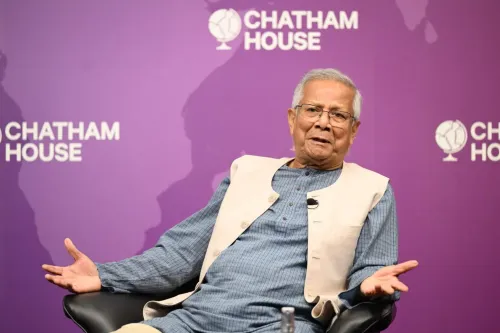
Will Bangladesh's Yunus Government Be Remembered for Its Lack of Strategic Direction?

Synopsis
The Yunus government in Bangladesh faces scrutiny for its lack of strategic governance and failure to implement vital anti-corruption reforms. Internal resistance and poorly crafted ordinances have thwarted progress, raising questions about accountability and transparency in leadership.
Key Takeaways
Yunus government marked by adhoc governance.
Absence of strategic reforms in anti-corruption .
Legal ordinances create operational risks.
Internal resistance undermines reform potential.
Compromised human rights legislation affects accountability.
Dhaka, Jan 26 (NationPress) The Interim Government (IG) of Bangladesh, led by Muhammad Yunus, is poised to be remembered for its unprecedented adhoc governance characterized by a lack of strategic direction and the establishment of numerous counterproductive legal and operational risks that contradicted its primary mandate for state reform, especially in the realm of anti-corruption, as reported on Monday.
The report noted that the Yunus administration was frequently held captive by internal resistance and factions it viewed as part of its power base, undermining the potential for substantial anti-corruption reforms.
Iftekharuzzaman, Executive Director of Transparency International Bangladesh, wrote for the country's prominent newspaper, The Daily Star, emphasizing that nearly every Ordinance issued by the Yunus government exhibited clear evidence of actions opposing the genuine spirit of its state reform mandate.
“The Police Commission Ordinance, for example, serves merely as a facade for police reform, acting as a rehabilitation haven for retired civil bureaucrats and police officials who will ultimately undermine its stated objectives. An otherwise commendable National Human Rights Ordinance has been compromised by the strategic insertion of a provision that guarantees bureaucratic control over its establishment, crushing the vision of an independent and effective commission,” stated Iftekharuzzaman.
“The Ordinances passed under the IG concerning cybersecurity, digital space, personal data protection, and data management have conferred mutually reinforcing, unaccountable surveillance powers to the government and pertinent agencies, facilitating targeted violations of privacy rights, free media, dissent, and civic space. The aspirations for an effective and accountable Anti-Corruption Commission (ACC) have been systematically thwarted,” he noted.
The report further highlights that the IG has failed to act on recommendations from the ACC-Reform Commission (ACC-RC) and ten other commissions, despite promises for urgent implementation through executive authority and institutional collaboration.
“The ACC has also been complicit, even acting as a catalyst in this failure. Following the launch of the ACC-RC report, the ACC at its top levels unconditionally endorsed all 47 recommendations. Both the ACC and the IG were aware that during national consensus negotiations, nearly all political parties supported almost every ACC-RC recommendation,” it stated.
“As the sole stakeholder formally engaged with the IG in drafting the Ordinance to amend the 2004 Act, the ACC colluded with the resistant forces within the government that took over the reform process, deliberately obstructing the inclusion of a provision for an independent Review Committee to ensure accountability of the ACC,” it concluded.
Point of View
It is essential to highlight the overarching issues of governance and accountability. The Yunus government has not only failed to implement necessary reforms but has also contributed to a climate of resistance that stifles progress. A commitment to transparency and strategic direction is urgently needed to restore faith in governance.
NationPress
2 Oct 2026