Gautam Adani on Bloomberg's vision: India needs visible and invisible infrastructure
Synopsis
At the Bloomberg New Economy Forum in New Delhi, Gautam Adani and Michael Bloomberg converged on a core insight: India needs both visible infrastructure — ports, power, compute — and invisible infrastructure of trusted data and accountable governance. Their Dharavi discussion signals the project's global ambitions beyond a Mumbai real estate play.
Key Takeaways
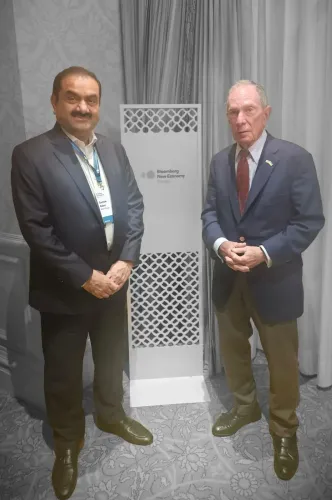
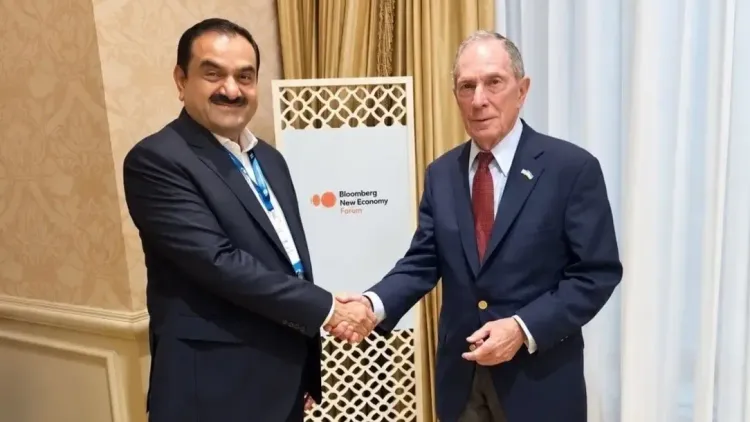
Gautam Adani shared reflections from his meeting with Michael Bloomberg at the Bloomberg New Economy Forum in New Delhi on 14 October .
Adani articulated a two-infrastructure framework: visible (ports, power, compute) and invisible (trusted data, accountable institutions, governance discipline).
He stressed that green energy must be affordable and reliable for a small business owner in Gujarat or a household in Uttar Pradesh , or the clean-energy transition risks collapse.
Bloomberg has operated in India for 30 years , backed by nearly two decades of philanthropic work — the basis Adani cited for Bloomberg's credibility on India's progress.
The Dharavi redevelopment was discussed as a test of collective capability, with Adani insisting it must be measured by 'dignity' — resilient homes, sanitation, power, and livelihoods — not square footage.
Adani outlined four non-negotiables for nation-building: patient capital, physical execution, transparent governance, and capable local leadership.
Gautam Adani, Chairman of the Adani Group, on Wednesday, 14 October reflected on his meeting with Bloomberg co-founder Michael Bloomberg at the Bloomberg New Economy Forum in New Delhi, saying that true leadership is measured not by today's milestones but by the commitment to expand what humanity can achieve tomorrow. Adani shared his observations in a post on LinkedIn, drawing on the conversations to articulate a framework for nation-building in a rapidly changing world.
Two Kinds of Infrastructure
At the heart of Adani's reflection was a distinction between two forms of national infrastructure. 'His line of questioning crystallised something for me. Nations need two kinds of infrastructure to endure. The first is visible and includes ports, transmission corridors, green hydrogen plants, gigawatt-scale compute clusters and transit systems. The second is invisible but decisive because it enables the first. It rests on trusted data, accountable institutions and governance treated as an operating discipline rather than a stage for announcements,' Adani wrote.
The Adani Group chairman argued that physical infrastructure — however transformative — cannot deliver its full potential without the invisible scaffolding of institutional integrity and data-driven governance. This framing positions governance reform not as a political aspiration but as an operational prerequisite.
Emerging Economy Imperatives vs Mature Market Priorities
Adani acknowledged that his perspective and Bloomberg's do not always converge. 'Our perspectives reflect our operating realities. From an emerging economy, the imperative is immediate. It means delivering the baseload power, industrial capacity and digital access to lift hundreds of millions into economic security without delay. From mature capital markets, the focus often leans toward the speed of decarbonisation and regulatory alignment,' he said.
Despite this divergence, Adani identified a shared conviction — that clean energy and affordability must advance together. 'Decarbonisation cannot be an ideological decree that prices out ordinary citizens, shuts down factories or stalls the Global South. If green energy is not reliable and viable for a small business owner in Gujarat or a household in Uttar Pradesh, the transition will collapse under its own weight,' he stated.
This comes amid a broader global debate about whether climate ambitions in wealthy nations are transferable to economies still building foundational capacity. Adani's framing — pragmatic rather than ideological — reflects a tension that has surfaced repeatedly at forums like COP and G20.
Why Bloomberg's Record Is Instructive
Adani pointed to Bloomberg's 30 years of operating presence in India and nearly two decades of philanthropic partnership as the basis for credibility. 'When he addressed the Bloomberg New Economy Forum in Delhi yesterday, he spoke with conviction about India's momentum across artificial intelligence, advanced manufacturing and green infrastructure. It was not rhetoric crafted for a podium,' Adani wrote.
Notably, Adani described Bloomberg's conviction on India's progress in AI, advanced manufacturing, and green infrastructure as grounded in ground-level experience rather than diplomatic courtesy — a distinction that underscores the substantive nature of their exchange.
Dharavi as a Test of Collective Capability
The two also discussed the Dharavi redevelopment project in Mumbai, which the Adani Group is leading. Adani drew a parallel with Bloomberg's record as mayor of New York City, noting that 'municipal data and rigorous execution can serve dense urban communities.' He was emphatic that Dharavi must not be treated as a real estate transaction.
'Dharavi cannot be approached as a real estate parcel. It is a vital, self-sustaining ecosystem of micro-entrepreneurs, multigenerational households, and relentless human grit. Its renewal cannot be measured in square footage. It must be judged by the tangible expansion of dignity through climate-resilient homes, modern sanitation, reliable power, and protected livelihoods,' Adani said.
He argued that if executed with both engineering discipline and community trust, Dharavi could become 'an enduring benchmark for urban regeneration across the developing world.'
Four Forces of Nation-Building
Adani concluded his reflection with what he described as four non-negotiable forces for genuine national progress: 'patient capital, physical execution, transparent governance and capable local leadership.' He stressed that none of the four can substitute for another — signalling a systems-level view that goes beyond the conventional focus on financing or policy alone.
As India accelerates its infrastructure build-out and the global debate over green transition timelines intensifies, conversations like the one between Adani and Bloomberg are likely to grow in strategic significance.
Point of View
And framing it in terms of 'dignity' and 'micro-entrepreneurs' is a deliberate counter-narrative. The invisible infrastructure argument — governance as operating discipline — is substantive, but it sits in tension with the Adani Group's own history of regulatory controversies. Invoking Bloomberg, whose data-driven New York mayoralty is well-documented, gives the argument external credibility, but the harder question is whether Adani's own governance architecture matches the standard he is publicly endorsing.
NationPress
14 Oct 2026
Frequently Asked Questions
What did Gautam Adani say at the Bloomberg New Economy Forum?
Gautam Adani shared reflections from his meeting with Bloomberg co-founder Michael Bloomberg at the Bloomberg New Economy Forum in New Delhi on 14 October, arguing that nations need both visible infrastructure — ports, power grids, compute clusters — and invisible infrastructure of trusted data and accountable governance. He posted his observations on LinkedIn.
What is the Bloomberg New Economy Forum and why was it held in New Delhi?
The Bloomberg New Economy Forum is a global gathering convened by Bloomberg to discuss economic, technology, and sustainability challenges. Its New Delhi edition drew leaders from business and policy, with India's momentum in AI, advanced manufacturing, and green infrastructure cited as a central theme.
What did Adani and Bloomberg discuss about Dharavi?
Adani and Bloomberg discussed the Dharavi redevelopment project in Mumbai, which the Adani Group is leading. Adani drew on Bloomberg's experience with data-driven urban governance in New York City, insisting that Dharavi must not be treated as a real estate transaction but judged by its delivery of climate-resilient homes, sanitation, power, and protected livelihoods.
What is Adani's position on green energy and the Global South?
Adani argued that decarbonisation must not price out ordinary citizens or stall developing economies. He said that if green energy is not reliable and affordable for a small business owner in Gujarat or a household in Uttar Pradesh, the clean-energy transition will 'collapse under its own weight' — a position that reflects the broader tension between climate speed and energy access.
What are the four forces of nation-building according to Gautam Adani?
Adani identified four non-negotiable forces for genuine national progress: patient capital, physical execution, transparent governance, and capable local leadership. He stressed that none of these four can substitute for another.