Adani at CII Summit: AI must empower Bharat, not just eliminate jobs
Synopsis
Gautam Adani used the CII Annual Business Summit 2026 to reframe India's AI debate — not as a productivity story for corporations, but as a sovereignty and inclusion challenge. With a $100 billion group commitment on the table and partnerships with Google and Microsoft, his call to 'own the infrastructure of our intelligence future' is as much a business pitch as a national manifesto.
Key Takeaways
Gautam Adani addressed the CII Annual Business Summit 2026 in New Delhi on 11 May 2026 .
He called for AI to be built as a force that creates jobs and empowers small enterprises, explicitly rejecting automation-first approaches.
Adani drew parallels with UPI , arguing India's best tech revolutions succeed by democratising access at scale.
He warned against dependence on foreign-controlled digital infrastructure, stating "data has a home and intelligence has a geography." The Adani Group has committed $100 billion across clean energy, digital infrastructure and data centres, with partnerships with Google and Microsoft for sovereign compute capacity.
Adani described India's AI ambition as a new freedom struggle fought across grids, data centres, factories and classrooms.
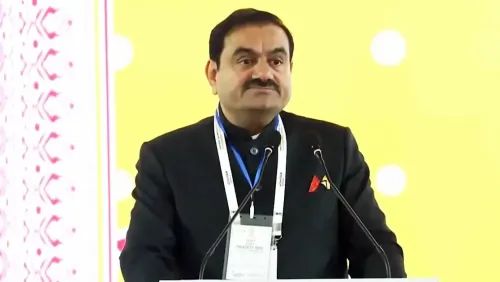
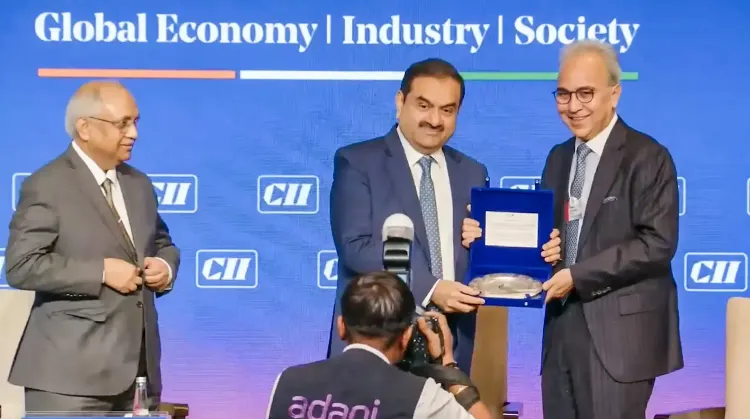
Gautam Adani, Chairman of the Adani Group, on Monday, 11 May 2026, called on India to build Artificial Intelligence as a democratising force — one that expands productivity, creates jobs and empowers small enterprises — rather than a tool that primarily automates livelihoods away. Addressing the Confederation of Indian Industry's (CII) Annual Business Summit 2026 in New Delhi, Adani argued that the true measure of India's AI revolution must be its impact on ordinary citizens, workers and small businesses across the country.
The UPI Parallel: Democratising Access at Scale
Drawing a sharp parallel with the transformational rise of the Unified Payments Interface (UPI), Adani said India's most consequential technology revolutions succeed when they democratise access, expand trust and create opportunity at scale. "UPI did not simply move money. It made small businesses visible, expanded trust and unlocked entirely new economic ecosystems," he said. He argued that AI now presents India with a comparable opportunity to build entirely new industries, business models and employment ecosystems — but only if the country approaches it with the same inclusive architecture.
Building the Full AI Stack — Infrastructure to Skills
Adani stressed that realising this opportunity requires India to build the full AI stack — spanning reliable energy, data centres, compute infrastructure, networks, applications and AI-integrated skilling ecosystems. Crucially, he pushed back against a purely digital framing of the intelligence age, arguing it cannot be built through chips, servers and algorithms alone. "The intelligence age equally needs technicians, electricians, operators, cooling engineers and millions of skilled workers supporting the physical infrastructure behind the digital economy," he said. This positions AI infrastructure as a blue-collar employment engine, not merely a knowledge-economy play.
Sovereignty Warning: Data Has a Home, Intelligence Has a Geography
In one of the sharpest passages of his address, Adani warned against dependence on externally controlled digital ecosystems. "Semiconductors have become instruments of statecraft. Data is being treated as a national resource. Clouds are being weaponised. Artificial Intelligence is being built behind the protective walls of data centres," he said. He urged India to resist what he called a decades-long pattern of treating digital worlds as borderless: "Data has a home and intelligence has a geography. India must not rent the infrastructure of its intelligence future. India must build it, power it and own it on its own soil."
Adani Group's $100 Billion Commitment and Global Partnerships
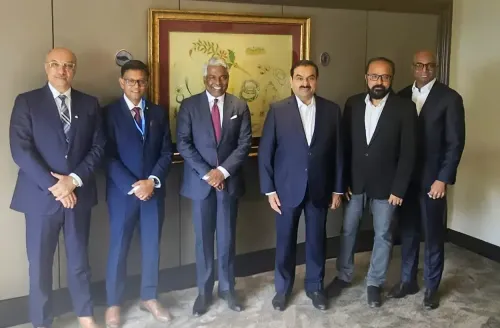
Adani anchored his remarks in concrete investment commitments, referencing the Adani Group's $100 billion pledge across clean energy, digital infrastructure and data centres. He also highlighted partnerships with Google and Microsoft to help build sovereign compute capacity on Indian soil. The group's footprint — from ports to power projects in previously underserved regions — was invoked as evidence that large-scale infrastructure in challenging geographies is achievable. "The future does not arrive. It is built," he said.
The Next Freedom Struggle: Grids, Data Centres and Classrooms
Closing on a sweeping note, Adani framed India's AI ambition as a civilisational imperative, describing the coming contest as a freedom struggle fought "in our grids, our data centres, our factories, our classrooms, our laboratories and our minds." Freedom in the intelligence age, he said, would mean "the capability to power ourselves, compute for ourselves and dream for ourselves." As India navigates a fractured global order where technology has become a geopolitical lever, the pressure to convert these commitments into verifiable outcomes — for Bharat as much as for boardrooms — will only intensify.
Point of View
But the risk is that 'build it on Indian soil' becomes a moat for incumbents with the capital to own that soil. The UPI analogy is instructive: UPI succeeded partly because it was state-backed, interoperable and not owned by a single private group. Whether a privately owned AI stack — however large — can replicate that democratic architecture remains the central unanswered question.
NationPress
24 Sept 2026
Frequently Asked Questions
What did Gautam Adani say at the CII Annual Business Summit 2026?
Gautam Adani called on India to build AI as a democratising force that creates jobs and empowers small businesses, rather than primarily automating livelihoods. He also warned against dependence on foreign-controlled digital infrastructure and urged India to build sovereign AI capacity on its own soil.
What is the Adani Group's AI and infrastructure investment commitment?
The Adani Group has committed $100 billion across clean energy, digital infrastructure and data centres. The group has also announced partnerships with Google and Microsoft to help build sovereign compute capacity in India.
Why did Adani compare AI to UPI?
Adani argued that India's most transformative technology revolutions succeed when they democratise access and create opportunity at scale. He cited UPI as a model — noting it made small businesses visible and unlocked new economic ecosystems — and said AI presents a similar opportunity if built with the same inclusive architecture.
What did Adani mean by 'data has a home and intelligence has a geography'?
Adani was warning against India's dependence on externally controlled digital ecosystems, where semiconductors, cloud infrastructure and AI development are concentrated in foreign hands. He argued India must own and power its own AI infrastructure rather than renting it from global platforms.
Who is affected by Adani's AI vision for India?
Adani's remarks were directed at the full economic spectrum — from large enterprises to small businesses, and from knowledge workers to technicians, electricians and cooling engineers who support physical AI infrastructure. His argument is that the intelligence age must generate broad-based employment, not concentrate gains at the top.