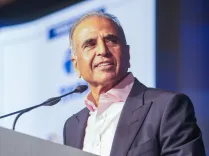
Shekhawat champions PM Gati Shakti as India's infra backbone

Synopsis
Union Minister Gajendra Singh Shekhawat has championed the PM Gati Shakti National Master Plan, highlighting seamless multi-modal connectivity, faster project delivery, and stronger logistics as pillars of the Modi government's Viksit Bharat vision.
Key Takeaways
PM Gati Shakti National Master Plan was launched on 13 October 2021 , making Shekhawat's post timed near the scheme's fifth anniversary.
The plan uses a GIS-based digital platform to integrate planning across roads, railways, airports, and ports, eliminating inter-ministry silos.
Shekhawat identified three outcomes: seamless multi-modal connectivity, improved coordination with faster delivery, and a stronger logistics backbone.
The scheme is positioned as a foundational pillar of the Viksit Bharat goal of reaching developed-economy status by 2047 .
Analysts are watching upcoming NITI Aayog reviews and budget cycles for fresh project approvals under the framework.
Five years after its launch, the PM Gati Shakti National Master Plan is still drawing top ministerial attention — and Union Culture and Tourism Minister Gajendra Singh Shekhawat made clear on Wednesday, October 14, 2026, exactly why. In a post on X, Shekhawat framed the plan as the structural engine powering India's infrastructure acceleration, signalling that the ruling coalition views it as central to the Viksit Bharat vision for 2047.
Posting in Hindi, Shekhawat wrote: 'नीतियां मजबूत हों, तो मंजिल दूर नहीं रहती!' — 'When policies are strong, the destination is never far.' He highlighted three pillars the government says the plan delivers: seamless multi-modal connectivity, better inter-agency coordination with faster project delivery, and a strengthened logistics backbone feeding a more resilient economy.
What PM Gati Shakti actually does
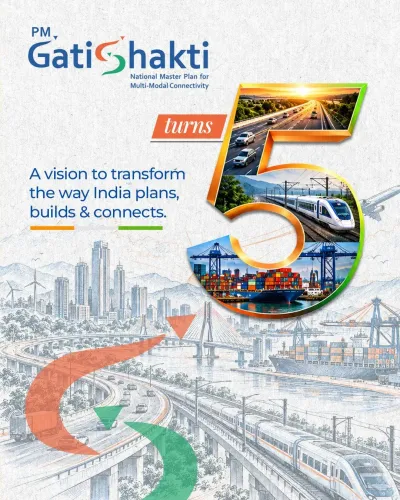
PM Gati Shakti National Master Plan was launched on 13 October 2021 — making this post land almost exactly on the scheme's fifth anniversary. The plan uses a GIS-based digital platform to integrate planning across roads, railways, airports, ports, and utilities, breaking the inter-ministry silos that historically stalled large infrastructure projects. The idea: if every agency can see every other agency's plans on one map, duplication collapses and clearances move faster.
Before Gati Shakti, infrastructure projects in India routinely ran into coordination failures — a highway approved without accounting for a railway crossing, or a port expansion delayed because utilities weren't mapped. The platform was designed to end exactly that kind of bureaucratic drag.
Logistics efficiency as economic argument
Shekhawat's emphasis on 'strong logistics, empowered economy' echoes a consistent line from the Modi government since 2014: that physical connectivity is not a support function but a primary growth driver. Reducing logistics costs — which have historically run higher in India than in comparable economies — directly improves manufacturing competitiveness and opens up landlocked districts to national supply chains.
The Viksit Bharat framework, the government's headline ambition to reach developed-economy status by 2047, treats infrastructure density as a core metric. Ministers across portfolios have increasingly used that framing to anchor routine infrastructure messaging to a longer national arc.
What Gati Shakti watchers are tracking next
Policy analysts and the logistics sector are watching upcoming budget cycles and NITI Aayog reviews for the next round of project approvals and funding releases under the Gati Shakti framework. Each fresh allocation is a test of whether the coordination architecture is actually compressing timelines — or whether execution bottlenecks downstream are clawing back the gains made at the planning stage.
When a senior minister invokes a five-year-old scheme with fresh urgency, it usually means rollout is at a critical inflection point. India's infrastructure story is far from written — the next chapter depends on whether the platform's promise translates into concrete, on-ground delivery at scale.
Point of View
Reinforcing the BJP's infrastructure-as-growth narrative ahead of budget deliberations. By anchoring it to the Viksit Bharat 2047 frame, the government signals that flagship schemes launched in Modi's second term are being carried forward with ownership across portfolios — not just by nodal ministries. The emphasis on logistics efficiency also reflects a deliberate pivot: after years of announcing headline project numbers, the government is now stressing outcomes — cost reduction, delivery timelines, and supply-chain competitiveness — because those are the metrics investors and states are actually tracking.
NationPress
14 Oct 2026
Frequently Asked Questions
What is the PM Gati Shakti National Master Plan?
PM Gati Shakti National Master Plan is a GIS-based digital platform launched on 13 October 2021 to integrate infrastructure planning across roads, railways, airports, ports, and utilities, reducing inter-ministry silos and speeding up project delivery.
Why did Gajendra Singh Shekhawat post about Gati Shakti?
Shekhawat posted to highlight the plan's role in accelerating infrastructure and logistics as part of the Modi government's broader Viksit Bharat vision, in a show of cross-portfolio ownership of the scheme.
What is Viksit Bharat and how does Gati Shakti relate to it?
Viksit Bharat is the government's vision for India to become a developed economy by 2047. Infrastructure density and logistics efficiency enabled by Gati Shakti are treated as core metrics on that path.
How does PM Gati Shakti reduce logistics costs in India?
By mapping all infrastructure projects on a single GIS platform, the plan prevents duplication, speeds up clearances, and ensures coordinated development so goods can move faster and more cheaply across modes.
What is next for PM Gati Shakti in 2026?
Policy watchers are tracking upcoming NITI Aayog reviews and budget cycles for fresh project approvals and funding releases that will test whether the framework is compressing real-world project timelines.