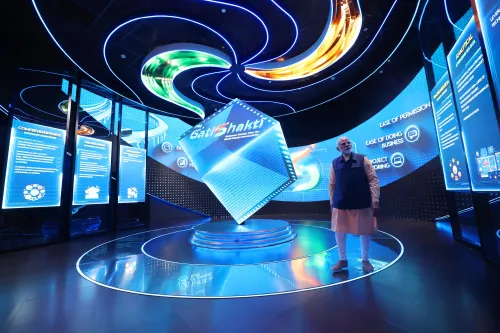
Piyush Goyal marks 5 years of PM GatiShakti Master Plan
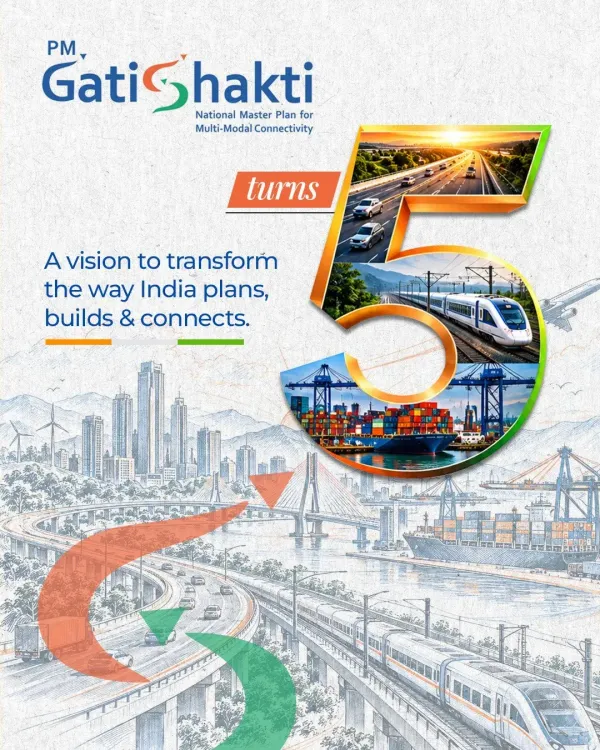
Synopsis
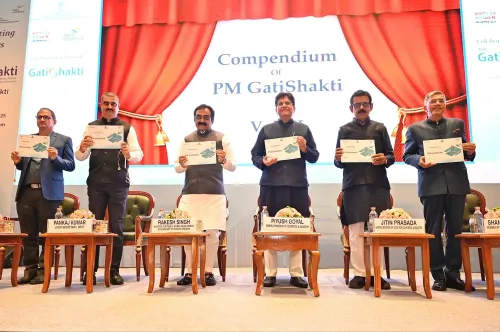
Union Commerce Minister Piyush Goyal marked five years of PM GatiShakti on 13 October 2026, highlighting how the GIS-based digital platform has replaced fragmented infrastructure planning with a coordinated, technology-driven Whole-of-Government framework spanning national, state and district levels.
Key Takeaways
PM GatiShakti National Master Plan was launched by Prime Minister Narendra Modi on 13 October 2021 and completed five years on 13 October 2026.
The platform is a GIS-based digital coordination tool used by central ministries, state governments and district bodies for unified infrastructure planning.
It has expanded beyond national highways and ports into state, district and social sector infrastructure , broadening its impact.
Key goals include multimodal connectivity, inter-ministerial coordination and data-driven decision-making to cut logistics costs.
The initiative builds on the National Infrastructure Pipeline and represents the government's broader push to lower India's historically high logistics costs.
Deeper state-level adoption and district-level social infrastructure integration remain the next milestones for the platform.
Five years ago, on 13 October 2021, Prime Minister Narendra Modi launched a platform designed to end one of India's oldest infrastructure curses — ministries and states building in silos, roads stopping at state borders, ports unconnected to rail. Today, Union Commerce and Industry Minister Piyush Goyal marked the fifth anniversary of the PM GatiShakti National Master Plan, calling it a transformation from 'a fragmented approach to a coordinated, technology-driven and Whole-of-Government framework.'
From silos to a single digital canvas
At its core, PM GatiShakti is a GIS-based digital platform that layers data from central ministries, state governments and district bodies onto one map. Before it existed, a highway project could be cleared by one ministry while a gas pipeline that crossed its path remained invisible to planners — a recipe for cost overruns, delays and duplication. The platform made those conflicts visible before a single shovel hit the ground.
Minister Goyal highlighted that the initiative has since extended beyond national-level infrastructure into state, district and social sectors, deepening its reach into the everyday fabric of regional development. That expansion — from highways and ports to schools and health facilities — is the 'inclusive regional development' he cited in his post.
Multimodal connectivity and the logistics cost equation
India's logistics costs have historically run significantly higher than those of peer economies, acting as a quiet tax on every manufactured good and agricultural shipment. PM GatiShakti sits at the centre of the government's sustained effort to bring those costs down by strengthening multimodal connectivity — ensuring roads, rail, ports and airports are planned together rather than in sequence.
The initiative builds on the foundation laid by the National Infrastructure Pipeline, which identified projects across sectors, and goes further by providing the inter-ministerial coordination layer needed to execute them without bureaucratic collision. 'Faster project execution, greater logistics efficiency and inclusive regional development' — that is the three-part promise Goyal restated as the plan enters its sixth year.
What the next phase of GatiShakti must deliver
The platform's immediate frontier is deeper state-level adoption — not every state has integrated its planning machinery fully into the national framework — and the integration of district-level social infrastructure projects that affect last-mile connectivity for ordinary citizens. The more granular the data and the more government layers that plug in, the more powerful the coordination effect becomes.
Five years into a project built on the idea that a single digital map can replace decades of departmental turf wars, the anniversary is less a celebration of what was built and more a checkpoint on how much further the architecture can scale.
Point of View
The platform's real test is no longer adoption at the Centre but how thoroughly it changes decision-making at the state and district level, where most infrastructure bottlenecks actually live. Goyal's anniversary post signals the government intends to keep GatiShakti at the centre of its logistics and competitiveness narrative as India positions itself as a global manufacturing hub. The absence of new quantitative targets in the post suggests the emphasis is on consolidation and depth rather than headline announcements.
NationPress
13 Oct 2026
Frequently Asked Questions
What is PM GatiShakti National Master Plan?
PM GatiShakti National Master Plan is a GIS-based digital platform launched on 13 October 2021 by Prime Minister Narendra Modi to coordinate infrastructure planning across central ministries, state governments and district bodies on a single map, eliminating siloed decision-making.
When was PM GatiShakti launched?
PM GatiShakti was launched on 13 October 2021 by Prime Minister Narendra Modi, making October 2026 its fifth anniversary.
What has PM GatiShakti achieved in 5 years?
Over five years, PM GatiShakti has extended coordinated infrastructure planning from national-level projects to state, district and social sectors, strengthening multimodal connectivity and inter-ministerial coordination across India.
How does PM GatiShakti reduce logistics costs in India?
By enabling roads, rail, ports and airports to be planned together on one digital platform rather than in isolated departmental processes, PM GatiShakti aims to reduce project delays and duplication, which directly lowers India's historically high logistics costs.
What is next for PM GatiShakti?
The next phase focuses on deeper state-level adoption of the platform and greater integration of district-level social infrastructure projects, extending its coordination benefits to last-mile connectivity for ordinary citizens.