Goyal Quotes PM Modi: Govt Will Enable, Industry Innovate
Synopsis
Commerce Minister Piyush Goyal amplified PM Modi's economic doctrine on 18 June 2026, framing India's growth strategy as a compact where the government enables, industry innovates, startups disrupt, and global partners scale alongside India.
Key Takeaways
Piyush Goyal shared a direct quote from PM Narendra Modi on 18 June 2026 outlining a four-pillar economic compact.
The four pillars are: government enablement, industry innovation, startup disruption, and scaling with global partners.
The statement draws on policy architecture built since 2014 , including Make in India , Startup India , and Atmanirbhar Bharat .
India's startup ecosystem and foreign investors are the primary audiences for the message.
The next Union Budget and ongoing bilateral trade talks will be the practical test of this vision.
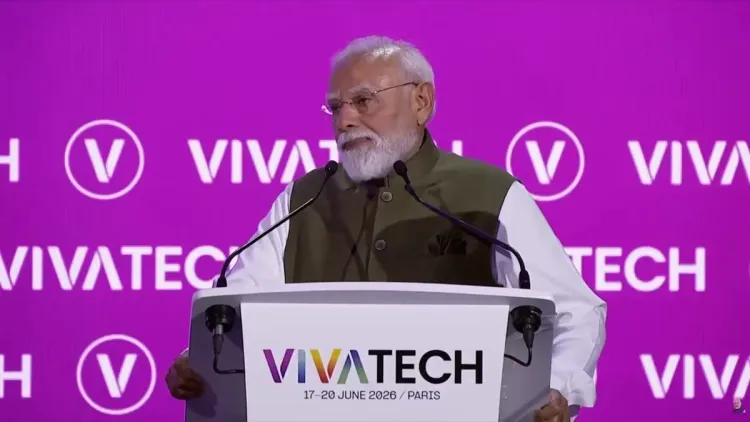
Union Commerce and Industry Minister Piyush Goyal on Thursday, 18 June 2026 shared a statement attributed to Prime Minister Narendra Modi, encapsulating the government's philosophy on economic growth through a four-pillar compact: state enablement, industry innovation, startup disruption, and global partnership.
Context
Quoting PM Modi directly, Goyal posted: 'Our government will enable, and industry will innovate, startups will disrupt, and global partners will scale with us.' The formulation is a concise articulation of the government's long-standing economic doctrine — that the state's role is to create conditions, not to compete with private enterprise. The post comes amid an active phase of trade diplomacy and ongoing bilateral negotiations with several major economies.
Goyal, as the minister responsible for trade policy and foreign direct investment promotion, is among the most visible faces of this outreach. His amplification of the Prime Minister's words signals alignment at the highest levels of the government on the direction of economic strategy.
Policy Backdrop
The four-pillar formulation draws on a decade of interlocking policy architecture. The Make in India campaign, launched in 2014, invited global manufacturers to set up production in India. The Startup India initiative, launched in 2016, simplified regulations and extended tax benefits to new ventures, helping India build one of the world's largest startup ecosystems. The Atmanirbhar Bharat package, unveiled in 2020, sought to combine domestic self-reliance with deeper integration into global value chains.
Successive Union Budgets have reinforced this framework through measures on ease of doing business, production-linked incentive schemes, and rationalisation of startup taxation. The phrase 'global partners will scale with us' reflects a deliberate pivot from import substitution to co-manufacturing and co-investment with foreign partners.
Stakeholders and Impact
The statement speaks directly to three constituencies: Indian industry, which is expected to invest and innovate within the enabling policy environment; the startup ecosystem, which has produced dozens of unicorns and is seen as a driver of employment and technology; and global investors and multinational firms, who are being invited to treat India as a long-term partner rather than merely a market.
For the startup community, the government's continued rhetorical and policy commitment matters at a time when funding cycles globally have tightened. For foreign partners, the signal is that India's regulatory environment is stabilising and that large-scale collaboration — in semiconductors, clean energy, defence manufacturing, and digital infrastructure — is on offer.
What's Next
Attention will now turn to the next Union Budget for concrete proposals on startup taxation, angel tax provisions, and any fresh FDI policy liberalisation. Ongoing bilateral trade negotiations — including framework discussions with major partners — will be the test of whether the 'scale with us' promise translates into signed agreements. Analysts will also watch for new production-linked incentive tranches and any regulatory changes that ease cross-border investment flows, as these would give operational weight to the Prime Minister's four-pillar vision.
Point of View
Reinforcing a narrative of India as a reliable, innovation-friendly destination for global capital. By quoting the Prime Minister directly, Goyal signals unified intent at the top of the government ahead of what is expected to be a busy period of trade diplomacy. The four-pillar framing — enable, innovate, disrupt, scale — is not new in substance, but its compact articulation suggests the government is sharpening its pitch to both domestic industry and international partners. The real test will be whether upcoming budget and trade-deal outcomes deliver the policy specificity that the rhetoric promises.
NationPress
17 Sept 2026
Frequently Asked Questions
What did PM Modi say about India's economic vision?
PM Modi, as quoted by Commerce Minister Piyush Goyal on 18 June 2026, said: 'Our government will enable, and industry will innovate, startups will disrupt, and global partners will scale with us.' This encapsulates the government's doctrine of state enablement paired with private innovation and global collaboration.
What is the Startup India initiative?
Startup India is a government programme launched in 2016 to simplify regulations, provide tax benefits, and offer funding support to new ventures. It has helped India build one of the world's largest startup ecosystems, with numerous unicorns emerging since its launch.
What is Make in India?
Make in India is a campaign launched in 2014 by the Modi government to encourage domestic manufacturing and attract foreign direct investment. It is a key pillar of India's strategy to integrate into global value chains.
Why did Piyush Goyal share this post?
As Union Commerce and Industry Minister and a senior leader responsible for trade and FDI policy, Goyal's amplification of PM Modi's statement signals the government's unified economic messaging, particularly relevant amid active bilateral trade negotiations.
What should we watch for next on India's startup and trade policy?
Key developments to watch include the next Union Budget's proposals on startup taxation and angel tax, any new FDI liberalisation measures, and the outcomes of ongoing bilateral trade negotiations with major partner economies.