CM Rekha Gupta hails 12 years of Modi-led infra growth

Synopsis
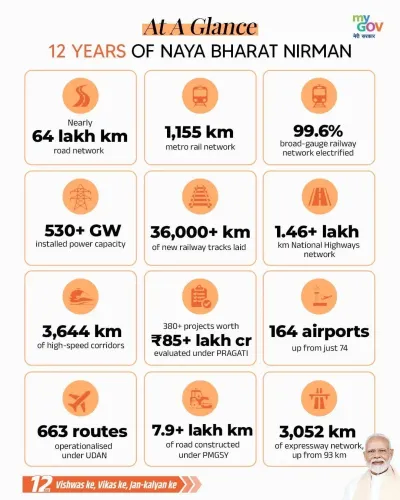
Delhi Chief Minister Rekha Gupta on 16 June 2026 praised PM Narendra Modi's 12-year tenure for transforming India's infrastructure, highlighting the Bogibeel Bridge, Chenab Bridge, Mission Gati Shakti, expanding expressways, and new metro networks as markers of the country's rising economic strength.
Key Takeaways
Delhi CM Rekha Gupta posted on 16 June 2026 crediting PM Modi's 12-year government with a 'transformation' of India's infrastructure.
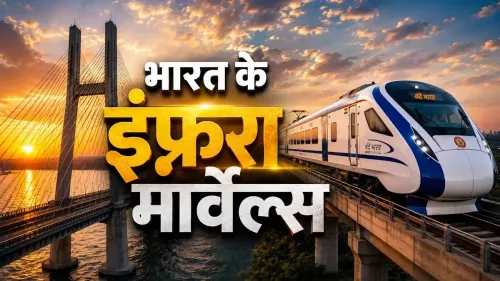
She named four landmark projects: Atal Setu , Sudarshan Setu , Bogibeel Bridge , and Chenab Bridge as symbols of engineering excellence and economic strength.
Mission Gati Shakti , launched in October 2021 , was cited for enabling faster, coordinated execution of infrastructure projects across ministries.
Special emphasis was placed on Northeast India connectivity, with the post stating that new initiatives have 'established new dimensions' of access for the region.
The post highlighted growth in expressways , modern metro systems , and railway expansion and modernisation as drivers of national momentum.
The message was published under the campaign hashtag #12YearsOfNayaBharatNirman , framing the record as a BJP political milestone.
Delhi Chief Minister Rekha Gupta on Tuesday, 16 June 2026, credited Prime Minister Narendra Modi's 12-year tenure with transforming India's infrastructure landscape, citing landmark bridges, expanding expressways, modern metro networks, and an unprecedented railway overhaul as proof of the country's rising economic strength.
Context
Posting under the hashtag #12YearsOfNayaBharatNirman, CM Gupta wrote that India is today building to world-class standards 'with resolve and speed' — a contrast, she argued, to an earlier era when 'major projects remained pending for years.' The post was published on the BJP's national campaign day marking a dozen years of the Modi government, which took office in May 2014.
She specifically named the Atal Setu, Sudarshan Setu, Bogibeel Bridge, and Chenab Bridge as emblems of the country's engineering ambition and growing economic power. 'These are proof of the nation's rising economic strength,' she stated.
Policy Backdrop
Mission Gati Shakti, launched in October 2021, created a national master plan to integrate planning across ministries and reduce project delays through coordinated multi-modal execution. CM Gupta cited the mission directly, crediting it with 'rapid implementation of projects' across the country.
The Bharatmala Pariyojana, approved in 2017, set out to develop 34,800 km of national highways with an emphasis on expressways and border connectivity — a programme that underpins much of the road infrastructure highlighted in the post. The Bogibeel Bridge over the Brahmaputra in Assam stands as India's longest rail-cum-road bridge and a flagship symbol of Northeast connectivity under this policy push.
The Chenab Bridge in Jammu and Kashmir — the world's highest railway arch bridge — represents the government's commitment to engineering projects in difficult, high-altitude terrain, bringing remote regions into the national rail grid.
Stakeholders and Impact
Residents of Northeast India — long underserved by physical connectivity — stand among the primary beneficiaries of the bridge and rail projects highlighted by CM Gupta. She noted that initiatives for the region 'have established new dimensions of connectivity,' aligning with the Centre's Act East Policy aimed at reducing the Northeast's geographic isolation and spurring economic integration.
Infrastructure developers, railway passengers, and commuters in cities with expanding metro networks are also cited as direct stakeholders. The growth of expressways and modern metro systems, the post argues, is 'giving new momentum to India' and changing the country's image on a continuous basis.
What's Next
The broader infrastructure narrative is expected to be tested in upcoming parliamentary discussions on the next phase of Mission Gati Shakti and fresh budget allocations for expressways and Northeast rail projects in the next financial year. CM Gupta's post frames the 12-year record as a foundation, suggesting the 'journey of national reconstruction is changing the country's picture' — a signal that the BJP intends to keep infrastructure at the centre of its political messaging ahead of future electoral cycles.
Point of View
Using infrastructure as the party's most tangible proof of governance. By anchoring the message in named, physical projects — bridges, expressways, metro lines — rather than abstract policy claims, the BJP seeks to convert steel-and-concrete achievements into electoral capital ahead of future contests. The emphasis on Northeast connectivity is notable: it signals a continued effort to consolidate gains in a region where the party has invested heavily both politically and in public works. The post also implicitly draws a contrast with the pre-2014 era of stalled projects, a narrative the BJP has deployed consistently to distinguish its governance record from that of its predecessors.
NationPress
18 Sept 2026
Frequently Asked Questions
What did Delhi CM Rekha Gupta say about PM Modi's infrastructure record?
Delhi CM Rekha Gupta praised PM Narendra Modi's 12-year tenure on 16 June 2026, saying India is now building to world-class standards with speed and resolve, citing bridges like Bogibeel and Chenab, expanding expressways, metro networks, and Mission Gati Shakti as evidence of the country's rising economic strength.
What is Mission Gati Shakti and why is it significant?
Mission Gati Shakti is a national master plan launched in October 2021 to coordinate infrastructure planning across central ministries and reduce project delays. It enables faster, integrated execution of roads, railways, ports, and other connectivity projects across India.
What is the Chenab Bridge and why is it famous?
The Chenab Bridge in Jammu and Kashmir is the world's highest railway arch bridge, built over the Chenab river in difficult mountainous terrain. It is a flagship engineering achievement connecting remote areas of J&K to the national rail network.
What is the Bogibeel Bridge?
The Bogibeel Bridge is India's longest rail-cum-road bridge, spanning the Brahmaputra river in Assam. It significantly improved connectivity in Northeast India and is seen as a landmark infrastructure project completed under the current central government.
What is the BJP's #12YearsOfNayaBharatNirman campaign?
The hashtag #12YearsOfNayaBharatNirman marks twelve years since the BJP-led government took office in May 2014. BJP leaders have used it to highlight infrastructure, economic, and social achievements under PM Modi's tenure across social media platforms.