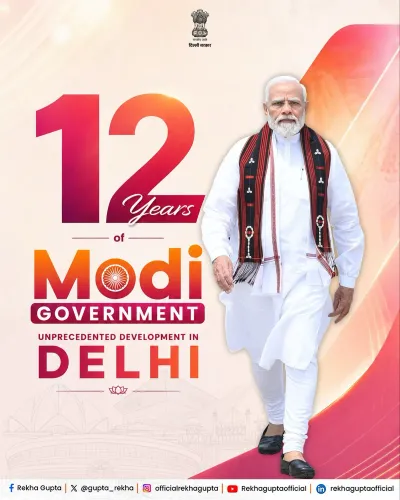
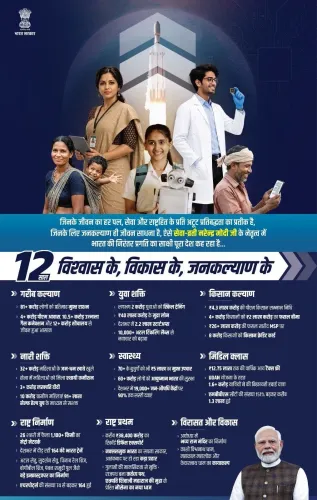
CM Rekha Gupta marks 12 years of Modi-led infrastructure push
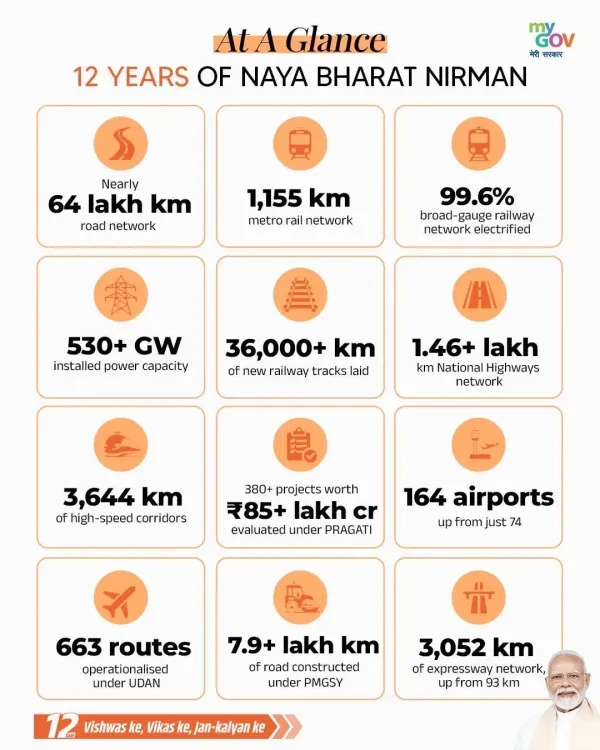
Synopsis
Delhi Chief Minister Rekha Gupta marked 12 years of PM Modi's governance on June 16, 2026, calling infrastructure 'an instrument of social justice' and positioning Delhi as a model of the Viksit Bharat vision — citing roads, railways and urban mobility as pillars of the BJP's development record.
Key Takeaways
Delhi Chief Minister Rekha Gupta posted on June 16, 2026 marking 12 years of PM Modi 's governance under the hashtag #12YearsOfNayaBharatNirman .
Gupta described roads as 'arteries of growth,' railways as 'engines of mobility,' and infrastructure as 'an instrument of social justice.' The post links Delhi's ongoing transformation to the central government's Viksit Bharat vision — India as a developed economy by 2047 .
Key central schemes referenced in the policy backdrop include Bharatmala Pariyojana (2015) and the PM Gati Shakti National Master Plan (2021).
With BJP governing both the centre and Delhi , upcoming civic budgets will be a key test of whether political messaging aligns with project delivery.
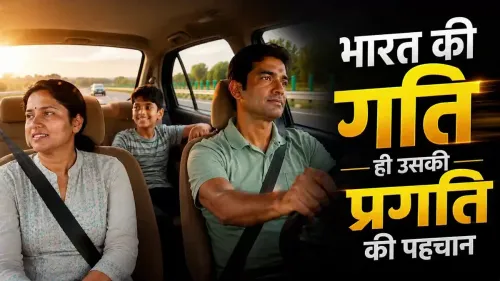
Delhi Chief Minister Rekha Gupta on Tuesday, June 16, 2026, credited the past 12 years of Prime Minister Narendra Modi's leadership with fundamentally reshaping India's infrastructure landscape, calling roads 'arteries of growth,' railways 'engines of mobility,' and infrastructure itself 'an instrument of social justice.' The remarks, posted on X under the hashtag #12YearsOfNayaBharatNirman, also positioned Delhi as a showcase of this national transformation.
Context
Gupta's post marks what the Bharatiya Janata Party (BJP) is framing as a 12-year milestone of governance under Prime Minister Modi, who took office in May 2014. The messaging is part of a coordinated political narrative — reflected in the hashtag — that ties physical infrastructure to a broader vision of national renewal. Gupta, as Delhi Chief Minister, added a local dimension by asserting that the capital is 'emerging as a city that reflects the confidence, ambition and aspirations of Viksit Bharat.'
The post is in English and quotes no specific project figures, instead offering a thematic framing of infrastructure as both economic and social policy. The reference to Viksit Bharat — the central government's vision for India as a developed economy by 2047 — signals alignment between state-level BJP leadership and the national party's long-term electoral and policy messaging.
Policy Backdrop
The 12-year period Gupta references spans several flagship central infrastructure programmes. The Bharatmala Pariyojana, launched in 2015, accelerated national highway construction across the country. The PM Gati Shakti National Master Plan, announced in 2021, introduced integrated, multi-modal infrastructure planning intended to reduce logistics costs and improve last-mile connectivity.
On the railways front, the expansion of Dedicated Freight Corridors and the rollout of Vande Bharat express services have been central to the government's pitch that rail modernisation benefits both commuters and the broader economy. These schemes collectively represent a sustained increase in central capital expenditure on physical infrastructure — a policy posture that has remained consistent across the Modi government's three terms.
Delhi itself has seen metro network expansions, road upgrades, and urban mobility investments during this period, though the pace and credit for specific projects have at times been contested between central and state governments.
Stakeholders and Impact
Delhi's roughly 3.3 crore residents are the most immediate stakeholders in the infrastructure narrative Gupta invokes. Urban commuters stand to benefit from improved road and metro connectivity, while the logistics sector — critical to the capital's role as a commercial hub — is directly affected by freight corridor and highway investments.
The framing of infrastructure as 'an instrument of social justice' is politically significant: it attempts to broaden the appeal of capital-intensive projects beyond the middle class and business community to lower-income groups who depend on affordable public transit and accessible roads. This language mirrors the central government's own communication strategy for schemes such as Bharatmala and PM Gati Shakti.
What's Next
Attention will now turn to whether Delhi's upcoming civic budgets and project announcements substantiate the transformation Gupta describes. Parliamentary discussions on central funding allocations for capital infrastructure in 2026-27 will be a key indicator of how much of this narrative translates into fresh disbursements for the capital.
With the BJP now governing Delhi at the state level, the alignment between central and state infrastructure priorities is closer than it has been for much of the past decade — making the coming budget cycle a critical test of whether the political messaging is matched by on-ground project delivery.
Point of View
She also signals the party's intent to own the capital's development story after years of fractious centre-state relations under previous administrations. The framing of roads and railways as instruments of equity, rather than mere economic assets, reflects a deliberate effort to broaden the BJP's appeal beyond its traditional urban, middle-class base. Whether the rhetoric holds up will depend on measurable project outcomes in Delhi over the next budget cycle.
NationPress
24 Sept 2026
Frequently Asked Questions
What is the #12YearsOfNayaBharatNirman hashtag about?
The hashtag marks 12 years of Prime Minister Narendra Modi's governance since 2014, with BJP leaders across the country posting about infrastructure and development milestones achieved during this period.
What is Viksit Bharat and why does Rekha Gupta mention it?
Viksit Bharat is the central government's vision to make India a fully developed economy by 2047. Rekha Gupta cited it to align Delhi's urban transformation with this national long-term goal.
What major infrastructure schemes were launched under PM Modi's government?
Key schemes include the Bharatmala Pariyojana for highway construction (2015), the PM Gati Shakti National Master Plan for integrated infrastructure (2021), and the expansion of Vande Bharat rail services and Dedicated Freight Corridors.
What infrastructure changes has Delhi seen in the last 12 years?
Delhi has seen metro network expansions, road upgrades, and urban mobility investments over the past 12 years, though the attribution of specific projects has at times been debated between central and state governments.
Who is Rekha Gupta and what is her political role?
Rekha Gupta is a BJP leader serving as the Chief Minister of Delhi, making her the head of the state government of India's national capital.