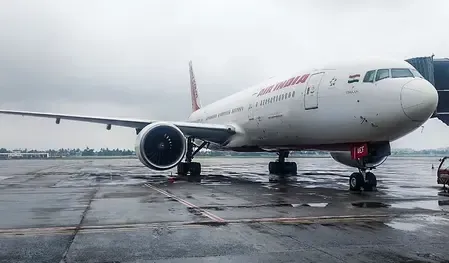
Air India Kolkata-Mumbai flight grounded 7 hours after hoax hijack note found

Synopsis
A handwritten hijack note found in an aircraft lavatory forced Air India flight AI 2772 to stay grounded at Kolkata for over seven hours, with all 105 passengers deboarded and the plane moved to an isolation bay. It is the second hoax-linked aviation security scare involving Air India in a month — and a passenger is now in police custody.
Key Takeaways
Air India flight AI 2772 (Kolkata–Mumbai) was grounded for over 7 hours on 12 November 2025 after a handwritten hijack threat note was found in the lavatory at 10.37 am .
All 105 passengers were deboarded and the aircraft moved to an isolation bay for comprehensive security checks.
Authorities declared the threat a hoax; the flight finally departed at 5.38 pm , against an original schedule of 10.30 am .
A passenger linked to the note was detained and handed over to Netaji Subhash Chandra Bose International Airport Police Station .
Last month, an Air India Frankfurt–Delhi flight made an emergency landing in Jaipur after transmitting the hijack code Squawk 7500 .
An Air India flight from Kolkata to Mumbai was grounded for nearly seven hours on Wednesday, 12 November 2025, after a handwritten hijack threat note was discovered inside the aircraft's lavatory, prompting a full security response at Netaji Subhash Chandra Bose International Airport. A passenger was subsequently apprehended and handed over to airport police, according to officials from the Airports Authority of India (AAI).
How the threat unfolded
The threat note was found by a cabin crew member at approximately 10.37 am aboard Air India flight AI 2772, roughly 23 minutes before its scheduled 10.30 am departure. The handwritten note warned that the aircraft would be hijacked at 11.10 am. Standard aviation security protocols were immediately activated.
All 105 passengers on board were deboarded and the aircraft was moved to an isolation bay for a thorough inspection. Multiple security agencies conducted mandatory screening procedures covering both passengers and the aircraft before any clearance was granted.
The all-clear and departure
After exhaustive checks, authorities declared the threat a hoax — no credible evidence of a hijacking plot was found. The aircraft was subsequently cleared for operations and departed for Mumbai at 5.38 pm, a delay of over seven hours from its original schedule.
The AAI confirmed that the passenger linked to the threat note was handed over to the Netaji Subhash Chandra Bose International Airport Police Station for further investigation. Authorities are examining the circumstances surrounding the note and a formal probe has been launched.
A pattern of aviation hoax alerts
This incident is not an isolated one. Last month, an Air India flight operating the Frankfurt-Delhi route made an emergency landing in Jaipur after reportedly transmitting Squawk 7500 — the internationally recognised aviation transponder code used to discreetly alert air traffic control to a hijacking or unlawful interference. That alert was reportedly received by Ahmedabad Air Traffic Control (ATC), and the aircraft landed safely. The precise circumstances that triggered the Squawk 7500 signal in that incident were not immediately available, according to reports.
Notably, this marks at least the second high-profile hoax or suspected hoax involving an Air India aircraft within the span of a month, raising questions about the adequacy of passenger screening and in-flight security checks at major Indian airports.
What happens next
The apprehended passenger faces investigation under applicable aviation security and criminal laws. Under Indian law, filing a false bomb or hijack threat is a serious cognisable offence that can attract significant jail time and fines. Security agencies are expected to review CCTV footage, forensic evidence from the note, and passenger manifests as part of the probe. The incident is likely to prompt a fresh review of pre-boarding screening procedures at Kolkata's international airport.
Point of View
Enormous security mobilisation, and reputational damage to a carrier mid-privatisation — is borne by the travelling public, not the perpetrators. India's aviation security laws carry stiff penalties for false threats, but their deterrent value is evidently not filtering through. The pattern also exposes a gap: pre-boarding screening failed to catch the note-writer before they boarded. That is the procedural question the DGCA and BCAS must answer publicly, not just in an internal review.
NationPress
12 Nov 2026
Frequently Asked Questions
What happened on Air India flight AI 2772 from Kolkata to Mumbai?
A handwritten hijack threat note was discovered by a cabin crew member in the aircraft's lavatory at around 10.37 am on 12 November 2025, before the flight's scheduled departure. All 105 passengers were deboarded, the aircraft was moved to an isolation bay, and after extensive checks the threat was declared a hoax. The flight eventually departed for Mumbai at 5.38 pm.
Was any real hijack threat found on Air India AI 2772?
No. After comprehensive security checks by multiple agencies, authorities found no credible threat and declared the note a hoax. The aircraft was cleared for operations and departed over seven hours late.
Who has been arrested in connection with the Kolkata hijack note?
A passenger believed to be linked to the handwritten threat note was apprehended and handed over to the Netaji Subhash Chandra Bose International Airport Police Station for further investigation. The probe is ongoing.
What is Squawk 7500 and why is it relevant here?
Squawk 7500 is an internationally recognised aviation transponder code that pilots use to discreetly signal air traffic control about a hijacking or unlawful interference. It is relevant because, separately, an Air India Frankfurt–Delhi flight transmitted this code last month, prompting an emergency landing in Jaipur — making this the second Air India security scare in a month.
What are the legal consequences for filing a false hijack threat in India?
Filing a false hijack or bomb threat is a serious cognisable offence under Indian aviation security and criminal law, attracting significant jail time and financial penalties. The detained passenger is expected to face charges following the ongoing investigation.