Anand Mahindra on Sujeet Kalkal's Asian Games comeback

Synopsis
Mahindra Group chairman Anand Mahindra used wrestler Sujeet Kalkal's stunning 9-2 deficit-to-gold comeback at the Asian Games to argue that suppressing the rational instinct to quit has been central to his own biggest business successes.
Key Takeaways
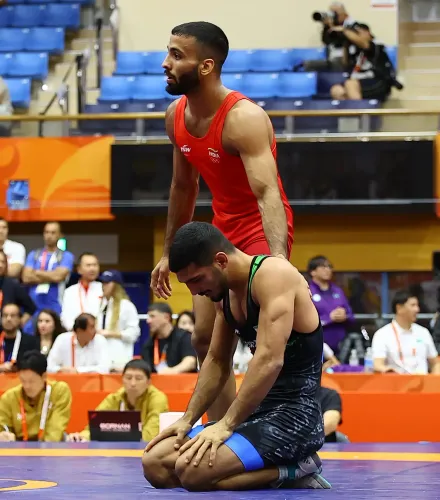
Wrestler Sujeet Kalkal trailed 9-2 with under 90 seconds remaining and won Asian Games gold, recovering to a final score of 10-9 .
Anand Mahindra invoked the comeback in a Monday, 6 October 2026 post on X as a framework for business resilience.
Mahindra acknowledged he personally hears the rational 'accept defeat' voice — and argued that knowing when to override it is the critical leadership skill.
He attributed some of his own key career successes directly to choosing the second, defiant inner voice over the rational one.
The post's closing line — 'It ain't over till it's over' — framed persistent effort not as blind optimism but as a disciplined, situational choice.
A 9-2 deficit with 90 seconds left. For most people, that scoreline is a verdict. For wrestler Sujeet Kalkal, it was apparently just a starting position. Mahindra Group chairman Anand Mahindra opened his Monday this week with that extraordinary comeback story — and turned it into a lesson he says has shaped his own career at the top of Indian industry.
From 9-2 to gold: what Kalkal actually did on that mat
At the Asian Games, Sujeet Kalkal trailed by seven points — a margin that, in competitive wrestling, the mathematics of regulation time makes almost theoretically irrecoverable. What followed, as Mahindra retells it, was a point-by-point refusal to acknowledge those mathematics. The score moved to 10-9. Then came the gold medal. The sequence is not a metaphor; it happened, on a mat, in front of a crowd, under a scoreboard that briefly made defeat look like arithmetic certainty. Mahindra's framing is precise: he distinguishes between 'the inner voice that does the maths' — the rational assessor that computes odds and counsels graceful exit — and a second voice that simply says 'Not yet.' He is explicit that he himself hears the first voice. What he argues is that knowing when to silence it is the harder, rarer skill.The business parallel Mahindra draws from his own record
Mahindra does not name specific deals or turnaround moments, but he makes a direct personal claim: 'some of my key successes in business came when I listened to my other voice that fought the rational one and simply refused to throw in the towel.' For the chairman of a conglomerate with footprints across automobiles, IT, real estate, and aerospace, that admission carries weight. The Mahindra Group has navigated multiple stress cycles — from economic downturns to fierce global competition in its core SUV business — and the chairman's willingness to attach his own credibility to a wrestler's comeback is notably unguarded for a figure of his stature. His closing line — 'It ain't over till it's over' — borrows the famous Yogi Berra aphorism, deployed here not as a cliché but as the logical endpoint of a structured argument: reason has its place, but there is a category of situations where invoking it too early is itself the error.Why a Monday-morning post lands differently than a press release
Anand Mahindra is one of India's most-followed business leaders on social media, and his #MondayMotivation dispatches have become a recurring fixture for a wide audience that spans students, entrepreneurs, and corner-office executives. What gives this particular post traction is its specificity — a real athlete, a real score, a real time window — and Mahindra's choice to make it autobiographical rather than prescriptive. He is not telling his audience what to do. He is confessing what it took for him to get it right.Point of View
This kind of autobiographical vulnerability functions as both authentic leadership storytelling and implicit corporate positioning. The framing also reflects a broader pattern among Indian business leaders who use sport as a proxy for enterprise resilience, a rhetorical bridge that plays well across demographics. What stands out here is that Mahindra grounds the lesson in a specific, verifiable athletic event rather than a vague inspirational arc — a choice that gives the argument credibility rather than the hollow ring of motivational content.
NationPress
5 Oct 2026
Frequently Asked Questions
Who is Sujeet Kalkal and what did he do at the Asian Games?
Sujeet Kalkal is an Indian wrestler who won a gold medal at the Asian Games after overturning a 9-2 deficit with less than 90 seconds remaining, ultimately winning 10-9 in a dramatic finish.
What did Anand Mahindra say about Sujeet Kalkal?
Mahindra Group chairman Anand Mahindra praised Kalkal's refusal to accept defeat and connected it to his own business philosophy, saying some of his key successes came when he silenced the rational voice that told him to quit.
What is Anand Mahindra's Monday Motivation series?
Anand Mahindra regularly posts under the hashtag #MondayMotivation on X, sharing stories, reflections, and personal lessons on leadership, innovation, and resilience with his large social media following.
What business lesson does Mahindra draw from Kalkal's comeback?
Mahindra argues that while rational assessment of odds is important, there are moments in business — as in sport — when overriding that rational instinct and simply refusing to concede is the decision that produces extraordinary results.
What is the 'it ain't over till it's over' quote Mahindra used?
The phrase is a famous aphorism associated with American baseball legend Yogi Berra, used by Mahindra to conclude his argument that premature acceptance of defeat is itself a strategic error in business and in life.