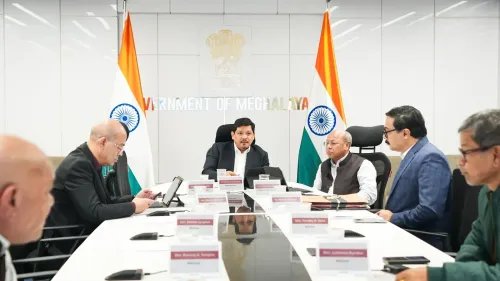
CM Conrad Sangma: Meghalaya Cabinet approves 3 new service rules

Synopsis
The Meghalaya Cabinet has approved service rules for Clinical Psychologists, Occupational Therapists, and Family Welfare Education staff, CM Conrad Sangma announced. The move is part of a state-wide mandate requiring all departments to replace ad hoc HR practices with transparent, rules-based frameworks for recruitment and promotion.
Key Takeaways
The Meghalaya Cabinet approved three new service rules: for Clinical Psychologists , Occupational Therapists , and Family Welfare Education employees.
The rules establish defined processes for vacancies, recruitment, and promotions in these cadres, replacing ad hoc practices.
The state government has made it mandatory for all departments to have service rules in place.
CM Conrad Sangma framed the approvals as part of a steady, systemic administrative reform effort.
The move aligns with a broader northeastern states trend of strengthening institutional HR frameworks in specialised sectors.
Further Cabinet approvals for service rules in additional departments and subsequent recruitment notifications are expected.
Meghalaya's administrative machinery just got a little less ad hoc. Chief Minister Conrad Sangma announced on Thursday, November 19, 2026, that the state Cabinet has approved three new sets of service rules — covering Clinical Psychologists, Occupational Therapists, and Family Welfare Education staff — as part of a broader government mandate requiring all departments to have structured HR frameworks in place.
Three departments, one clear signal
The Meghalaya Clinical Psychologists' Service Rules, the Meghalaya Occupational Therapists' Service Rules, and the Meghalaya Family Welfare Education Service Rules now give workers in these specialised sectors defined pathways for vacancies, recruitment, and promotion. Before such rules exist, appointments in these cadres often happen informally — decisions made case by case, without a binding framework. That is precisely what the Cabinet is moving away from.
Sangma framed the approvals as part of a systemic push: 'The Government has made it mandatory for all departments to have Service Rules in place to ensure that vacancies, recruitments and promotions follow a clearly defined and transparent process, moving away from ad hoc practices.'
A reform that has been building across Meghalaya's departments
This is not a one-off move. The Meghalaya Cabinet has been progressively codifying service rules across multiple departments over recent years, replacing a culture of ad hoc appointments with structured, rules-based HR governance. The pattern mirrors a wider administrative reform trend across northeastern states, where institutional mechanisms for specialised health and welfare cadres have historically been underdeveloped compared to general administration.
For health-sector employees specifically — clinical psychologists and occupational therapists being relatively newer, more specialised roles in state health systems — the absence of clear service rules had created uncertainty around career progression. The new frameworks change that.
What clarity means for state employees and citizens
The immediate beneficiaries are government employees in these three cadres: they now have a codified basis for how they will be hired, evaluated, and promoted. But the downstream benefit runs wider. Transparent recruitment reduces scope for arbitrary appointments; clear promotion criteria improve retention of trained specialists in a state that competes with metropolitan centres for skilled health professionals.
Sangma underlined the direction of travel: 'We are steadily working towards this reform, bringing greater structure, clarity and consistency to our administrative system and ensuring clear career progression for employees.' With the mandatory departmental rule requirement in place, the question is simply how fast the remaining departments follow.
Meghalaya is rewriting the fine print of how its government employs people — and in specialised healthcare, that fine print determines whether the state can hold on to the professionals its people depend on.
Point of View
Meghalaya is building an institutional floor under its HR practices, reducing the discretionary space that has historically fed patronage concerns in state recruitment. The focus on clinical psychologists and occupational therapists is also notable: these are cadres that northeastern states have struggled to staff and retain, and codified career paths are a low-cost lever to improve retention. If the reform is implemented consistently, it could become a governance reference point for other small northeastern states navigating similar capacity constraints.
NationPress
19 Nov 2026
Frequently Asked Questions
What are the three service rules approved by the Meghalaya Cabinet?
The Meghalaya Cabinet approved the Meghalaya Clinical Psychologists' Service Rules, the Meghalaya Occupational Therapists' Service Rules, and the Meghalaya Family Welfare Education Service Rules.
Why did the Meghalaya government approve these service rules?
The government approved the rules to replace ad hoc appointment and promotion practices with clearly defined, transparent frameworks for vacancies, recruitment, and career progression in these specialised departments.
Is it mandatory for all Meghalaya departments to have service rules?
Yes. Chief Minister Conrad Sangma stated that the state government has made it mandatory for all departments to have service rules in place.
Who benefits from the new Meghalaya service rules?
Government employees in the clinical psychology, occupational therapy, and family welfare education cadres are the direct beneficiaries, gaining defined pathways for hiring and promotion.
What is Conrad Sangma's role in Meghalaya?
Conrad Sangma has been Chief Minister of Meghalaya since 2018 and is also the national president of the National People's Party (NPP).