Anand Mahindra salutes Navi Mumbai, recalls Charles Correa's vision
Synopsis
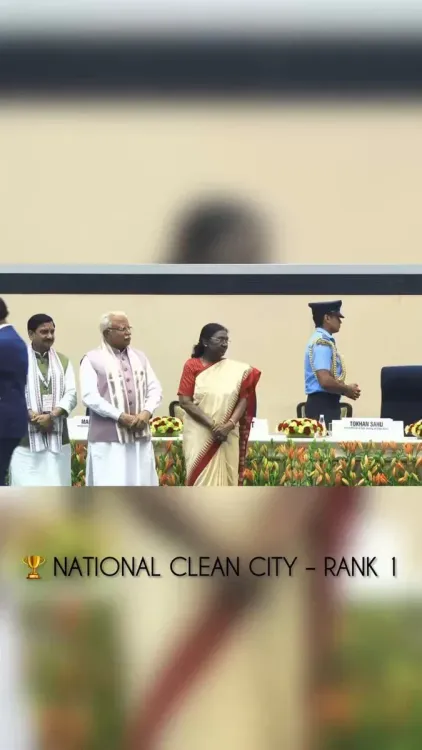
Mahindra Group chairman Anand Mahindra celebrated Navi Mumbai's cleanliness award on X, honouring legendary architect Charles Correa who led CIDCO's planning team for the satellite city over 50 years ago, calling the civic recognition the achievement that would have given Correa the greatest satisfaction.
Key Takeaways
Anand Mahindra congratulated Navi Mumbai on a cleanliness award on 12 November 2026 .
He paid tribute to architect Charles Correa , who led the planning team for Navi Mumbai under CIDCO more than half a century ago.
CIDCO was established in 1970 to build Navi Mumbai as a planned satellite city to decongest Mumbai.
Mahindra argued that a cleanliness citation — a human-scale civic outcome — would have given Correa greater satisfaction than any growth statistic.
Navi Mumbai remains one of post-independence India's most cited examples of large-scale planned urban development.
A cleanliness award has done what decades of urban growth statistics could not — it brought Mahindra Group chairman Anand Mahindra to pause and invoke the name of a legend. On Thursday, 12 November 2026, Mahindra took to X to celebrate Navi Mumbai's latest civic honour, and in the same breath, to pay tribute to Charles Correa, the architect who first drew the city into existence more than half a century ago.
Mahindra's post read: 'Bravo Navi Mumbai! And a moment to remember the legendary architect Charles Correa, who led the team that envisioned and planned this new city for CIDCO over half a century ago. Back then, it must have seemed like an almost impossible dream. But the dream became a reality. And I suspect that, more than the city's growth and success, it is this award for cleanliness that would have given Correa the greatest satisfaction.'
From an 'impossible dream' to a thriving planned city
When the City and Industrial Development Corporation of Maharashtra (CIDCO) was constituted in 1970, its mandate was audacious: build an entirely new city on the mainland east of Mumbai to relieve the island metropolis of its crushing density. Charles Correa — already regarded as one of independent India's foremost architectural minds — led the planning team that gave Navi Mumbai its bones: its street grids, its nodes, its philosophy of human-scale urban living embedded inside a modern framework.
That original vision has aged with unusual grace. What began as a government-backed new-town experiment now houses millions and anchors one of India's most significant satellite-city success stories. Post-independence India bet heavily on planned urban centres to manage metropolitan sprawl, and Navi Mumbai remains among the earliest and largest vindications of that wager.
Why cleanliness, of all things, moves Mahindra most
Mahindra's choice of emphasis is deliberate and telling. He does not reach for GDP figures or infrastructure milestones — he points to a cleanliness award as the metric that would have given Correa the deepest satisfaction. It is a quietly powerful argument: that great urban planning is ultimately judged not by what a city builds, but by how its residents choose to inhabit and care for it. A city that wins a cleanliness citation is a city whose civic contract is working.
Correa, who passed away in 2015, spent his career insisting that architecture must serve human dignity before it serves any aesthetic ideal. For Mahindra, a civic award rooted in everyday public behaviour — sweeping streets, managing waste, sustaining cleanliness — is precisely the kind of human-scale outcome Correa's work was always pointed toward.
Correa's legacy and the long arc of Indian urbanism
India's urban planning conversation today — smart cities, transit-oriented development, housing for all — still draws, often unconsciously, from the template Navi Mumbai pioneered. Contemporary cleanliness surveys and civic rankings are, in a real sense, the latest chapter in a story CIDCO and Correa began writing more than fifty years ago. That a prominent industrialist pauses in November 2026 to connect a present-day award to a 1970s blueprint is itself a signal: foundational decisions in urban design echo for generations.
The city that once seemed 'an almost impossible dream' now competes — and wins — on the metrics that matter most to the people who live in it. That is the kicker Correa could never have scripted, but would absolutely have savoured.
Point of View
Not quarters. By anchoring a present-day civic award to a 1970s planning decision, he frames urban investment as long-horizon capital allocation — a logic that resonates as Indian corporates and policy bodies debate the next wave of smart-city spending. The pivot to 'cleanliness as the truest metric' also reflects a broader ESG-era shift in how business leaders publicly evaluate public infrastructure: outcomes for residents, not just asset creation.
NationPress
12 Nov 2026
Frequently Asked Questions
Who is Charles Correa and what is his connection to Navi Mumbai?
Charles Correa was one of India's most celebrated modernist architects. He led the planning team that designed Navi Mumbai for CIDCO in the 1970s, shaping the city's layout and urban philosophy. He passed away in 2015.
What is CIDCO and why was Navi Mumbai built?
CIDCO, the City and Industrial Development Corporation of Maharashtra, was established in 1970 to develop Navi Mumbai as a planned satellite city on the mainland east of Mumbai, with the goal of relieving population and infrastructure pressure on the island city.
What cleanliness award did Navi Mumbai win?
The specific award referenced by Anand Mahindra relates to a cleanliness recognition received by Navi Mumbai. The exact name and date of the award has not been independently confirmed, but Mahindra's post indicates it is a formal civic honour for cleanliness.
Why did Anand Mahindra post about Navi Mumbai on X?
Mahindra posted to congratulate Navi Mumbai on its cleanliness award and to pay tribute to architect Charles Correa, arguing that this kind of human-scale civic achievement would have been the most meaningful recognition for Correa's original urban vision.
Is Navi Mumbai considered a successful planned city?
Yes, Navi Mumbai is widely regarded as one of post-independence India's most successful planned satellite cities, demonstrating that large-scale government-led urban development can produce sustained civic outcomes over decades.