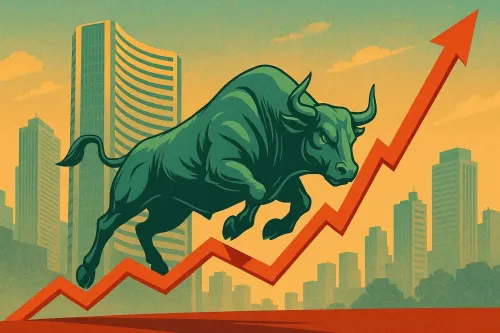
BSE market cap reclaims $5 trillion as geopolitical calm, crude drop fuel rally

Synopsis
India's equity market quietly crossed a landmark — $5 trillion in BSE market cap — not on a budget day or a policy announcement, but on the back of a potential US-Iran peace deal and falling crude. With domestic investors holding the fort against FII selling, the rally's breadth into midcaps and smallcaps signals something more than a relief bounce.
Key Takeaways
BSE total market capitalisation crossed $5 trillion on 17 June , its highest in nearly six weeks .
The rally added more than 6 per cent to aggregate market value over four trading sessions .
Sensex rose over 400 points to 77,219 ; Nifty50 gained over 100 points to 24,108 .
Sensex surged over 2 per cent in three sessions from Friday's close of 75,527.95 .
Easing US-Iran tensions and falling crude oil prices were the primary catalysts, according to analysts.
Banking , telecom , and IT sectors are expected to lead the next phase of the recovery.
The combined market capitalisation of all BSE-listed companies crossed the $5 trillion mark on Wednesday, 17 June, hitting its highest level in nearly six weeks as domestic equities rallied sharply on the back of easing geopolitical tensions and a significant decline in global crude oil prices. The milestone marks a swift reversal from the pressure that had weighed on Indian markets in preceding weeks.
What Drove the Rally
Analysts attributed the surge to two converging tailwinds: progress on a proposed US-Iran peace agreement, which tempered risk aversion across global markets, and a sharp moderation in crude oil prices that reduced inflationary pressure on the Indian economy. Falling volatility indicators further improved risk appetite, drawing buyers back into equities.
The recovery has added more than 6 per cent to the aggregate market value of BSE-listed firms over just four trading sessions, underscoring the pace and breadth of the rebound.
Broader Market Outperforms Benchmarks
While the Sensex jumped as much as 0.53 per cent, or over 400 points, to 77,219 during Wednesday's session, the gains were even more pronounced in the wider market. Midcap, smallcap, and microcap indices delivered stronger returns than benchmark gauges, reflecting wider participation in the ongoing recovery. The Nifty50 traded 0.50 per cent higher, adding more than 100 points to reach 24,108.
Notably, the Sensex surged over 2 per cent across the last three sessions, rising from Friday's closing level of 75,527.95 to Wednesday's intraday high.
Macro Relief and Domestic Resilience
According to analysts, a sustained easing of tensions in West Asia could provide meaningful relief to India's macroeconomic outlook — reducing pressure on inflation, the current account deficit, and corporate earnings simultaneously. This comes amid a period in which domestic equities have remained resilient despite persistent selling by foreign institutional investors (FIIs), largely cushioned by steady inflows from domestic investors.
Experts noted that any improvement in foreign fund flows could provide an additional boost to market sentiment in the coming months. They also pointed to structural reforms, improving corporate balance sheets, and rising capital expenditure as long-term growth drivers. Corporate leverage levels have moderated and cash-flow generation has remained healthy, according to analysts.
Sectors to Watch in the Next Phase
Analysts expect banking, telecom, and information technology to play a leading role in the next phase of the market recovery. The broader participation of midcap and smallcap stocks in the current rally suggests investor confidence is extending beyond large-cap defensives into growth-oriented segments of the market.
Whether the $5 trillion milestone holds will depend on the durability of geopolitical de-escalation and the trajectory of crude oil prices in the weeks ahead.
Point of View
But its foundation is fragile — it rests on a geopolitical development (a US-Iran peace process) that is far from concluded. Indian markets have shown structural resilience through sustained FII selling, propped up by domestic flows, but that domestic bid has limits. The broader rally in midcaps and smallcaps is encouraging as a sign of participation, yet these segments are also the most vulnerable to a reversal if crude spikes again or the peace process stalls. The macro relief narrative — lower oil, lower inflation, better current account — is compelling only if it holds. Analysts are right to flag banking and IT as next-phase leaders, but the market is pricing in an optimistic scenario that geopolitics has not yet confirmed.
NationPress
20 Sept 2026
Frequently Asked Questions
Why did BSE market cap cross $5 trillion on 17 June?
The BSE market cap crossed $5 trillion on 17 June 2025 primarily due to easing geopolitical tensions linked to a proposed US-Iran peace agreement and a sharp fall in global crude oil prices. These factors improved risk appetite and drove a broad-based rally in domestic equities.
How much has the market gained in recent sessions?
BSE-listed firms have added more than 6 per cent in market value over four trading sessions. The Sensex alone surged over 2 per cent in three sessions, rising from Friday's close of 75,527.95 to an intraday high of 77,219 on Wednesday.
Which market segments led the recovery?
Midcap, smallcap, and microcap stocks outperformed benchmark indices during the rally, reflecting wider market participation. Analysts expect banking, telecom, and information technology sectors to drive the next phase of recovery.
How have foreign and domestic investors behaved during this rally?
Foreign institutional investors (FIIs) have continued to sell, but steady inflows from domestic investors have cushioned the impact and kept equities resilient. Analysts say any improvement in FII flows could provide an additional boost to sentiment.
What does easing West Asia tension mean for India's economy?
A sustained reduction in West Asia tensions could lower crude oil prices, easing pressure on India's inflation, current account deficit, and corporate earnings. Analysts view this as a meaningful tailwind for India's near-term macroeconomic outlook.