Delhi firecracker ban: CTI asks if AQI can stay below 300 without crackers
Synopsis
Delhi's Chamber of Trade and Industry has thrown down a pointed challenge to authorities: before banning Diwali firecrackers, can anyone guarantee the city's AQI stays below 300 from October to January? With AQI already between 350–400 on three days before Diwali — and roughly 10 lakh livelihoods at stake — the debate over seasonal pollution is far more complex than a single-festival crackdown.
Key Takeaways
The Chamber of Trade and Industry (CTI) has challenged authorities to guarantee Delhi's AQI stays below 300 between October and January even if firecrackers are completely banned.
CTI Chairman Brijesh Goyal noted that Delhi's AQI was between 350 and 400 on November 5, 6, and 7 — before any firecrackers were burst on November 8 .
The CTI attributes the winter pollution spike to stubble burning in neighbouring states , not Diwali fireworks.
Around one million people across India — including workers in Sivakasi and Delhi retailers — depend on the firecracker trade for their livelihoods.
The CTI has proposed a 'balanced approach' : reduced use, designated time slots, and court-approved green crackers , instead of an outright ban.
The body has also alleged that environmental regulations are applied disproportionately to Hindu festivals compared to other public celebrations.
The Chamber of Trade and Industry (CTI) has challenged the rationale behind a complete ban on firecrackers in Delhi, questioning whether prohibiting their sale during Diwali would actually guarantee that the city's Air Quality Index (AQI) stays below 300 between October and January. The traders' body has called for a balanced approach that addresses pollution at its root rather than targeting a single-day festival.
CTI's Core Challenge to Authorities
CTI Chairman Brijesh Goyal said the organisation could persuade affiliated firecracker traders not to set up stalls or sell crackers in Delhi next year — but only if a credible and accountable authority guaranteed that the city's AQI would not cross 300 between October and January. No such guarantee, he said, has been forthcoming.
Goyal pointed to November 5, 6, and 7 as evidence, noting that Delhi's AQI had already hovered between 350 and 400 on those three days even though no firecrackers had been burst. Firecrackers were ignited on November 8, but the preceding days' data, he argued, demonstrated that the festival itself was not the root cause of the city's air crisis.
'The Chamber of Trade and Industry wishes to clarify that we are firmly opposed to pollution; we want to see clean air in Delhi. However, it is unfair to hold firecrackers — used on a single day during Diwali — solely responsible for the pollution,' the CTI said in its statement.
Stubble Burning as the Real Culprit
The CTI drew a direct correlation between stubble burning in neighbouring states and Delhi's deteriorating air quality during the winter months. The organisation pointed out that pollution levels in the capital consistently spike during October to January — the same period when crop residue burning peaks in Punjab and Haryana — and ease between March and September when such burning is absent.
'As soon as the burning of stubble begins, Delhi starts to suffocate. As soon as it stops, the air in Delhi clears. This direct correlation is no secret. So, why is the blame placed on Diwali firecrackers every year, instead of taking action against stubble burning?' Goyal said.
The question taps into a long-running policy debate: successive state and central administrations have struggled to enforce stubble-burning restrictions in neighbouring states, yet firecracker curbs in Delhi are easier to implement and enforce locally.
Economic Impact on the Firecracker Industry
The CTI highlighted that roughly one million people across the country depend on the firecracker sector for their livelihoods. This includes workers at manufacturing units in Sivakasi, Tamil Nadu — the hub of India's fireworks industry — as well as retailers and small shopkeepers in Delhi and other parts of the country.
Goyal noted that traders invest capital throughout the year and rely heavily on the 15 to 20 days around Diwali to earn a significant share of their annual income. Many have also obtained legal licences and complied with court directives by stocking 'green crackers' — a category of lower-emission fireworks approved for use in several states.
'A last-minute ban causes their entire investment to be wiped out. Even when traders have manufactured green crackers in compliance with court directives, why do they continue to be targeted repeatedly?' Goyal said.
Selective Regulation Allegation
The CTI went further, alleging that environmental restrictions were disproportionately applied to Hindu festivals. The organisation listed several examples — including water usage during Holi, concerns about the Yamuna river during Chhath Puja, DJ restrictions during the Kanwar Yatra, and pollution from Ganpati idol immersions — and questioned why comparable scrutiny was not applied to events such as New Year's Eve celebrations, during which firecrackers are routinely set off at midnight across the country.
The CTI clarified it was not opposed to any religion and respected all faiths, but said it had the right to raise questions about what it described as an uneven legal and regulatory framework.
What the CTI Is Asking For
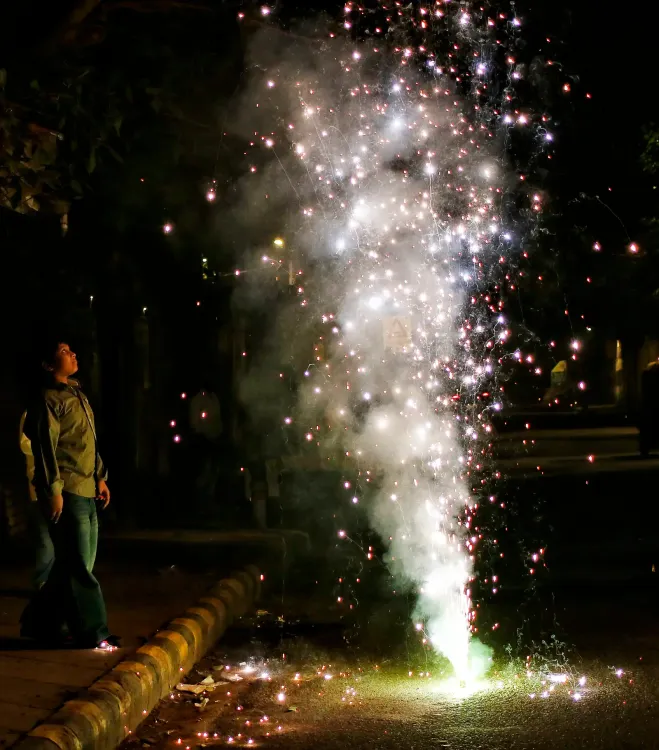
Rather than an outright ban, the organisation has advocated a 'balanced approach' involving reduced firecracker use, adherence to designated time slots, and the promotion of court-approved green crackers. It said such measures could address environmental concerns without completely eliminating the celebrations associated with the festival.
'We want a balance: clean air, thriving businesses, the preservation of traditions, the continued joy of children, and a legal framework that applies equally to all. The solution to pollution does not lie in selective bans, but rather in scientific and balanced management throughout the year,' Goyal said.
The debate is likely to intensify as Delhi's air quality enters its worst seasonal phase, with courts, environmental bodies, and trade associations all staking out increasingly divergent positions.
Point of View
Yet it sidesteps the evidence that firecracker bursting does cause measurable, temporary spikes on top of an already-stressed baseline. The more substantive point — that stubble burning is the dominant seasonal driver and receives comparatively softer enforcement — is a legitimate accountability question that policymakers have consistently failed to answer. Framing this as selective targeting of Hindu festivals, however, risks muddying a valid environmental-economics argument with identity politics, potentially weakening the credibility of the livelihood case the CTI is best-positioned to make.
NationPress
9 Nov 2026
Frequently Asked Questions
What is the CTI's argument against the Delhi firecracker ban?
The Chamber of Trade and Industry argues that a complete ban on firecrackers cannot guarantee Delhi's AQI will stay below 300 between October and January, since the city's AQI was already between 350 and 400 on November 5, 6, and 7 — days when no firecrackers were burst. The CTI holds stubble burning in neighbouring states, not Diwali fireworks, as the primary driver of winter pollution.
What was Delhi's AQI before Diwali firecrackers were burst in 2026?
According to the CTI, Delhi's AQI hovered between 350 and 400 on November 5, 6, and 7, 2026 — three consecutive days before firecrackers were ignited on November 8. The traders' body cited this as evidence that firecrackers are not the root cause of Delhi's seasonal air pollution.
How many people depend on the firecracker industry in India?
The CTI estimates that around one million people across the country are associated with the firecracker sector. This includes factory workers at manufacturing hubs such as Sivakasi in Tamil Nadu, as well as retailers and small shopkeepers in Delhi and other cities.
What alternative to a ban has the CTI proposed?
Instead of an outright prohibition, the CTI has advocated a balanced approach involving reduced firecracker use, strict adherence to designated time slots, and the promotion of court-approved green crackers. The organisation says this would address environmental concerns without destroying traders' livelihoods or eliminating the festival's celebratory element.
Why does Delhi's air quality worsen between October and January every year?
The CTI attributes the seasonal deterioration primarily to stubble burning in neighbouring states such as Punjab and Haryana, which peaks during the post-harvest months of October to December. The organisation argues that the direct correlation between crop residue burning and Delhi's AQI spikes is well-established, and calls for stronger enforcement action against stubble burning rather than festival-specific firecracker bans.