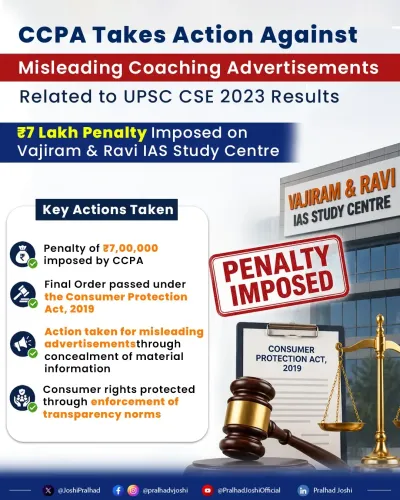
CCPA fines Motion Education ₹10 lakh, CLC ₹5 lakh for misleading coaching ads
Synopsis
India's consumer watchdog has fined two coaching institutes — Motion Education and CLC Sikar — for advertising IIT-JEE and NEET success rates without disclosing that many featured students attended free or test-series courses, not the paid programmes being promoted. The penalties are among the first major enforcements under the 2024 coaching-sector ad guidelines, and both institutes have moved the NCDRC to challenge the orders.
Key Takeaways
The CCPA imposed a ₹10 lakh penalty on Motion Education Private Limited and a ₹5 lakh penalty on Career Line Coaching (CLC) , Sikar , on 15 May .
Motion Education advertised 51.02% JEE Advanced and 91.2% NEET pass rates without disclosing that many featured students were in the free 'I-Eklavya' batch, not paid programmes.
CLC claimed '1650+ CLCians' in MBBS/IIT but gave contradictory explanations — once citing cumulative selections since 1996 , then claiming the figure covered only 2024 .
Both institutes used student names and photographs without proper consent and failed to disclose whether featured students attended full-time, crash-course, or test-series programmes.
The orders were passed by Chief Commissioner Nidhi Khare and Commissioner Anupam Mishra under the Consumer Protection Act, 2019 and the 2024 coaching-sector ad guidelines .
Both institutes have challenged the penalties before the National Consumer Disputes Redressal Commission (NCDRC) .
The Central Consumer Protection Authority (CCPA) on Friday, 15 May imposed penalties on two prominent coaching institutes — Motion Education Private Limited and Career Line Coaching (CLC), Sikar — for publishing misleading advertisements and engaging in unfair trade practices under the Consumer Protection Act, 2019. The watchdog levied ₹10 lakh on Motion Education and ₹5 lakh on CLC after finding both institutes had made exaggerated claims about student success in IIT-JEE and NEET examinations while concealing critical details about the actual courses attended by those students.
What the CCPA Found Against Motion Education
The Authority took suo motu cognisance of advertisements published by Motion Education on its official website, YouTube channel, Instagram account, and in newspapers. The institute had prominently claimed '51.02 per cent qualified students in JEE Advanced' and '91.2 per cent qualified students in NEET', while simultaneously promoting its paid classroom and residential programmes.
An investigation by the Director General (Investigation) revealed that many students featured in these advertisements were actually enrolled in 'I-Eklavya', a special rankers' batch offered free of cost to selected students through tests and interviews — a fact the institute never disclosed in its promotional material. The CCPA also found that some students whose names and photographs were used had joined the institute only after appearing for the examinations, falsely attributing their success to the coaching centre's programmes.
Additionally, the Authority noted that Motion Education had used names and photographs of students without obtaining proper consent from the students or their parents, and failed to substantiate several claims despite repeated directions to produce documentary proof.
How CLC Sikar's Ads Were Found Misleading
Career Line Coaching (CLC), based in Sikar, Rajasthan, came under scrutiny for claims including '1650+ CLCians in MBBS, IIT & Others', '2 CLCians in NEET AIR-100', and '3 CLCians at AIIMS Delhi'. The investigation found that several students featured in its advertisements were enrolled only for test series courses — not full-time classroom programmes — a fact the institute allegedly concealed from prospective students and parents.
The CCPA also flagged contradictions in CLC's own submissions: the institute initially claimed the figure of '1650+' represented cumulative selections since 1996, then later argued during hearings that it referred only to the year 2024. The Authority held that such contradictory statements rendered the claims misleading and unsubstantiated. CLC also failed to produce documentary evidence of written consent obtained from successful candidates after declaration of results, as mandated under the Guidelines for Prevention of Misleading Advertisement in Coaching Sector, 2024.
Orders Passed and What Both Institutes Must Do
The orders were passed by the CCPA headed by Chief Commissioner Nidhi Khare and Commissioner Anupam Mishra. Both institutes have been directed to immediately discontinue the offending advertisements, refrain from publishing similar material in future, and ensure truthful and complete disclosures in all promotional content going forward.
Both Motion Education and CLC have challenged the CCPA's orders before the National Consumer Disputes Redressal Commission (NCDRC).
Broader Context: Coaching Sector Under Regulatory Lens
This action is part of a wider regulatory push targeting the coaching industry, which has faced mounting criticism for aggressive and often unverifiable advertising claims. The Guidelines for Prevention of Misleading Advertisement in Coaching Sector, 2024 were specifically introduced to address such practices — making these penalties among the first high-profile enforcements under that framework. Notably, coaching institutes across India routinely feature toppers in promotional material without clearly distinguishing between paid and complimentary course enrolments, a practice that the CCPA is now explicitly targeting.
With both institutes approaching the NCDRC, the legal proceedings will test how robustly the 2024 guidelines can be enforced — and could set a precedent for the broader coaching sector.
Point of View
Which raises the question of whether fines alone will deter an industry where a single high-rank advertisement can drive crores in enrolments. The 2024 coaching-sector guidelines exist precisely because self-regulation failed; the real test is whether the NCDRC upholds these orders or dilutes them on appeal. If it does the latter, the guidelines risk becoming another toothless framework in a sector that has long outpaced its regulators.
NationPress
19 Sept 2026
Frequently Asked Questions
Why did the CCPA fine Motion Education and CLC?
The CCPA fined Motion Education ₹10 lakh and CLC ₹5 lakh for publishing misleading advertisements that promoted high IIT-JEE and NEET success rates without disclosing that many featured students were enrolled in free or test-series courses rather than the paid programmes being advertised. Both institutes were also found to have used student names and photographs without proper consent.
What was misleading about Motion Education's advertisements?
Motion Education claimed 51.02% of its students qualified in JEE Advanced and 91.2% in NEET, but an investigation found many of those students were in 'I-Eklavya', a free rankers' batch — not the paid classroom programmes the ads were promoting. Some students featured had also joined the institute only after their exams, meaning their results could not be attributed to the coaching.
What was wrong with CLC Sikar's '1650+ CLCians' claim?
The CCPA found that CLC gave contradictory explanations for the figure — initially saying it represented cumulative selections since 1996, then claiming during hearings it referred only to 2024. Several students in the ads were enrolled only for test series, not full-time courses. The Authority held these inconsistencies made the claim misleading and unsubstantiated.
What are the coaching-sector ad guidelines under which action was taken?
The Guidelines for Prevention of Misleading Advertisement in Coaching Sector, 2024 require institutes to clearly disclose the nature of the course attended by any student featured in promotional material and to obtain written consent from successful candidates after results are declared. The CCPA found both institutes had violated these requirements.
What happens next after the CCPA orders?
Both Motion Education and Career Line Coaching have challenged the CCPA's penalty orders before the National Consumer Disputes Redressal Commission (NCDRC). The outcome of those proceedings will determine whether the penalties stand and could set a precedent for how strictly the 2024 coaching-sector ad guidelines are enforced across the industry.