Centre launches QPR portal for data harmonisation across Ministries
Synopsis
India’s fragmented federal data architecture just got a structural fix — or at least a framework for one. The QPR Portal on Data Harmonisation, launched by MoSPI on 8 September, compels all Union Ministries to standardise datasets, metadata and identifiers on a quarterly basis, with automated cross-checks and dashboards. The real test is whether Ministries comply in substance, not just in form.
Key Takeaways
The Centre launched the QPR Portal on Data Harmonisation on 8 September , covering all Union Ministries , departments and organisations.
The portal was unveiled at a MoSPI workshop and supports the National Data System through automated validation, dashboards and cross-verification with the NMDS portal.
Shaktikanta Das , Principal Secretary-2 to the Prime Minister, launched the portal, stressing the need for trusted, timely and interoperable data.
Krishnan linked high-quality data availability to the successful deployment of Artificial Intelligence (AI) in governance.
MoSPI Secretary Saurabh Garg called for a shift from siloed departmental systems to an integrated, government-wide data ecosystem with harmonised definitions and identifiers.
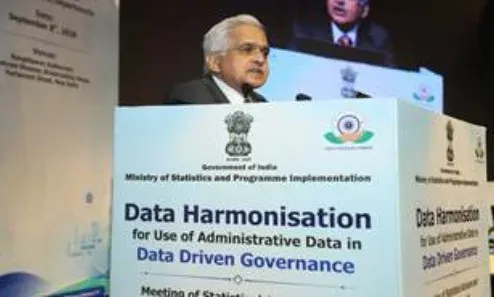
The Centre on Tuesday, 8 September launched a Quarterly Progress Report (QPR) Portal on Data Harmonisation for use by all Union Ministries, departments and organisations, with the stated aim of advancing data-driven governance and evidence-based policymaking across the federal government. The portal was unveiled at a workshop organised by the Ministry of Statistics and Programme Implementation (MoSPI) in New Delhi.
What the QPR Portal Does
The QPR Portal is a technology-enabled platform designed to allow all Union Ministries, departments and organisations to report progress on the identification and cataloguing of datasets prepared for public dissemination. It also covers metadata preparation, adoption of national and international standards, use of common unique identifiers in machine-readable formats, and quality checks as prescribed under the Statistical Quality Assurance Framework (SQAF).
The portal features automated validation, real-time dashboards, and cross-verification with the National Metadata Structure (NMDS) web portal. It is designed to generate analytical insights across Ministries, departments and organisations, replacing fragmented, siloed reporting with a unified, interoperable data ecosystem.
What Senior Officials Said
Shaktikanta Das, Principal Secretary-2 to Prime Minister Narendra Modi, launched the portal and underscored that trusted, timely and interoperable data is essential for evidence-based policymaking and data-driven governance. He called for greater use of administrative data and statistical expertise across Ministries for policy formulation, monitoring and outcome assessment.
S. Krishnan, Secretary of the Ministry of Electronics and Information Technology (MeitY), highlighted the importance of effective data sharing, harmonisation and interoperability across Ministries. He stressed that high-quality data is fundamental to the successful deployment of Artificial Intelligence (AI) in governance. “Efforts should focus on utilising such data effectively for improved welfare outcomes, policy formulation and delivery of government services. Whole-of-government approach should be adopted. Existing resources, including statistical officers, India AI Mission experts, NIC personnel and other data professionals working across Ministries and Departments, should be leveraged,” he said.
Saurabh Garg, Secretary of MoSPI, emphasised the need to move away from siloed departmental data systems toward an integrated, government-wide data ecosystem. He underscored harmonisation of concepts, definitions, classifications, identifiers, geographies, metadata and data structures for effective data utilisation, and highlighted the complementary roles of Statistical Advisers and Chief Data Officers in ensuring data quality and interoperability.
Why This Initiative Matters
India’s federal data architecture has long been criticised for inconsistency across Ministries — different departments have historically used divergent definitions, classifications and identifiers for the same datasets, making cross-Ministry analysis difficult. This initiative, backed by the National Data Governance Committee, represents a structural attempt to address that fragmentation. Notably, the launch also aligns with the government’s broader push under the India AI Mission, which requires clean, interoperable datasets to function at scale.
The emphasis on administrative data — data generated as a by-product of government operations — is significant. With rapid digitisation expanding the volume of such data, officials argue that leveraging it effectively could improve welfare delivery and reduce duplication in policy monitoring.
What Comes Next
All Union Ministries, departments and organisations are now expected to begin using the QPR Portal to report their data harmonisation progress on a quarterly basis. The portal’s cross-verification with the NMDS web portal is intended to enforce consistency over time. How swiftly Ministries adopt the platform — and whether reporting translates into genuine interoperability — will determine the initiative’s real-world impact.
Point of View
But India has a long history of governance portals that generate dashboards without driving behaviour change. The real question is whether Ministries will treat quarterly reporting as a compliance checkbox or as a genuine data-quality exercise. The involvement of MeitY and the India AI Mission signals that this is partly about building clean datasets for AI applications — which raises the stakes considerably. If inter-Ministry data remains inconsistent in practice, the AI ambitions built on top of it will be similarly unreliable.
NationPress
24 Oct 2026
Frequently Asked Questions
What is the QPR Portal on Data Harmonisation launched by the Centre?
The QPR Portal on Data Harmonisation is a technology-enabled platform launched on 8 September by MoSPI for use by all Union Ministries, departments and organisations. It enables quarterly reporting on dataset identification, metadata preparation, adoption of national and international standards, and quality checks under the Statistical Quality Assurance Framework (SQAF).
Who launched the QPR Portal and what was the occasion?
The portal was launched by Shaktikanta Das, Principal Secretary-2 to Prime Minister Narendra Modi, at a workshop organised by the Ministry of Statistics and Programme Implementation (MoSPI) in New Delhi on 8 September. The event focused on strengthening the National Data System and promoting administrative data harmonisation.
Why is data harmonisation across Ministries important for India?
Different Ministries have historically used divergent definitions, classifications and identifiers for the same datasets, making cross-Ministry analysis and policy monitoring difficult. Harmonisation is also critical for the government’s AI ambitions, as high-quality, interoperable data is a prerequisite for deploying AI in governance effectively.
What role does Artificial Intelligence play in this initiative?
MeitY Secretary S. Krishnan stated that the availability of high-quality data is fundamental to the successful deployment of AI for governance. The QPR Portal is aligned with the India AI Mission, which requires clean, standardised datasets across government departments to function at scale.
Who is responsible for overseeing data governance under this framework?
MoSPI Secretary Saurabh Garg highlighted the complementary roles of Statistical Advisers, who handle statistical leadership and quality assurance, and Chief Data Officers, who manage data governance and interoperability. Both are supported by the National Data Governance Committee and the QPR on Data Harmonisation.