Chandrasekaran backs patient capital in semiconductors, eyes India's long-term chip future
Synopsis
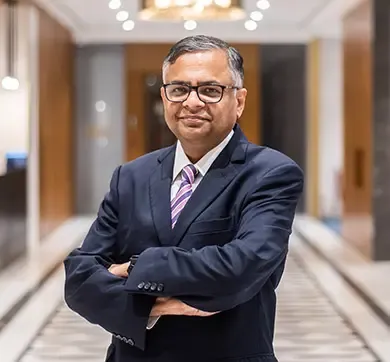
Tata Sons Chairman N. Chandrasekaran used the Bloomberg New Economy Forum 2026 to reframe India's semiconductor debate — away from missed milestones and toward the inevitability of the long game. With electronics exports up nearly four-fold to $48 billion, he made the case that patient, disciplined capital — not headline chip announcements — is what will determine whether India truly joins the global semiconductor map.
Key Takeaways
Tata Sons Chairman N.
Chandrasekaran spoke at the Bloomberg New Economy Forum 2026 in New Delhi on 13 October 2026 .
He argued India's long-term semiconductor need matters more than whether two- or three-year targets are met on schedule.
India's electronics exports have grown from approximately $12 billion five years ago to $48 billion in 2026.
Chandrasekaran cautioned against recklessness, saying announcing a 2-nanometer chip without demand alignment would not work.
A cyber attack cost Jaguar Land Rover nearly six weeks of production , cited as evidence that resilience is an efficiency strategy, not a trade-off.
Despite global disruptions, the Tata Group is on track for double-digit growth with margins holding up.
Tata Sons Chairman N. Chandrasekaran on Tuesday, 13 October 2026 made a strong case for patient, long-term investment in strategic sectors such as semiconductors, arguing that India's enduring need for chips matters far more than whether near-term milestones are hit on schedule. Speaking at the Bloomberg New Economy Forum 2026 in New Delhi, Chandrasekaran said the fundamentals of the industry are not in question — only the pace.
Long-Term Vision Over Short-Term Targets
Chandrasekaran was direct: whether semiconductor targets are met in two years or three years is secondary, because chips will be fundamentally required by economies, enterprises and people alike. He argued that if investment decisions are grounded in the belief that the technology is indispensable for India and the world, the direction will ultimately prove correct — even if the path is not smooth.
'Directionally, if you design it on the belief that it is needed for India, it is needed for mankind and for enterprises, you will get it right. It doesn't mean everything will be smooth,' he said.
India's Electronics Export Surge
Underscoring the sector's momentum, Chandrasekaran highlighted that India's electronics exports have risen sharply from approximately $12 billion five years ago to $48 billion this year — a near four-fold jump that reflects the country's growing footprint in global supply chains. Notably, this growth has come even before India's domestic semiconductor fabrication capacity is fully established, suggesting significant runway ahead.
Ambition Must Be Matched With Financial Discipline
Chandrasekaran was equally emphatic that ambition cannot come at the cost of balance-sheet discipline. 'You need to keep an eye on the balance sheet. So you can't be reckless,' he said. He cautioned that simply announcing a 2-nanometer chip roadmap would not be credible at this stage — Tata, he said, must follow actual demand and pursue technologies where commercial viability is demonstrable. He also acknowledged that India does not yet possess all the required technologies and needs global partners to fill those gaps.
His investment yardsticks were clear: the importance of a project for India, its businesses and people; the jobs it creates; and its financial viability. Direction and need are certain, he said, but the speed of ramp-up and specific technology choices remain areas of uncertainty that require ongoing calibration.
Resilience Is Efficiency in a Volatile World
Chandrasekaran pushed back on the widely held view that building for resilience necessarily sacrifices efficiency. In a volatile environment, he argued, designing for resilience is itself the optimal way to run an enterprise. He cited two concrete examples: a cyber attack that cost Jaguar Land Rover nearly six weeks of production, and supply disruptions such as magnet shortages that can bring vehicle output to a halt. These are not tail risks, he implied — they are the new operating reality.
He added that despite these shocks, the Tata Group remains on track to deliver double-digit growth with margins holding up, pointing to the group's diversified structure as a buffer against sector-specific disruptions.
The Broader Context
Chandrasekaran's remarks come as India accelerates its semiconductor ambitions, with the Centre having approved several chip and display fabrication projects under its India Semiconductor Mission. The global semiconductor industry is itself navigating a complex moment — geopolitical fragmentation, export controls, and post-pandemic demand corrections have created both urgency and uncertainty for new entrants. His framing of 'patient capital' as the appropriate response aligns with how other major semiconductor-aspiring nations — from the United States to Japan — have approached the sector's long investment cycles.
With Tata Electronics already involved in chip packaging and assembly, Chandrasekaran's comments are likely to be read as a calibration of expectations rather than a retreat from ambition. The road ahead, he suggested, will be defined less by headline announcements and more by disciplined execution.
Point of View
Not design or fabrication. The harder question is whether patience is a strategic posture or a soft cover for slow execution. His admission that India lacks all required technologies and needs global partners is honest, but it also underscores how far the country remains from fab-level self-sufficiency. The real test of the 'long game' framing will come when the first large disbursements under the India Semiconductor Mission face parliamentary review.
NationPress
13 Oct 2026
Frequently Asked Questions
What did N. Chandrasekaran say about India's semiconductor sector?
Chandrasekaran said India's long-term need for semiconductors matters more than whether near-term targets are met in two or three years, arguing that chips are fundamentally required by economies, enterprises and people. He made these remarks at the Bloomberg New Economy Forum 2026 in New Delhi on 13 October 2026.
How much have India's electronics exports grown?
India's electronics exports have risen from approximately $12 billion five years ago to $48 billion in 2026, a near four-fold increase. Chandrasekaran cited this as evidence of India's growing role in global electronics supply chains.
Why did Chandrasekaran caution against announcing a 2-nanometer chip?
He said Tata must follow actual demand and that India does not yet possess all the technologies needed for cutting-edge chip fabrication, requiring global partners to fill gaps. Simply announcing advanced chip targets without the underlying demand and technology base would not be credible.
How does Chandrasekaran view the trade-off between resilience and efficiency?
He argued there is no trade-off — designing for resilience in a volatile environment is itself the most efficient strategy. He cited a cyber attack that cost Jaguar Land Rover nearly six weeks of production and magnet shortages halting vehicle output as proof that resilience failures are costly efficiency failures.
What is the Tata Group's financial outlook despite global disruptions?
Chandrasekaran said the Tata Group remains on track for double-digit growth with margins holding up, crediting its diversified structure as a buffer against sector-specific shocks.