Chariot-1 AI models launched by MeitY under IndiaAI Mission
Synopsis
India's sovereign AI push has its first showcase: Chariot-1, an LLM and speech model trained from scratch at home. Its IndicShift tokeniser reportedly uses up to 2.5 times fewer tokens on Indian text than OpenAI's GPT tokeniser, a gain that could make AI in regional languages far cheaper to run.
Key Takeaways
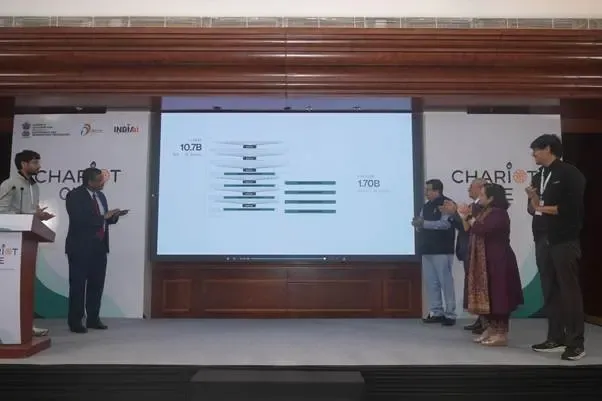
Krishnan launched the Chariot-1 foundation models in New Delhi on 26 November 2026 .
The suite includes an LLM and a TTS model, both pre-trained from scratch in India by Chariot Artificial Intelligence .
IndicShift maps 1,012 characters across 12 scripts onto 350 letters and reportedly uses up to 2.5x fewer tokens than OpenAI's GPT tokeniser.
Nested Training reportedly speeds up training by 62 per cent and supports deployment from data centres to edge devices.
Chariot-1 TTS supports English and 10 Indian languages .
Chariot is one of the first four teams selected to build sovereign models under the IndiaAI Mission.
The Ministry of Electronics and Information Technology (MeitY) on Thursday, 26 November 2026, launched the Chariot-1 foundation models in New Delhi. The indigenous artificial intelligence (AI) suite was developed by Chariot Artificial Intelligence under the IndiaAI Mission. The models were pre-trained from scratch in India and target multilingual language processing and speech generation built around the country's linguistic diversity, according to an official statement.
MeitY Secretary S. Krishnan launched the models alongside a research showcase. The ministry said the event highlights India's growing capacity to build sovereign AI technologies through domestic research and innovation.
What the Chariot-1 Suite Includes
The Chariot-1 suite has two components: the Chariot-1 Large Language Model (LLM) and Chariot-1 Text-to-Speech (TTS). Both were developed through pre-training from scratch in India, not by adapting a foreign base model.
According to the ministry, the models include new research aimed at improving computational efficiency, multilingual capability and adaptability across different deployment environments.
The TTS model can generate speech in English and 10 Indian languages: Hindi, Bengali, Marathi, Tamil, Telugu, Kannada, Malayalam, Gujarati, Punjabi and Odia.
Key Research Innovations Showcased
The launch featured three research innovations developed by the Chariot team and built into the training of the Chariot-1 models. The statement detailed two of them.
IndicShift, released as open source, introduces a shared alphabet for Indian scripts. This lets AI models use the similarities between languages instead of processing each script separately.
IndicShift maps 1,012 characters across 12 Indian scripts onto 350 letters. The developers report that it uses up to 2.5 times fewer tokens on Indian text than OpenAI's GPT tokeniser.
The research also reports a 5 per cent to 8 per cent gain in model performance on Indian languages using the same compute. Performance in English and code was maintained.
Nested Training tackles a common industry problem: building separate models for different computing environments. The method allows deployment across data centres, laptops, smartphones and edge devices. It reportedly delivers a 62 per cent improvement in training speed compared with training the three model sizes separately.
Why It Matters for India's Sovereign AI Push
Chariot Artificial Intelligence is one of the first four teams selected under the IndiaAI Mission to build sovereign foundation models. That makes Chariot-1 an early test of whether the government-backed programme can produce usable, home-grown AI systems.
The ministry said the initiative reflects the government's commitment to building indigenous AI capabilities and supporting advanced research. It also aims to enable AI models that address India's unique technological, linguistic and societal requirements.
Tokenisation efficiency matters because many global models split Indian-language text into far more tokens than English. More tokens raise inference costs and can lower output quality. If IndicShift's reported gains hold up under independent testing, AI services in regional languages could become cheaper to deploy at scale.
What Comes Next
The other teams selected under the IndiaAI Mission are still building their own sovereign models. Researchers and developers are likely to judge Chariot-1 by how its reported benchmarks perform in independent evaluations and real-world use.
Point of View
Every performance figure so far comes from the developers themselves. The credibility of India's sovereign AI ambition now depends on independent benchmarking and on whether real deployments in government and industry follow, instead of another showcase.
NationPress
26 Nov 2026
Frequently Asked Questions
Who launched the Chariot-1 AI models?
MeitY Secretary S. Krishnan launched the Chariot-1 models in New Delhi on 26 November 2026, alongside a research showcase by the Chariot team.
Which languages does Chariot-1 TTS support?
Chariot-1 TTS generates speech in English and 10 Indian languages: Hindi, Bengali, Marathi, Tamil, Telugu, Kannada, Malayalam, Gujarati, Punjabi and Odia.
How does Chariot-1 fit into the IndiaAI Mission?
Chariot Artificial Intelligence is one of the first four teams selected under the IndiaAI Mission to develop sovereign foundation models. The launch is part of the government's effort to build AI suited to India's linguistic and societal needs.