Dual-chipset phones redefine mobile gaming in India's ₹30,000 segment
Synopsis
India's ₹30,000 smartphone segment is no longer a spec-sheet race — it's an architecture race. With mobile gaming projected to command 80% of a $9.89 billion market by 2031, brands are deploying dual-chipset designs that split computing and AI visual tasks across two processors, delivering frame stability and thermal control that a single chip increasingly cannot sustain alone.
Key Takeaways
India's gaming market is projected to grow from $5 billion in 2026 to $9.89 billion by 2031 , at a 14.52% CAGR , with mobile accounting for nearly 80% of the market.
89% of Indian smartphone buyers say AI features influence their purchase decision, according to the Flipkart x Counterpoint Smartphone Insights Report 2026 .
Dual-chipset architecture distributes workloads between a primary application processor and a dedicated AI chip, improving frame stability, thermals, and battery efficiency.
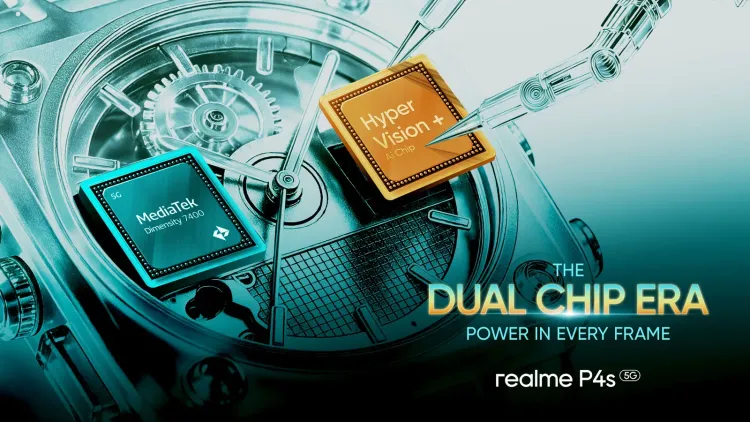
The realme P4s 5G , launching 26 August , pairs the MediaTek Dimensity 7400 Ultra with the Hyper Vision+ AI Chip , a 144Hz Samsung 1.5K AMOLED display, and an 8,000 mAh battery with 80W fast charging.
AI visual processing benefits extend beyond gaming to video streaming, sports content, and HDR viewing experiences.
India's mobile gaming market is undergoing a fundamental hardware shift, with dual-chipset architecture emerging as the defining feature of the best gaming phones under ₹30,000 in 2026. Rather than competing on raw processor speed alone, manufacturers are pairing primary application processors with dedicated AI chips to deliver more consistent frame rates, richer visuals, and better thermal management over extended sessions.
Why the market is demanding more
According to data from Mordor Intelligence, India's gaming market is projected to grow from approximately $5 billion in 2026 to $9.89 billion by 2031, at a compound annual growth rate of 14.52%. Mobile accounts for close to 80% of that market, making the smartphone the country's primary gaming device — ahead of consoles and PCs.
This growth is pushing the performance bar higher. Users now expect high refresh rates, low-latency touch response, stable frame delivery, and sustained performance across long sessions — requirements that a single processor increasingly struggles to meet without thermal throttling.
AI's expanding role in gaming performance
Artificial intelligence is no longer confined to photography and productivity features on smartphones. In gaming, dedicated AI processing is being used to generate intermediate frames for smoother motion, reconstruct visual detail without demanding higher native rendering loads, and dynamically adjust graphics based on real-time on-screen activity.
This trend aligns with shifting buyer behaviour. According to the Flipkart x Counterpoint Smartphone Insights Report 2026, 89% of Indian smartphone buyers now say AI features influence their purchase decision — a significant move from AI being a secondary consideration to a core expectation at the point of sale.
How dual-chip architecture distributes the load
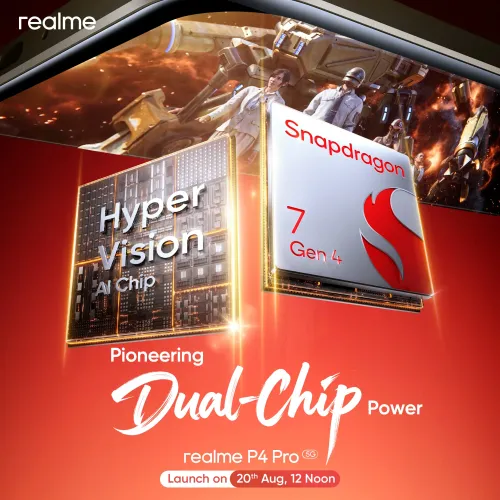
The underlying logic of dual-chipset design is workload distribution. By offloading visual processing and AI tasks to a secondary dedicated chip, the primary application processor is freed to focus on core computing. The result, according to manufacturers, is more stable frame rates, reduced heat buildup, and better battery efficiency during extended gaming sessions.
Realme's P4 series has brought this architecture to the sub-₹30,000 segment. The realme P4s 5G, set to launch on 26 August, pairs the MediaTek Dimensity 7400 Ultra with a dedicated Hyper Vision+ AI Chip. While the Dimensity 7400 Ultra handles core computing, the AI chip manages visual processing tasks — enabling smoother graphics, higher frame rates, and enhanced HDR output.
Display, cooling, and battery: the full stack
The dual-chip setup on the realme P4s 5G is paired with a 144Hz Samsung 1.5K AMOLED display and up to 3,000Hz instantaneous touch sampling. AI capabilities include AI Hyper Motion for frame stability, AI Hyper Clarity for sharper visuals, and AI Always-On HDR for improved brightness and contrast.
Thermal management is handled by a 7,000 mm² AirFlow VC Cooling System. Battery capacity stands at 8,000 mAh with 80W fast charging and All-Scenario Bypass Charging — positioning the device among the more capable options for users who prioritise endurance over extended gaming or streaming sessions.
The AI Gaming Partner suite — covering GT Mode, Cleanup Acceleration, Do Not Disturb, and network optimisation — manages background resources and system performance during gameplay.
Beyond gaming: content and streaming benefits
The benefits of the Hyper Vision+ AI Chip are not limited to gaming. The chip is also designed to improve motion clarity and dynamic range for video content, making fast-moving material such as sports broadcasts and action sequences appear smoother and more vibrant on screen.
As these technologies mature and become more integrated across mid-range devices, the distinction between a gaming phone and a premium content-consumption device is narrowing. The trajectory suggests that specialised AI processing and intelligent hardware coordination — not peak benchmark scores — will define the next generation of mobile gaming and viewing experiences in India.
Point of View
But it also reflects a genuine engineering constraint: single-chip designs throttle under sustained load, and thermal management in slim mid-range bodies is a real bottleneck. The more interesting question is whether dedicated AI visual chips deliver measurable, user-perceptible improvements in everyday conditions — not benchmark labs. India's 80% mobile-first gaming base is a demanding real-world test. If the frame-stability and HDR claims hold up in extended sessions at room temperature, this architecture could set a new floor expectation for the sub-₹30,000 segment. If they don't, it risks becoming another spec-sheet differentiator that fades into background noise.
NationPress
8 Oct 2026
Frequently Asked Questions
What is dual-chipset technology in smartphones?
Dual-chipset technology pairs a primary application processor with a dedicated secondary chip — typically focused on AI or visual processing tasks. By distributing workloads between the two, the main processor is freed from graphics-intensive tasks, which can result in more stable frame rates, lower heat output, and improved battery efficiency during gaming or video playback.
How big is India's mobile gaming market in 2026?
According to data from Mordor Intelligence, India's gaming market is valued at approximately $5 billion in 2026 and is projected to reach $9.89 billion by 2031, growing at a 14.52% CAGR. Mobile devices account for close to 80% of that market, making smartphones the dominant gaming platform in the country.
What is the realme P4s 5G and when does it launch?
The realme P4s 5G is a smartphone priced in the sub-₹30,000 segment, set to launch on 26 August. It features a dual-chip architecture combining the MediaTek Dimensity 7400 Ultra with a dedicated Hyper Vision+ AI Chip, a 144Hz Samsung 1.5K AMOLED display, 3,000Hz touch sampling, an 8,000 mAh battery with 80W fast charging, and a 7,000 mm² vapour-chamber cooling system.
Why do AI features matter for Indian smartphone buyers?
According to the Flipkart x Counterpoint Smartphone Insights Report 2026, 89% of Indian smartphone buyers say AI features influence their purchase decision. This marks a shift from AI being a secondary selling point to a core expectation, particularly in gaming, photography, and visual content consumption.
Does dual-chipset architecture benefit content viewing as well as gaming?
Yes. Dedicated AI visual chips are designed to improve motion clarity, sharpness, and dynamic range for video content — not just games. Fast-moving content such as sports broadcasts and action sequences can appear smoother and more vibrant, effectively extending the gaming-focused hardware benefits to everyday streaming and viewing use cases.