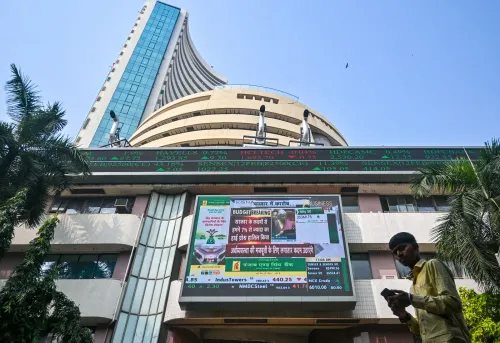
FIIs net sellers for 6th straight week, offload ₹11,490 crore amid geopolitical turbulence

Synopsis
Foreign investors have now sold net ₹18,531 crore in September alone, yet the Nifty has not collapsed — because domestic institutions have pumped in more than ₹52,617 crore this month. The divergence is historic in scale, and it raises a critical question: how long can DII firepower hold the line if FII selling and $105-a-barrel crude persist into October?
Key Takeaways
FIIs remained net sellers for the sixth consecutive week , offloading ₹11,490 crore as of 26 September 2026 .
DIIs net bought ₹16,398 crore during the same week, cushioning the decline.
Month-to-date, FIIs have sold a net ₹18,531 crore against DII net buying of ₹52,617 crore .
The Nifty50 has slid 4.91 per cent over the past month, from 24,334.55 to 23,140.50 .
The Sensex closed at 73,895.74 on Friday, up 0.43 per cent after a partial recovery.
Brent crude near $105–106 a barrel , US–Iran tensions, and US Q2 GDP data are the key triggers for the week ahead.
Foreign institutional investors (FIIs) remained net sellers for the sixth consecutive week, offloading a net ₹11,490 crore from Indian equities, according to exchange data. Domestic institutional investors (DIIs), however, continued to act as a counterweight, logging net purchases of ₹16,398 crore during the same period and cushioning the broader market decline.
Month-to-Date Scorecard
On a month-to-date basis through 26 September 2026, FIIs have net sold ₹18,531 crore worth of Indian equities, while DIIs have net bought ₹52,617 crore — a stark divergence that underlines the growing role of domestic capital in providing market stability. Despite this DII buffer, the Nifty50 has declined 3.90 per cent from its August-end close of 24,080.40.
One-Month Trend: FII Selling vs DII Support
Over the past month, FIIs were net sellers in every single week, while DIIs remained consistent net buyers throughout. According to Pabitro Mukherjee, Deputy Vice President – Research at Bajaj Broking, this sustained divergence has limited the Nifty's slide to 4.91 per cent, from a high of 24,334.55 down to 23,140.50. Notably, this marks one of the most persistent bouts of foreign selling seen in recent quarters, with no single week of FII net buying in the past month.
Friday's Market Session
Markets witnessed a volatile session on Friday, eventually ending with modest gains and a partial recovery from the sharp sell-off of the prior session. After a marginally positive open, benchmark indices oscillated within a narrow range before settling — the Nifty50 closed at 23,140.50 while the Sensex ended at 73,895.74, up 0.43 per cent. Analysts noted that oversold positions in sectoral heavyweights provided some bottom-up support and helped limit further downside.
Key Macro Triggers to Watch
The recovery remained measured as investors continued to monitor elevated global yields, sticky crude oil prices, and persistent foreign selling pressure. Brent crude, trading near $105–106 a barrel, remains too elevated to offer meaningful macroeconomic relief for India, a major oil importer. Market participants noted that progress in US–Iran negotiations could ease the geopolitical risk premium embedded in oil prices, while any renewed escalation or supply disruption could intensify inflationary pressures further. In the coming week, market direction is likely to be shaped by Brent crude movements, US–Iran geopolitical developments, and the release of US Q2 GDP data.
Outlook
If FII selling persists and global headwinds continue, Indian markets are likely to remain volatile in the near term. However, steady DII buying is broadly expected to continue limiting the downside. The key question for the weeks ahead is whether domestic institutional firepower remains sufficient to absorb sustained foreign outflows — a dynamic that has so far prevented a sharper correction but has not eliminated it.
Point of View
Elevated global yields, and unresolved geopolitical flashpoints. DIIs have admirably plugged the gap, but ₹52,617 crore of domestic buying in a single month is an extraordinary level of absorption that cannot be taken for granted indefinitely. If Brent stays above $100 and FII outflows continue into October, the DII cushion may start to compress just as corporate earnings season arrives. The real risk is not a single bad week but a slow-burn erosion of market confidence if the macro headwinds do not ease.
NationPress
26 Sept 2026
Frequently Asked Questions
Why are FIIs selling Indian equities for six straight weeks?
Foreign institutional investors have been net sellers for six consecutive weeks primarily due to volatile geopolitical conditions, elevated global bond yields, and Brent crude prices near $105–106 a barrel, which raise inflation and current-account concerns for India. Sustained risk-off sentiment globally has reduced appetite for emerging-market equities.
How much have FIIs sold in September 2026?
On a month-to-date basis through 26 September 2026, FIIs have net sold ₹18,531 crore worth of Indian equities, according to exchange data. This compares with DII net buying of ₹52,617 crore over the same period.
How has the Nifty50 performed amid this FII selling?
The Nifty50 has declined 4.91 per cent over the past month, sliding from 24,334.55 to 23,140.50, according to Bajaj Broking's Pabitro Mukherjee. On Friday it closed at 23,140.50, recovering modestly after a sharp sell-off in the previous session.
What role are domestic institutional investors playing?
DIIs have acted as a consistent buffer against FII outflows, remaining net buyers in every week over the past month. Their net purchases of ₹16,398 crore in the latest week, and ₹52,617 crore month-to-date, have been credited with limiting the Nifty's overall decline to under 5 per cent.
What are the key market triggers to watch in the coming week?
Market participants are closely monitoring Brent crude oil prices, developments in US–Iran geopolitical tensions, and the release of US Q2 GDP data as the primary drivers of market direction in the near term. A de-escalation in US–Iran tensions could ease the oil-price risk premium, while any supply disruption could worsen inflationary pressures.