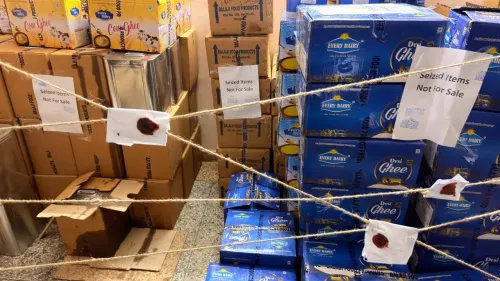
FSSAI suspends Ganesh Products licence over cockroaches, dead mice, bleaching agents in paneer units

Synopsis
FSSAI inspectors walked into a paneer factory and found dead mice, non-functional pest controls, industrial bleaching agent, fabric whitener — and 7,600 kg of paneer stored in soiled containers. All of it was destroyed on the spot. The licence of Ganesh Products Private Limited is now suspended indefinitely, and lab results on four collected samples could trigger further action.
Key Takeaways
FSSAI suspended the licence of Ganesh Products Private Limited with immediate effect on 16 September 2026 following a surprise inspection.
Inspectors found cockroaches, dead mice, rodents, flies, cobwebs, rusted containers, algae, and fungal growth across processing and storage areas.
Industrial-grade Bleaching Agent , Fabric Whitener , and Poster White Colour were detected on the premises, raising adulteration concerns.
Approximately 7,600 kg of paneer stored in grossly unhygienic conditions was destroyed on the spot by the administration.
No owner, manager, or authorised representative was present during the inspection; no FSSAI certificate or signboard was displayed.
Four paneer samples have been sent for laboratory analysis; results could determine further regulatory or legal action.
The Food Safety and Standards Authority of India (FSSAI) on 16 September 2026 suspended with immediate effect the licence of Ganesh Products Private Limited after a surprise inspection of its food manufacturing premises uncovered severe hygiene violations, pest infestations, and the presence of industrial-grade chemicals — including a fabric whitener and an industrial-grade bleaching agent — at a site producing paneer for public consumption.
What Inspectors Found Inside the Premises
The inspection revealed the facility to be in a deeply unsanitary state. Significant accumulation of dirt, soil, dark matter, algae, and fungal growth was recorded across processing and storage areas, alongside live and dead cockroaches, rodents, flies, and cobwebs. Inspectors noted rusting on most production containers and reported the presence of unwanted material deposited on equipment.
Finished-product storage was found to be critically inadequate — products were stacked improperly, placed close to walls, and stored in areas with insufficient ventilation. Expired and unlabelled food materials were found alongside finished goods, and waste, rejected lots, old stock, and scrap material had accumulated in food-handling zones.
Pest infestation extended to both finished-product and packaging-material storage areas. Dead mice, cockroaches, and flies were observed. Rodent-control boxes were absent, and pest-control equipment was reportedly non-functional at the time of the inspection.
Industrial Chemicals and Adulteration Concerns
Among the most alarming findings, inspectors detected Milk Powder, Fabric Whitener, Industrial-grade Bleaching Agent, Refined Palm Oil, Soybean, and Poster White Colour on the premises. The presence of non-food industrial chemicals at a dairy manufacturing unit has raised serious adulteration concerns, though laboratory analyses of the four paneer samples collected from the inspected units are pending and no formal adulteration finding has yet been declared.
The inspection covered three operational paneer manufacturing units at the main site. Notably, no food business operator, owner, manager, or authorised representative was present when inspectors arrived. Neither an FSSAI registration certificate nor any signboard was displayed at the facility.
7,600 kg of Paneer Destroyed on the Spot
Authorities found approximately 7,600 kg of paneer stored under what the FSSAI described as grossly unhygienic and insanitary conditions — in soiled containers on unclean platforms. The entire quantity was destroyed by the administration at the spot to prevent it from re-entering the food supply chain. A subsequent inspection was also carried out at another paneer manufacturing unit at Village Nai, from which additional samples were collected.
Records and Infrastructure Also Found Deficient
Beyond the physical violations, several mandatory food safety and quality-management records and procedures were found to be missing. These included mock recall records, a jewellery policy, consumer complaint records, internal training records, and both internal and external audit records. Appropriate testing records for control samples — required to be maintained for one year or the shelf life of the product — were not available.
Infrastructure deficiencies included flaking paint, dampness, broken floor tiles, and damaged corners throughout the premises. Proper handwashing facilities were also absent.
Licence Suspended Until Further Orders
In view of the cumulative findings, FSSAI stated that the serious deficiencies had the potential to compromise food safety and public health, and that food manufactured under such conditions could render products unsafe for consumption. The licence of Ganesh Products Private Limited stands suspended forthwith in the interest of public health and will remain so until further orders. Four paneer samples collected across the inspected units have been sent for laboratory analysis, and the outcome of those tests could determine further regulatory or legal action.
Point of View
A far graver offence than sanitation failure. FSSAI's licence suspension is a necessary first step, but the real accountability question is how a facility of this scale — running three paneer units simultaneously — operated without a visible licence certificate, no management on-site, and no functional pest controls. That suggests a systemic failure in routine surveillance, not a one-off lapse caught by a single raid. Until lab results confirm or rule out adulteration, the public health stakes remain unresolved.
NationPress
16 Sept 2026
Frequently Asked Questions
Why did FSSAI suspend the licence of Ganesh Products Private Limited?
FSSAI suspended the licence of Ganesh Products Private Limited after a food safety inspection found severe hygiene violations including cockroaches, dead mice, rusted equipment, expired materials, non-functional pest controls, and industrial chemicals such as bleaching agent and fabric whitener at its paneer manufacturing premises. The suspension is effective immediately and will remain in place until further orders.
What happened to the 7,600 kg of paneer found at the facility?
Approximately 7,600 kg of paneer found stored in soiled containers on unclean platforms was destroyed on the spot by the administration to prevent it from re-entering the food supply chain. The destruction was carried out during the inspection itself.
What industrial chemicals were found at the Ganesh Products facility?
Inspectors detected Fabric Whitener, Industrial-grade Bleaching Agent, and Poster White Colour — along with Milk Powder, Refined Palm Oil, and Soybean — at the premises. The presence of non-food industrial chemicals at a dairy manufacturing unit has raised adulteration concerns, though laboratory analysis of collected samples is pending.
Were any paneer samples collected for testing?
Yes, four paneer samples were collected from the inspected units — including the main facility and a unit at Village Nai — properly packed, sealed, and labelled for laboratory analysis. The results could determine whether further regulatory or legal action is taken.
Who is affected by the FSSAI action against Ganesh Products?
The immediate impact falls on consumers who may have purchased paneer from Ganesh Products, as the products were manufactured under conditions FSSAI described as potentially rendering them unsafe. Retailers or distributors stocking Ganesh Products paneer would also be affected by the licence suspension, which halts all manufacturing and distribution until further orders.