India's Ease of Doing Business reforms: NSWS, MUDRA, and startup surge ahead of 80th Independence Day
Synopsis
India's 80th Independence Day arrives with a data-heavy government report card on economic reform: startups have grown from 502 to over 2.47 lakh since 2016, MUDRA has crossed ₹40 lakh crore in loans, and a single digital window now links 32 ministries and 34 states. The numbers are large — but the real test is whether the infrastructure is translating into durable jobs and private investment.
Key Takeaways
The National Single Window System (NSWS) integrates approvals across 32 Union Ministries and 34 states , having granted more than 8.29 lakh approvals since its 2021 launch.
DPIIT-recognised startups surged from 502 in 2016 to more than 2.47 lakh as of 12 August .
The MCA21 platform processed 3.84 crore filings between 2021 and 2025 , with 3.33 crore cleared via Straight Through Process.
MUDRA Yojana has sanctioned ₹40.07 lakh crore through 57.79 crore loans since inception, as of 27 March 2026 .
CGTMSE approved cumulative credit coverage of ₹13.67 lakh crore , benefiting 1.41 crore guarantees as of March 2026 .
Udyam Portal MSME registrations grew from 0.1 lakh in October 2020 to more than 9.27 lakh by 13 August .
As India marks its 80th Independence Day, the Union government has released an official factsheet detailing a sweeping set of economic reforms designed to accelerate enterprise-led growth, simplify business entry, and widen access to formal finance — particularly for startups and micro, small and medium enterprises (MSMEs). The measures, spanning digital infrastructure, credit guarantees, and regulatory simplification, collectively signal a structural shift toward a self-reliant and investor-friendly economy.
Digital Single-Window System Scales Up
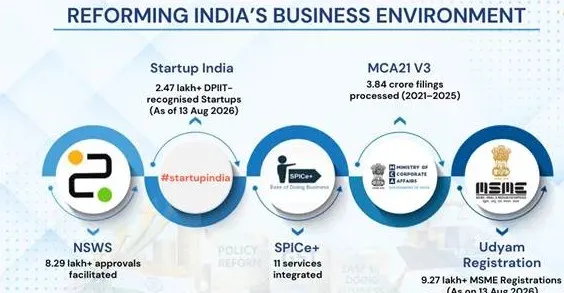
The National Single Window System (NSWS), launched in 2021, has emerged as a cornerstone of the government's Ease of Doing Business agenda. The platform integrates approvals across 32 Union Ministries and 34 states, providing access to more than 686 Central and 7,498 state-level approvals. Since its launch, the system has granted more than 8.29 lakh approvals, according to the official factsheet.
Complementing the NSWS is the SPICe+ web-based form, which consolidates 11 services from 3 Central government Ministries and departments. It integrates 10 essential procedures — including name reservation, company incorporation, Director Identification Number (DIN) allotment, PAN and TAN issuance, EPFO and ESIC registration, Profession Tax registration, bank account opening, and GSTIN allotment — along with first-time shop and establishment registration for new companies in Delhi. The consolidated process reduces procedural burden, saves time, and lowers compliance costs.
Startup Ecosystem Records Explosive Growth
The Startup India initiative, designed to transform India from a nation of job seekers to one of job creators, has seen remarkable traction. The number of startups recognised by the Department for Promotion of Industry and Internal Trade (DPIIT) surged from just 502 in 2016 to more than 2.47 lakh as of 12 August, according to the factsheet. This near-500-fold increase over nine years reflects both a liberalised recognition framework and a maturing entrepreneurial culture.
Notably, this growth has occurred alongside a parallel buildout in corporate registry infrastructure. The MCA21 Project — an AI-driven platform for end-to-end registry and incorporation services for companies and limited liability partnerships (LLPs) — processed 3.84 crore filings between 2021 and 2025, with 3.33 crore approved through the Straight Through Process, significantly reducing manual intervention and processing delays.
MSME Registrations and Credit Access Expand
The Udyam Registration Portal has dramatically lowered the barrier for MSMEs entering the formal economy. Registrations grew from 0.1 lakh in October 2020 to more than 9.27 lakh by 13 August — a paperless, self-declaration-based system offered free of charge. The Business Reform Action Plan (BRAP), introduced in 2015, continues to drive state-level regulatory simplification across single-window clearances, land, labour, taxation, inspections, and environmental approvals.
Access to formal credit has also widened. The Credit Guarantee Fund Trust for Micro and Small Enterprises (CGTMSE) had, as of March 2026, approved cumulative coverage worth ₹13.67 lakh crore, benefiting 1.41 crore guarantees. A separate Credit Guarantee Scheme enables micro and small enterprises to access credit facilities of up to ₹10 crore without collateral or third-party guarantees.
MUDRA Scheme Crosses ₹40 Lakh Crore in Loans
The Pradhan Mantri MUDRA Yojana (PMMY) has crossed a significant milestone in collateral-free lending. As of 27 March 2026, the scheme has sanctioned loans worth ₹40.07 lakh crore through 57.79 crore loans since inception, targeting non-corporate and non-farm income-generating activities with loans of up to ₹20 lakh. Critics have previously noted that a significant share of MUDRA disbursements are small-ticket loans to existing micro-enterprises rather than new job-creating ventures, though the scheme's reach remains unmatched in its category.
What This Means for Enterprise Growth
Taken together, these reforms represent a multi-layered effort to reduce friction at every stage of a business lifecycle — from registration and approvals to credit access and regulatory compliance. The convergence of digital infrastructure (NSWS, MCA21, SPICe+), financial inclusion (PMMY, CGTMSE), and state-level reform (BRAP) suggests a coordinated architecture rather than isolated initiatives. Whether these structural enablers translate into sustained private investment and employment generation will depend on execution quality and last-mile delivery — factors that independent assessments will track closely in the years ahead.
Point of View
And attrition data is conspicuously absent. MUDRA's ₹40 lakh crore headline obscures the fact that the majority of loans are small-ticket repeat disbursements to existing micro-enterprises, not new venture formation. The real measure of these reforms — private investment as a share of GDP and formal employment growth — has been more modest than the registration numbers imply. The infrastructure is real; the outcomes need independent verification.
NationPress
14 Aug 2026
Frequently Asked Questions
What is the National Single Window System (NSWS) and how does it work?
The NSWS is a digital platform launched in 2021 that allows businesses to identify and apply for regulatory approvals in one place. It integrates approvals across 32 Union Ministries and 34 states, covering more than 686 Central and 7,498 state-level approvals, and has granted over 8.29 lakh approvals since launch.
How many startups are recognised by DPIIT in India as of 2025?
As of 12 August, more than 2.47 lakh startups have been recognised by the Department for Promotion of Industry and Internal Trade (DPIIT), up from just 502 in 2016. The growth reflects both a liberalised recognition process and the expansion of the Startup India initiative.
What is the Pradhan Mantri MUDRA Yojana and who does it benefit?
PMMY is a government scheme that provides collateral-free loans of up to ₹20 lakh to non-corporate and non-farm income-generating activities. As of 27 March 2026, it has sanctioned ₹40.07 lakh crore through 57.79 crore loans since inception, primarily targeting micro-entrepreneurs and small business owners.
What is the SPICe+ form and how does it simplify company incorporation?
SPICe+ is a web-based form that consolidates 11 services from 3 Central government Ministries into a single application. It covers 10 essential procedures — including incorporation, DIN allotment, PAN, TAN, GSTIN, and EPFO registration — reducing the time and compliance costs involved in starting a new company.
How does the CGTMSE help MSMEs access credit?
The Credit Guarantee Fund Trust for Micro and Small Enterprises (CGTMSE) allows MSMEs to access credit facilities of up to ₹10 crore without collateral or third-party guarantees. As of March 2026, it had approved cumulative coverage worth ₹13.67 lakh crore, benefiting 1.41 crore guarantees.