Hyundai Motor August sales drop 14% on strikes; Renault Korea plunges 34%
Synopsis
South Korea's auto sector had a bruising August — Hyundai down 14%, Renault Korea down 34%, KG Mobility down 23% — all in the same month. The one exception was Kia, up 5% on SUV strength. The divergence reveals a sector where strike exposure and product mix now determine winners and losers more than broader market conditions.
Key Takeaways
Hyundai Motor global sales fell 14% in August to 288,574 units , hurt by partial strikes and fewer working days.
Hyundai's domestic sales plunged 41% to 34,333 units ; overseas sales declined 8.5% to 254,241 units .
Kia bucked the trend with a 5% global sales rise to 296,675 units , led by the Sportage and Seltos SUVs.
Renault Korea Motors sales collapsed 34% to 4,261 units ; hybrid models made up 79% of its domestic sales in January–August.
KG Mobility reported a 23% sales drop to 6,800 units , with domestic volumes down 43% .
Hyundai Motor, South Korea's largest carmaker, reported a 14 percent decline in global sales for August, with volumes falling to 288,574 vehicles from 336,141 units in the same month a year earlier. The company attributed the drop to partial strikes and fewer working days during the month.
Hyundai's August Sales Breakdown
Domestic sales bore the steepest brunt, plunging 41 percent to 34,333 units from 58,330 a year ago. Overseas sales declined a comparatively modest 8.5 percent to 254,241 units from 277,811. For the January–August period, cumulative global sales fell 6 percent to 2,575,360 units from 2,738,615 in the same stretch last year, with domestic sales down 15 percent and overseas sales off 4.1 percent.
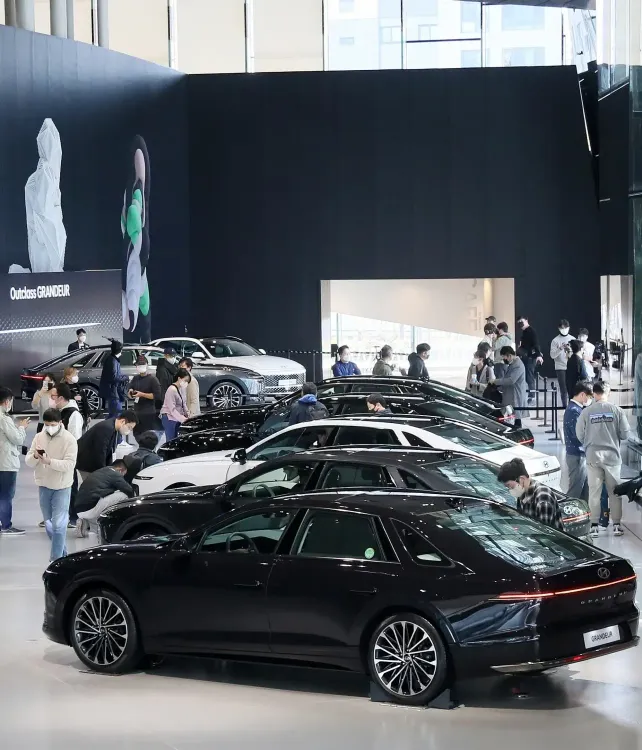
To arrest the slide, Hyundai said it plans to promote new models — including the New Grandeur sedan and the all-new Avante compact — in the months ahead, with the carmaker projecting improved market share for the remainder of the year.
Kia Bucks the Trend With 5% Growth
In contrast, fellow South Korean automaker Kia posted a 5 percent rise in global sales for August, selling 296,675 vehicles worldwide — driven by robust demand for its SUV lineup. Overseas sales climbed a solid 7.4 percent year-on-year to 225,413 units, partially offset by a 7.6 percent dip in domestic sales to 40,213 units. The Sportage remained Kia's bestselling model at 46,239 units, followed by the Seltos at 35,689 units. Kia's divergent performance underscores how product mix and strike exposure can produce starkly different outcomes even within the same national industry.
Renault Korea and KG Mobility Also Record Sharp Falls
Renault Korea Motors, the South Korean arm of France's Renault S.A., saw sales collapse 34 percent in August to 4,261 vehicles from 6,457 units a year earlier, as demand weakened both at home and abroad. Domestic sales fell 47.7 percent to 2,024 units, while overseas sales declined 13.6 percent to 2,237 units. Notably, hybrid models accounted for 79 percent of Renault Korea's domestic sales in the January–August period, with 19,630 units sold — signalling a structural shift in buyer preference even as overall volumes contract.
KG Mobility also reported a 23 percent drop in August sales to 6,800 vehicles from 8,830 units a year ago, driven largely by weaker domestic demand. Domestic sales plunged 43 percent to 2,300 units from 4,055, while exports edged down 5.1 percent to 4,560 units from 4,805.
What the Numbers Signal for South Korea's Auto Sector
The August data paints a mixed picture for South Korea's automotive industry. Strike disruptions at Hyundai — historically a recurring pressure point — combined with a shrinking domestic market are compressing volumes across multiple brands simultaneously. The outlier performance by Kia, however, suggests that carmakers with a stronger SUV and export mix are better insulated. This comes amid broader global auto-industry headwinds, including softening consumer demand in key export markets and ongoing supply-chain recalibration. The trajectory for the rest of the year will likely hinge on new model launches and whether domestic consumer sentiment recovers.
Point of View
Driven by SUVs and export diversification, is the clearest signal of where resilience actually lives. Renault Korea's hybrid pivot — 79% of domestic sales — is strategically sound but has not yet translated into volume recovery, raising questions about pricing and brand positioning in a crowded segment.
NationPress
1 Sept 2026
Frequently Asked Questions
Why did Hyundai Motor's sales fall in August?
Hyundai Motor's global sales fell 14% in August to 288,574 units, primarily due to partial strikes and fewer working days compared to the same month a year earlier. Domestic sales were hit hardest, plunging 41% to 34,333 units.
How did Kia perform in August compared to Hyundai?
Kia posted a 5% increase in global sales to 296,675 units in August, contrasting sharply with Hyundai's decline. Strong SUV demand — led by the Sportage at 46,239 units and the Seltos at 35,689 units — drove the growth, with overseas sales up 7.4%.
How much did Renault Korea Motors' sales fall in August?
Renault Korea Motors reported a 34% drop in August sales to 4,261 vehicles from 6,457 units a year earlier. Domestic sales fell 47.7% and overseas sales declined 13.6%, amid weak demand at home and abroad.
What is Renault Korea's hybrid sales share?
Hybrid models accounted for 79% of Renault Korea Motors' domestic sales in the January–August period this year, with 19,630 units sold, reflecting a significant shift in buyer preference toward electrified vehicles.
How did KG Mobility's sales perform in August?
KG Mobility's sales fell 23% in August to 6,800 vehicles from 8,830 units a year ago. Domestic sales plunged 43% to 2,300 units, while exports declined 5.1% to 4,560 units, with weaker domestic demand cited as the primary cause.