Can a Single Light Pulse Control Quantum States in 2D Materials?
Synopsis
Discover how IIT Bombay's latest research could transform computing! They've found a way to control quantum states in ultra-thin materials using just a single laser pulse. This breakthrough promises to create faster, more energy-efficient computers. Dive into the details of this cutting-edge technology.
Key Takeaways
Breakthrough in light manipulation: IIT Bombay's method simplifies the control of quantum states using a single laser pulse.
Valleytronics potential: The research opens new avenues in valleytronics, a field combining quantum mechanics and electronics.
Energy-efficient computing: The findings could lead to the development of computers that are significantly faster and more energy-efficient.
Reversible switching: The new technique enables reliable and reversible transitions between quantum states.
Wide applicability: The method works across various laser wavelengths without needing fine-tuning.
Mumbai, Dec 14 (NationPress) Researchers from the Indian Institute of Technology (IIT) Bombay revealed a groundbreaking method that utilizes light to manipulate quantum states in ultra-thin materials. This innovation could pave the way for computers that operate much faster and consume less energy compared to current electronic devices.
The focus of this study is on two-dimensional semiconductors, which are merely one atom thick and significantly thinner than a human hair.
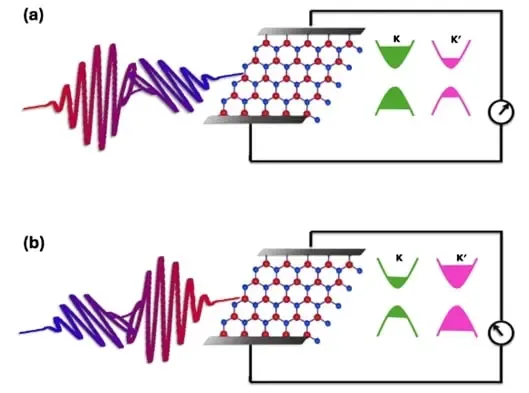
Within these materials, electrons can occupy two unique quantum states termed valleys, identified as K and K′.
These states can be likened to the binary digits 0 and 1 used in digital computing, forming the foundation of an emerging field called valleytronics.
Historically, controlling these valley states has posed challenges. Previous methodologies necessitated intricate laser configurations utilizing circularly polarized light and multiple laser pulses, often leading to partial control that was tough to measure.
Consequently, achieving reliable and reversible transitions between these valley states has been a significant hurdle.
The IIT Bombay team has demonstrated that such a convoluted setup is unnecessary. In their research published in the journal Advanced Optical Materials, they showcased that a solitary linearly polarized laser pulse can effectively control and read the valley state of electrons.
The crux of this technique lies in applying a slight, controlled tilt to the laser pulse’s polarization.
As explained by Prof. Gopal Dixit from IIT Bombay, this minor asymmetry in the pulse is sufficient to direct electrons into either the K or K′ valley.
By altering the tilt in the pulse, electrons can be reverted back to the other valley. This renders the process completely reversible, with the two valley states functioning as quantum representations of 0 and 1.
Additionally, this discovery is remarkable as the same laser pulse generates a minuscule electric current.
This current serves as an intrinsic signal indicating which valley state the electrons have entered. Simply put, the system can be simultaneously controlled and monitored, eliminating the need for additional lasers or measuring instruments.
The researchers also noted that this method is effective across a broad spectrum of laser wavelengths and does not require precise tuning to the energy levels of the material.
Point of View
IIT Bombay has made strides in quantum technology, showcasing the potential of light in manipulating quantum states. This discovery not only enhances our understanding of valleytronics but also highlights India's growing expertise in cutting-edge research. As we move towards a more technology-driven future, such innovations are crucial for sustainable advancements in computing.
NationPress
1 Oct 2026
Frequently Asked Questions
What is valleytronics?
Valleytronics is an emerging field of research focusing on the manipulation of valley states in two-dimensional materials, which can serve as quantum bits for computing.
How does the new method work?
The new method involves using a single linearly polarized laser pulse with a controlled skew in its polarization to switch between two quantum states, K and K′.
What are the potential applications of this research?
This research could lead to the development of faster and more energy-efficient computers that utilize quantum states for processing information.
Is the method reliable?
Yes, the method has been demonstrated to be reliable and fully reversible, allowing effective control and measurement of quantum states.
What makes this discovery significant?
This discovery simplifies the control of quantum states, potentially revolutionizing computing technology and advancing the field of valleytronics.