Have India and the EU Finalized Financial Services Negotiations to Enhance Digital Payments and Fintech?

Synopsis
India and the EU have reached a pivotal agreement on financial services as part of the Free Trade Agreement, marking a new era in digital payments and fintech collaboration. This partnership promises to enhance cross-border transactions and support India's booming digital payment ecosystem.
Key Takeaways
India and EU finalize financial services negotiations.
Enhanced interoperability in digital payments.
Support for fintech innovation and collaboration.
Market access for Indian financial institutions in the EU.
Improved remittance flows from Indian diaspora.
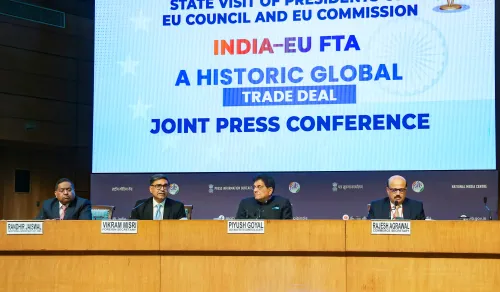
New Delhi, Jan 29 (NationPress) In a major advancement in enhancing bilateral economic and strategic ties, India and the European Union (EU) have successfully wrapped up negotiations regarding financial services as part of the Free Trade Agreement (FTA).
Among the primary accomplishments of the Financial Services Annex, both parties have pledged to work together to foster improved interoperability, develop electronic payment frameworks, and facilitate seamless cross-border payments. This initiative aims to encourage real-time remittances, merchant transactions, and various other transfers.
As stated by the ministry, this provision directly bolsters India's expanding digital payments landscape, promotes increased remittance inflows from the Indian diaspora residing in the EU, opens up market access for Indian payment service providers, and capitalizes on India's technological prowess in digital payment solutions like UPI.
Both nations are devoted to enhancing collaboration in fintech innovation, signifying India's most notable accomplishment in fintech partnerships.
They have agreed to fortify cooperative efforts in the financial services domain and advocate for the development of FinTech initiatives. This includes specific clauses aimed at exploring new business opportunities and collaboration in fintech sectors, including Sup Tech, Reg Tech, and Central Bank Digital Currency (CBDC).
Indian financial institutions are safeguarded from arbitrary or biased credit assessment practices within the market.
“This provision guarantees equal treatment with the EU’s domestic institutions, paves the way for market access for Indian banks, insurance companies, and other financial service providers, and prevents biased regulatory treatment that could hinder the operational capabilities of Indian financial service suppliers,” remarked the ministry.
Furthermore, the schedules of particular commitments illustrate progressive collaboration between both parties, incorporating comprehensive commitments on Market Access and National Treatment within the Banking, Insurance, and other financial service sectors and subsectors.
India's sectoral offerings reflect a forward-thinking liberalization strategy, considering the recent allowance for 100% Foreign Direct Investment in the Insurance sector and featuring enhanced Foreign Direct Investment limits of 74% in banking, alongside a relaxed bank branch licensing framework allowing the establishment of up to 15 bank branches over a four-year span—an impressive increase from the previously offered GATS limits of 12 branches.
At present, three Indian banks—State Bank of India, Bank of Baroda, and Bank of India—operate branches within the EU, totaling five branches, while only one bank—State Bank of India—maintains a representative office in the EU.
From the EU, five banks, collectively managing 33 branches, are currently operational in India, while 17 banks are sustaining their representative offices.
In 2024, total service trade between India and the EU reached approximately $83 billion. India exported $700 million in financial services to the EU and imported around $600 million in financial services from the EU.
A Finance Ministry statement noted that both nations have collaboratively worked to formulate a forward-looking, balanced, and mutually advantageous agreement that will unveil enhanced prospects for their respective financial services sectors.
Point of View
It is essential to recognize that the successful conclusion of negotiations between India and the EU on financial services is a significant step towards enhancing India's global economic presence. This agreement not only benefits Indian financial institutions but also aligns with India's vision of becoming a global fintech hub.
NationPress
11 Oct 2026
Frequently Asked Questions
What are the main objectives of the India-EU financial services agreement?
The agreement aims to enhance interoperability in digital payments, facilitate cross-border transactions, and promote fintech innovation between India and the EU.
How does this agreement benefit Indian financial institutions?
It provides Indian banks and financial service providers with market access in the EU and ensures equal treatment with EU institutions, preventing discriminatory regulatory practices.
What impact does this have on digital payments in India?
The agreement supports India's expanding digital payments ecosystem by improving remittance flows and leveraging India's technological expertise in payment systems.
What is the significance of fintech cooperation mentioned in the agreement?
The cooperation focuses on exploring innovative financial services, including Sup Tech, Reg Tech, and Central Bank Digital Currency, fostering a collaborative environment for fintech development.
How much trade occurs between India and the EU in financial services?
In 2024, India exported approximately $700 million in financial services to the EU and imported around $600 million from the EU.